Blog

  • Stepping it Up

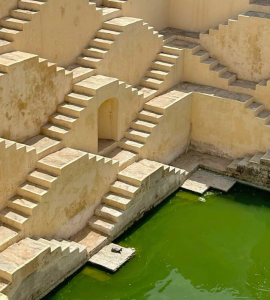
    In the desert city of Jodhpur, architect A Mridul and his team are restoring the early-18th C Mahamandir stepwell. It is 150 feet deep and sits at the heart of an old Jaipuri neighborhood. Thousands of miles away, in Portugal’s beach town Melides, a circular structure resembling these ancient stepwells, has been making the news. It is the work of Egyptian architect Tarek Shamma, who designed it as a space for gathering and retreat, in the home of fashion designer Christian Louboutin. 

    Both India and the West have developed a fresh interest in these water reservoirs built hundreds of years ago. Their ingenious architecture spotlights them as a crucial climate crisis solution.  These bavdis or vav, as they are called, store rainwater all year round. The steps, running up and down all around the water, make it possible for people to reach the source even when water recedes during the summer. Made with locally-available stone and lime, stepwells are the original ‘cooling centers’ or ‘climate centers’. The water and the built-in sheltered balconies provide respite from scorching heat. 

    It’s why state governments, local communities and NGOs are restoring these ancient structures that have been ignored for far too long. Many of them had been reduced to dumping yards, explains Mahendra Singh Tanwar, convenor of Jodhpur’s INTACH (Indian National Trust for Art and Cultural Heritage) chapter. The not-for-profit organization has initiated several stepwell restoration projects in the city over the last two decades.

    And the restored stepwells are now brimming with water. Hospitality and tour companies are promoting these as tourism and event hotspots. From music performances to poetry readings, these stepwells are buzzing with people again. Jodhpur has included a few of these in its city tours, and has a dedicated stepwell walk too, facilitated by INTACH. “Tourism and events help fund the upkeep of the conserved stepwells, which, in turn, generate employment for the locals,” says Tanwar. “It’s a great incentive for communities to take ownership of these structures and not let them fall into ruin again,” adds Tanwar.
     

    in.pinterest.com


    The international design world is taking notice too. Italy-based CC Tapis launched a line of rugs inspired by stepwells two years ago. Then there is the monumental Vessel at Hudson Yards, in New York City. The $150-million public monument designed by Thomas Heatherwick was structurally inspired by stepwells too. Stefano Ricci recently shot his Spring/Summer 2026 campaign at the Panna Meena stepwell in Jaipur. “The inverted pyramid geometry and optical illusion of stepwells fascinate designers,” explains Mridul.

    Stepwells in India are not just in Rajasthan. They are also found in Punjab, Haryana, UP, Maharashtra, and Telangana, and those are being restored too. These too have always functioned as social sites where people gathered, especially women when they came here to fetch water. Pujas and cultural festivals were held here too. 


    Perhaps the most difficult aspect for many international audiences to grasp is that these reservoirs once supplied drinking water.


    Even historically, these structures were the combined responsibility of the administration and the people. While the elaborately carved ones were commissioned by kings, queens and rich traders, the smaller and humbler-looking ones were funded by different communities by pooling together contributions from multiple people.

    “The social use of these structures makes these water reservoirs unique among other such ancient water storage solutions around the world,” says Mridul, who has worked on many stepwell conservation projects in Jodhpur. He has also built the Birkha Bawari inside the private Umaid Heritage Housing Township in Jodhpur. Completed in 2009, this 21st-century stepwell spans 224 metres in length and can hold over 17.5 million litres of water to supply the housing complex. It was built with red sandstone and traditional masonry techniques without any cement or concrete.

    Perhaps the most difficult aspect for many international audiences to grasp is that these reservoirs once supplied drinking water. “People are often surprised that communities consumed stored, untreated water,” says Mridul, who has presented his work on stepwell conservation at universities including Harvard and MIT. “But they did. The layers of stone acted as natural filters.”


    Made with locally available stone and lime, stepwells are the original ‘cooling centers’. The water and the sheltered balconies provided respite from scorching heat.


    As cities around the world search for ways to adapt to rising temperatures, water scarcity and increasingly erratic rainfall, stepwells offer a reminder that sustainable solutions do not always need to be invented from scratch. Sometimes they are hidden in plain sight, carved deep into the earth centuries ago, waiting to be rediscovered.

  • Say Cheese!

    There’s no denying India’s love for dairy. Ghee, butter, milky mithai, buttermilk, yogurt – the evidence is everywhere. But what about Indian cheese?

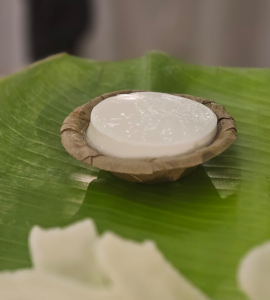
    Paneer of course is indelibly twined with Indian cooking, but in fact the country is home to multiple iterations of cheese: Ladakh’s chhurpi, traditionally made from yak milk, chewy, dense and smoky; of course the Parsi community’s voluptuous topli (basket) paneer, served in a pool of salt water; crumbly, smoke-sluiced Bengali Bandel discs; Jammu’s kalari cheese, supple and stretchy, usually eaten pan fried.

    This makes eminent sense since India is the world’s largest producer of milk, accounting for nearly a quarter of global production. Yet, for decades, the only pan-Indian staple was processed Amul cheese, its salty, gooey texture a beloved accompaniment for everything from pizzas to dosa stuffing. 

    But the tide is turning, and a new generation of artisanal cheesemakers is helping Indians rediscover the country’s dairy traditions while building a market for high-quality, locally-made cheeses. In the process, they are also earning recognition on some of the world’s biggest stages.

    In fact, the rise of artisanal cheesemaking began in the 1970s, with cheeses such as Gouda and mozzarella. Their products found local audiences but rarely travelled beyond the regions where they were made.

    The past five years, however, have brought a noticeable shift. Pandemic-era disruptions elbowed consumers, retailers and restaurants to look closer to home for ingredients; the fromageries levelled up, and consumers began to empty their pockets.

    According to market research firm IMARC Group, India’s cheese market was worth 88.9 billion rupees in 2023 and is projected to grow to more than 512 billion rupees by 2032. Of this, the artisanal segment is nascent, but burgeoning. Across India, artisan cheesemakers such as the Spotted Cow Fromagerie, Begum Victoria, Eleftheria and Käse are crafting products that rival their European counterparts. 


    The Parsi topli paneer | Photo credit: Meher Mirza


    Not only is there a stampede for cheese by customers looking to buy cheeses online, there is now a huge B2B demand as well. “Last year, 77% of our business was B2B,” says Namrata Sundaresan of Käse, who supplies to Papa’s, the Oberoi group of hotels and a host of others. There is now also a swelling pool of eaters who wish to learn cheese-making – Sundaresan takes class after class in Ooty (and online). Smoked Cheddar, Gouda, Pepper Jack, Camembert, Brie, Feta, Belper Knolle – this is the new Indian palate.

    And the world is beginning to sit up and take notice. 


    In April 2026, PM Modi tweeted:

    “Cheese from India makes its mark globally… India made an impressive debut at the Mundial do Queijo do Brasil 2026, which is a vibrant international competition for cheese and dairy products. Four Indian products won medals, including 1 Super Gold, 2 Golds and 1 Silver. The Super Gold was won by Eleftheria Gulmarg (Brie Style), the Golds were won by Yak Churpi-Soft, Nordic Farm, Leh, Ladakh and Eleftheria Brunost (Whey Cheese) while the Silver was won by Eleftheria Kaali Miri (Belper Knolle Style). Congratulations to Mausam Narang and Thenlay Nurboo. Such successes strengthen India’s artisanal dairy sector on the world stage.”

    The cavalcade of prizes point of course to the rising prominence of Indian fromageries on the global stage. But they illumine something else too: not only are Indian cheesemakers the cream of the crop, indigenous Indian cheeses such as chhurpi are now rubbing shoulders with the Camemberts of the world. Thus is the Western gaze inverted. 

    Many fromageries are also incorporating distinctly Indian flavours into European styles. One of Käse’ semi-hard cheeses is studded with fenugreek seeds, then aged. Eleftheria’s Belper Knolle-style cheese is daubed with crushed garlic, Himalayan pink salt, and Kerala black pepper. And at The Cheese Collective, Mansi Jasani infuses cabécou with pav bhaji masala. Meanwhile, Spotted Cow Fromagerie cheekily winks at their cheeses’ hallowed origins by naming them Bombrie, Camembay, and Tomme de Bombai.


    unsplash.com


    This also reflects the current moment in Indian fine dining more broadly — creators beholden to a yoke of two origins, plucking and borrowing from and subsuming Indian and international flavors with abandon. Cheese purists may scoff, but the suggestion that there is only one standard, preserved in aspic, for what a cheese should be, is specious. Cheese, like everything else, adapts and acclimatizes to its home, wherever in the world it may be.


    Not only are Indian cheesemakers the cream of the crop, indigenous Indian cheeses such as chhurpi are now rubbing shoulders with the Camemberts of the world.


    Clearly, Indian restaurants subscribe to this view as well, since the border-bending inventiveness of cheese-besotted chefs seems endless. Bombay Canteen takes salan, a dish foundational to Hyderabad, and plops a burrata into it. In Bengaluru’s LUPA, a slow-smoked Roma tomato galette is coupled with a Five Cheese Boursin on thinly-rolled puff pastry. At Bandra Born in Mumbai, creamed stracciatella is served with podi butter and cumin focaccia.

    But perhaps at the end of the day, all we need are hunks of bread torn by hand, the bright sweet crunch of a perfectly ripe tomato and a plate of cheese  – crumbly, gooey, oozing, melting – for the perfect meal.

  • The Finishing Touch

    On a sun-scorched summer afternoon in Mumbai, a young woman stands in front of a mirror practicing the perfect smile. She is not preparing for a wedding, a beauty pageant, or a television appearance. She is preparing for a job interview with a company headquartered in Silicon Valley. Around her, a dozen other students are engaged in similar exercises. One is trying out his firm-gripped handshake. Another is rehearsing small talk. 

    We are behind the scenes at one of India’s finishing schools. Across cities, the names may vary (finishing school, grooming academy, image-consulting center, communication institute), but the curricula all point in the same direction — how to adopt social fluency in a furiously competitive world. At their core lies the age-old idea: how you present yourself is how the world will judge you. After all, relying on grit, talent and academics alone can get you only so far. 

    Outside these schools, the city never sleeps. It is an ever-throbbing hive of Pilates studios, fancy restaurants, luxury shops, and multi-story buildings. The polished faces of Bollywood stars shine from gigantic billboards suspended over car-choked roads. Delivery riders zig and zag between SUVs, while vendors hawk their wares outside colonnaded five-star hotels. Everywhere is movement — economic, digital, social. Mumbai, like India’s other metropolises, is poised at the threshold of a new era of emerging multipolarity. 

    Image consulting centers began opening their doors in the 1990s when India launched its open market economy; as the economy kept revving up, so did the schools. Today, the industry sits at the crossroads of several forces: economic liberalization, massive globalization, the growth of the middle class, and of course the vagaries of an inscrutable social media. 


    India's grooming school industry sits at the crossroads of several forces: economic liberalization, globalization, the expansion of the middle class, and of course the vagaries of an inscrutable social media.


    It is a time ripe for these institutes. Knowledge of etiquette, interpersonal skills, deportment, and social graces carried a particular prestige because it signaled membership in an international world. “I know my English was good, but my confidence was quite low,” says Preeti S, who attended Amity Finishing School in Noida, “I think it definitely helped my leadership skills develop.”


    www.pexels.com

    A Wide Appeal

    Students come from all classes and communities, and include aspiring corporate professionals, homemakers, entrepreneurs, beauty influencers, college graduates, and middle managers. A young graduate in Kanpur aspires to work for a multinational company in Singapore. A beauty enthusiast in the Maharashtrian village of Kolad dreams of becoming an influencer. A software engineer in Kochi spends half the day speaking to colleagues in California. A model in Mumbai is preparing for Mr Universe. 

    Depending on their goals, they are taught etiquette and manners, workplace communication, public speaking, networking, emotional intelligence, interview techniques, leadership development and even social responsibilities. Certain agencies steer students into exhausting training regimens that even involve prepping for the IELTS (a standardized exam that tests English proficiency for people wanting to emigrate to). Diet, makeup, and fashion decisions are policed to meet global standards. 


    unsplash.com


    Each school has its own curriculum and style. The Refinery Finishing School for instance focuses on blended etiquette. The founder, Ematullah V, explains, “We often forget what Indian culture gives us – sanskar, adaab. So I try to bring in a lot of personal context.” 

    She goes on to explain that she has seen a recent boom in image consulting, and soft skill training. A generation raised on Instagram, YouTube, and reality television has inherited a culture saturated with transformation narratives. Every platform offers examples of people who have reinvented themselves through some type of makeover. Naturally enough, the schools today include personal branding and social media strategy within their curriculum.


    A generation raised on Instagram, YouTube, and reality television has inherited a culture saturated with transformation narratives.


    Once Upon a Time

    We know that the story of finishing schools begins far from India.

    For much of the 19th and 20th C, Switzerland represented the global capital of the finishing school world. Homed in ancient mansions girdled by perfectly-manicured gardens, sat dozens of institutions that existed only to polish the manners and etiquette of the daughters of aristocratic families. 

    But the social revolutions of the postwar era crushed the old ways underfoot. The war upended conservative ideas of femininity, while soaring property values made it more profitable to sell off old school buildings. The Swiss finishing school fell into eclipse. 

    But battling all odds, one school survived. Cannily, they recalibrated their lens away from European aristocracy and towards the global elite. Rather than preparing women for high society, they unbolted their gilded gates to students from around the world readying for international business, diplomacy, luxury hospitality, even modern household management. French yielded to English. Sewing and waltz lessons vanished. International etiquette and cultural intelligence (e.g. how to eat with chopsticks) took their place.

    In India, the mirror turns the other way around. The students are rarely members of aristocrats, billionaires, or oligarchs. They are far more likely to be first-generation professionals, knuckling it out until they lift their families from poverty.

    The critique is familiar. Grooming schools encourage conformity. They reward appearance over substance. They package insecurity as opportunity and sell confidence back to consumers at a premium. 

    And yet “I think it is fantastic for the country,” says Ematullah, “It’s one way to set yourselves apart from the competition.” 

    Whatever verdict history renders on India’s grooming school boom, it captures something unmistakable about this moment: a country sprinting to reinvent itself, one handshake, one accent, one LinkedIn post at a time. The finishing school may have started in Swiss mansions built for aristocrats, but in India it has been reborn as something more democratic — a bet, however imperfect, that anyone willing to practice hard enough in front of a mirror can confidently walk into a room and straightaway feel at home.

  • Art in the Age of Algorithms

    They’re probably seven or eight, the two little girls who are running across the floor, bursting the mist-filled bubbles that descend slowly from a towering, aluminium tree. After a little while, their mothers join them, interacting with A.A. Murakami’s (Azusa Murakami and Alexander Groves) artwork New Spring. The work perfectly recreates the fleeting beauty of cherry blossoms with the help of digital-tech.

    Nine such works of art are featured in Second Nature, an exhibition that explores humanity’s relationship with the environment. Housed at Mumbai’s Nita Mukesh Ambani Cultural Centre (NMACC) for six months, it is powered by motion sensors, responsive lights and sound, as well as digital printers. Naturally, it’s gone viral on Instagram and YouTube. 

    From Qatar to Singapore, Tokyo to Zurich, digital and AI art exhibitions are fast gaining popularity among tourists and locals. While digital art is enabled by tech, AI art is created by artificial intelligence with prompts from the artists. 

    And both are criticized for creating a spectacle that overshadows the purpose of art itself. It’s gimmicky, simulative, and meant to please social media. Some have even gone as far as calling it slop. Also, like anything AI, the art is condemned for copying or borrowing from copyrighted works, without giving their creators any credit or compensation.

    Yet, both artists and viewers are drawn to it. Artist Refik Anadol and wife Efsun Erkiliç opened Dataland in Los Angeles, the world’s first permanent AI museum. Dubai has announced one too. Japan-based teamLab, famed for its immersive digital light installations (also showing at NMACC), is building its second permanent space in Singapore soon.

    Digital and AI art have democratized both art making and art viewing. Anyone with a great idea can create art now. Besides, “viewers are drawn in with its easy access, and because it responds to them,” says Mollie Dent-Brocklehurst, curator of Second Nature and the co-founder of Miami-based Superblue, a 50,000-sq-ft space of immersive art. In a country like India, where the art-viewing or museum-going culture is still negligible, the spectacle of AI art becomes a big motivating factor for people to get out of their houses and into art galleries.


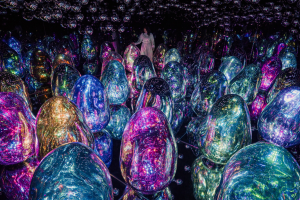
    teamLab’s interactive installation Resonating Microcosms – Solidified Light is a room full of pod-like structures that shine and emit a sound when viewers touch them | Picture credit – teamLab


    Outside of the few public museums and a handful of private museums, art viewing in the country has largely been an intimidating experience. The jargon-heavy wall texts, the exclusive, invite-only wine-and-cheese openings, the posh, Anglophile art world, and frequent references to Western art theories, have made it inaccessible for the majority.


    In a country like India, where the art-viewing or museum-going culture is still negligible, the spectacle of AI art becomes a big motivating factor for people to get out of their houses and into art galleries.


    Even today, if you visit a private gallery on weekdays, most times, you’ll be on your own. There won’t be anyone to walk you through the work or hand you reading material. It’s hard then to feel connected with that static painting on the wall. Whereas the immersive digital and AI works don’t alienate you. They don’t make you feel small or foolish, even if you haven’t studied art history. Instead, they respond to you, literally — Random International’s Presence and Erasure at Second Nature prints the images of onlookers on a photochromatic surface. 

    Plus, such art offers a different experience each time you view it. Artists and curators Jiten Thukral and Samir Tagra invited Zambian artist and writer Bwanga Kapumpa to showcase his AI art project Dr Bwanga at Goa’s Serendipity Arts Festival last year. Kampupa trained an AI chatbot to counsel viewers based on his research on Zambia’s traditional healers. A viewer would enter a traditional telephone booth, voice their anxiety or ask a question and the chatbot would answer. Because the algorithm was trained to push machine learning, many participants found the responses eerily accurate and therapeutic. So, they would try it over and over again. 

    These works are pushing the boundaries of how we experience art. At Dataland, viewers are given a box of chocolate that give you the taste and smell of different parts of a rain forest. Created in collaboration with Valerie Confections, these chocolates are physically shaped by data.


    The immersive digital and AI works don’t alienate you. They don’t make you feel small or foolish, even if you haven’t studied art history. Instead, they respond to you.


    The textures, geometric patterns, and molds of the chocolates represent visual data maps generated directly by machine intelligence. Each comes with a distinct smell and taste that is intended for the viewer to touch and taste different parts of a rainforest, not just see and hear it. 


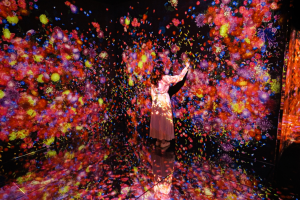
    teamLab’s installation Flowers and People, cannot be Controlled but Live Together, at Second Nature, an immersive and interactive art exhibition. | Picture credit – teamLab


    “AI art is here to stay whether you like it or not,” says Dent-Brocklehurst. After all, it has enabled artists to realise some of the most ambitious projects that would otherwise just remain in their imagination. Perhaps then the measure of these works is not whether they satisfy critics, but whether they spark curiosity. Judging by the two little girls chasing bubbles through New Spring—and the adults who eventually joined them—they already have.

  • A Seat at the Table

    In today’s world of Uber Eats and algorithm-driven dining, the idea of a slow-cooked meal shared with strangers, feels quietly radical. Across Indian cities, a new kind of dinner table is emerging. And it’s not in a restaurant.

    Imagine this. You ring the doorbell of a stranger’s home. The door opens. The dining table is full, the room warm with chatter and the occasional clang of serving spoons. You sit down with people you don’t know yet; a few faces you’ll forget, maybe one or two you won’t. The air is thick with the aroma of coconut-sluiced curries, fluffy Basmati rice, perhaps a drizzle of locally sourced olive oil over fresh salad greens. There’s no maître d’, no laminated menu, only a handwritten note at your place setting, telling you what you’re about to eat, and a host who treats you less like a customer and more like family.

    This is the new face of fine dining in India. And yet, it feels remarkably familiar.


    A Culture Remembered And Reimagined

    While the world might call it a supper club, in India, the idea of communal dining isn’t new. From sprawling wedding daawats to community feasts where plates are shared and hierarchy dissolves, the act of breaking bread together has always held cultural weight. What’s changing today is the form: more curated, more intimate, more narratively driven. Supper clubs in India are experiences — and they’re quietly redefining what it means to dine well.

    Globally, supper clubs have long been a rebuttal to the stiffness and formality of fine-dining restaurants — think Eleven98 in London, the Mumba Milano in Milan, The Gathering Table in New York or Roti Mami in Berlin — where strangers meet for a home-cooked meal and conversation. In India, the idea is finding fertile ground, not as a rebellion against fine dining, but as an evolution of it.

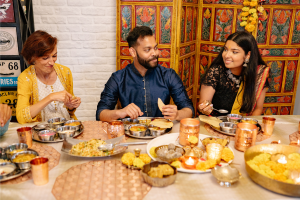
    Today’s Indian supper clubs focus on intimacy over grandeur. They unfold in private, invite-only settings — a sunlit studio, a tucked-away terrace, a chef’s own apartment — often hosting no more than a dozen guests. The person welcoming you is also the one who cooked the meal — walking you through where each ingredient came from. Maybe it’s millets their grandmother made in Karnataka, or tomatoes grown in someone’s rooftop garden in Mumbai. There’s a story behind every bite.

    The food is often hyper-local, seasonally driven, and deeply personal. It’s an extension of the larger global moment towards farm-to-table and slow food, but with Indian accents: indigenous grains, old community recipes, hyper-regional techniques. From Má Là Kitchen in Bengaluru (a Sichuan supper club) to The LOST Table in Gurgaon (run by husband-and-wife duo Natasha and Archit Agarwal), bring together excellent cooking with new social connections.


    www.pexels.com


    In Kolkata, Bengal Soiree is a community supper-club collective that brings people together for curated Bengali meals in intimate settings, offering a contemporary yet nostalgic take on the region’s rich culinary legacy. 


    From sprawling wedding daawats to community feasts where plates are shared and hierarchy dissolves, the act of breaking bread together has always held cultural weight.


    A Cultural Continuum

    At a deeper level, supper clubs tap into something inherently Indian: the act of hosting. And increasingly, that hospitality is rooted in the local. Across the country, there’s a growing pull toward ingredients grown nearby, recipes passed down through generations, and flavours tied to a single neighborhood or farm. Hosts and chefs are plucking basil leaves from their tiny balcony garden, painstakingly making their own ghee — like it’s always been done.

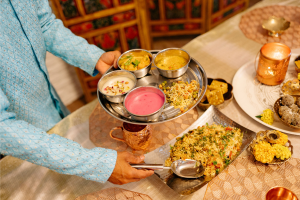
    Because in many parts of India, food is more than what’s on the plate. It’s how you’re welcomed. Bohri Muslim families eat together from one big thaal, a gesture of kinship and communion. In the South, elaborate meals are served on banana leaves. Sikh gurdwaras have long embodied the spirit of community meals through the langar. And in Parsi homes, hospitality is almost theatrical: steaming curry and rice arrives with tangy onion kachumber, washed down with raspberry soda, and finished with a nut-studded baked custard

    Supper clubs are simply reinterpreting these traditions for an urban, globally aware audience that craves connection as much as they crave flavor. In an era of Zomato and Swiggy, sitting down for a slow, home-cooked, shared meal feels radical. It feeds the human desire for stories, for slowness.


    www.pexels.com


    The Rise of the Hyper-Local Plate

    In a globalized world, the new marker of sophistication isn’t internationalism — it’s specificity. Knowing which village your saffron came from, which grandmother perfected that chutney. Supper clubs allow for that kind of detail, that kind of intimacy. What they’re really offering isn’t just food — it’s belonging. A way to feel rooted in a world that often feels too fast, too polished, too transactional.


    Across the country, there’s a growing pull toward ingredients grown nearby, recipes passed down through generations, and flavours tied to a single neighbourhood or farm.


    And clearly diners are craving more than just convenience. A 2024 Zomato survey found that nearly two-thirds of diners in cities like Delhi, Mumbai, and Bengaluru said they preferred ‘intimate, offline dining experiences’ over traditional restaurants or delivery apps. The Godrej Food Trends Report echoes this shift, predicting a rise in ‘intentional eating’ and ‘micro-community meals’ across Indian metros. But this doesn’t mean India’s love for convenience is fading — quite the opposite. The food delivery market is still booming, expected to double from $6.3 billion in 2023 to $13.5 billion by 2029. What’s changing is this: curated, offline meals and algorithmic convenience are no longer opposites. They’re coexisting — two sides of how we now want to eat. 

    Of course, there are downsides. Menus are not always affordable — a reflection of curation, but also a potential barrier to inclusivity. 

    Yet, in stepping into a stranger’s home, breaking bread together, and sharing stories over seasonal, soulful dishes, we’re participating in a tradition as old as India itself — one that reminds us that eating together has always been about more than just satisfying hunger. It’s about satiating the spirit.

  • Niacinamide and Neem: India’s New Beauty Mashup

    In the age of 10-minute deliveries, beauty is never more than a swipe away. A hit of dewy serum or a glitter lip oil can now land at your doorstep faster than your chai. It’s addictive — a kind of self-care roulette powered by dopamine and good design. Quick commerce has turned beauty into a high-speed pursuit, where the line between indulgence and impulse is increasingly hard to trace.

    But while the shelves of Blinkit and Instamart reload in real-time, something quieter is unfolding beneath the scroll. Among India’s Gen Z, there’s a growing sense that beauty — like everything else — might be moving too fast. There is a buzz to being on trend — but there is also, more recently, a feeling of fatigue. 

    And so a counter-movement is slowly taking shape. Skin-first, not glam-first. Efficacy over aesthetic. Welcome to the era of ‘quiet luxury’: think barrier-repair creams, stripped-back routines, muted packaging, and a shift toward simple ingredients that actually work without promising the universe.


    unsplash.com


    The shift is visible across India’s beauty landscape. Brands such as Dot & Key, Minimalist, The Derma Co. and Foxtale have built loyal followings by prioritizing ingredients like niacinamide, ceramides and salicylic acid over aspirational, unattainable glamour. Their success suggests that younger consumers increasingly want products that clearly explain what the ingredients do, rather than merely promise magical transformations. 


    There’s no tug-of-war between East and West here — Gen Z moves between niacinamide and neem with ease.


    In India, what we’re seeing is products tie into our community’s beauty memories. Ayurveda, which once lived in handwritten notes, home kitchens, and half-remembered instructions from elders, is slowly being translated for a younger demographic. Brands like Fable & Mane are taking what many grew up with, like hair oiling before school or on Sunday afternoons, and giving it a new kind of visibility. It’s the same practice, but now with sleeker packaging in fancy stores.

    The shift is visible across the Indian beauty landscape. Brands such as Forest Essentials, Kama Ayurveda and Indē Wild have built audiences by pairing traditional ingredients like saffron, ashwagandha and bhringraj with contemporary branding and ingredient transparency. What once felt old-fashioned is increasingly being reframed as aspirational. 

    We’re watching a remix in real time: where retinol can sit comfortably beside tulsi, and glass-skin routines make room for ghee-infused balms. There’s no tug-of-war between East and West here — Gen Z moves between niacinamide and neem with ease. They might add a snail mucin essence to the cart in the same breath they search for a kumkumadi oil. For them, beauty isn’t about loyalty to one system. They’re not following a single rulebook. One day it’s a retinol serum discovered through a friend’s story; the next, it’s a haldi-and-honey mask passed down from a grandmother. For Gen Z, routines aren’t rigid — they’re a bit of a collage. YouTube one minute, family kitchen the next.


    in.pinterest.com


    A typical routine might include a Korean snail-mucin essence from COSRX, a niacinamide serum recommended by a dermatologist on Instagram, and a homemade hair-oiling ritual involving coconut oil and curry leaves. The combination may appear eclectic, but for many consumers it feels entirely natural.


    Ayurveda, which once lived in handwritten notes, home kitchens, and half-remembered instructions from elders, is slowly being translated for a younger demographic.


    It’s less about keeping up and more about feeling out what actually works — for their skin, their budget, their timeline. Some of it’s instinct, some of it’s habit. There’s no master plan — just small choices, layered over time, that somehow start to feel like their own version of care.

  • Dating Apps and India’s Divided Hearts

    On any given night in India’s metros, you’ll meet two kinds of people who use dating apps. There’s the first group — swiping late into the night, looking for something light and fleeting. These are the people for whom a date might mean drinks, a long walk, or just another chat on the app itself. Then there’s a second, very different group — families and individuals browsing Shaadi.com or Bharat Matrimony, sorting profiles by caste, profession, or income bracket. Both groups are active, both are growing. But between them is… almost nothing.

    This stark split explains why some of the world’s biggest dating apps — Hinge, Bumble, Grindr, Tinder, have recently scaled back or exited India altogether. Their promise of a single ‘catch-all’ platform for romance never fit comfortably with the social realities of Indian love and marriage.

    India’s digital dating scene is not small – the online dating app market was projected to reach USD 1.42 billion by 2030. But most of the engagement sits at two extremes. Apps like Tinder and Bumble thrive among users seeking casual connections. As one 27-year-old Mumbai user put it, “Everyone knows these apps are for hooking up first, and maybe something more if it works out.”

    On the other hand, matrimonial platforms like Shaadi.com, Bharat Matrimony, and Jeevansathi, segment users by caste, religion, profession, and even salary. Shaadi.com, for example, offers filters for ‘business families’, ‘defence officers’, or ‘income above ₹1 crore’. Some newer services go further, asking for offer letters or salary slips as proof of social standing. Here, the expectation is explicit: serious, marriage-oriented matchmaking shaped by long-standing social hierarchies.

    The result? If you want casual fun, you know which apps to open. If you want marriage, you know which portals to join. The middle ground — slow dating, open-ended relationships, or simply ‘seeing where it goes’ — is still culturally thin.


    in.pinterest.com


    Dating apps like Hinge were built on the idea of self-directed romantic discovery: you browse profiles, chat, and meet without family oversight. In the U.S. or Europe, where dating outside family mediation has decades of precedent, this works. In India, where marriage remains closely tied to family, caste, and community networks, swiping can feel unserious if your goal is long-term partnership.

    That tension plays out in subtle ways. Even well-educated, urban Indians often feel pressure to justify relationships in traditional terms once they turn serious. Parents are still gatekeepers for many marriages. Without a cultural bridge from casual dating to family-approved commitment, global apps struggle to retain users beyond a certain age or stage of life.


    India’s marriage market is famously granular. There are apps and services for specific castes, for alumni of elite colleges, for high-income professionals, and for non-resident Indians seeking partners abroad. Each is a carefully carved niche that understands its users’ expectations.

    Global dating apps, by contrast, try to be universal. Their swipe-left, swipe-right interface flattens difference into personal choice, assuming that chemistry and conversation are enough. But in India, choice is only part of the equation. Family approval, social compatibility, and community expectations remain powerful forces, making a single “everything app” feel mismatched.

    This cultural reality has business consequences. User engagement on casual-dating apps can be intense — heavy swiping and short bursts of activity — but often lacks the long-term monetization that subscription-based matrimonial sites enjoy. Families often maintain paid profiles on Shaadi.com or Bharat Matrimony for months or even years, which gives those services a steady stream of subscription income. Dating apps run on a thinner margin. Most rely on advertising or small monthly fees from users who can swipe intensely for a few weeks and then disappear, leaving their revenue far less predictable.


    unsplash.com


    Safety concerns add to the strain. Even with photo verification or ‘women-first’ messaging, many women say they face unwanted messages, or harassment. That discourages them from staying on the platform and limits growth.

    Some Indian startups are trying to bridge the gap. Apps like Aisle and TrulyMadly market themselves as spaces for ‘serious dating’, offering detailed profiles, curated communities, and a slower pace that suggests commitment without moving straight to arranged marriage. Others like HiHi use invitations and background checks to create curated networks. But these are still niche players, and none yet match the scale of either Tinder’s casual dominance or Shaadi.com’s matrimonial reach.


    This landscape suggests that success in India requires specificity — whether it’s a platform for tech people in Bengaluru, working professionals in Mumbai, or a particular linguistic or caste group. The lesson may be that in India, romance is too diverse, too structured, and too negotiated for a single global template.

    Dating apps aren’t slowing their flow in India because people aren’t dating. They faltered because Indian society already offers strong, culturally specific digital ecosystems for both ends of the romantic spectrum — casual flings and family-approved matches. Until an app can bridge that structural and cultural gap, the space between will remain stubbornly narrow.

  • A Level Playing Field

    Women’s sports have seen a surge in viewership over the past few years, reopening the conversation on gender equality in sports — namely, what real equality would look like. The upcoming Los Angeles Olympics (LA28) is a case in point: 26 mixed-gender events are on the medal roster, up from 20 at Paris 2024 and 18 at Tokyo 2020. For the first time, LA28 will feature mixed-gender competition in golf, gymnastics, and the 4x100m relay. 

    Mixed-gender team sports aren’t new. Tennis has had mixed doubles at the Grand Slam level since 1892 — India’s own Sania Mirza built much of her career around it, winning majors alongside partners like Mahesh Bhupathi and Rohan Bopanna. Badminton had introduced Olympic mixed doubles by 1996. Shooting, gymnastics, equestrian sports, and rally car racing have featured direct men vs women competitions almost since their inception.

    And so we ask — are the barriers to mixed-gender play in other sports systemic, physiological, or ideological? 

    Mixed gender sports or co-ed sports have long been a part of the school sports landscape. However, for sports like baseball, football, or even cricket, they tend to be curtailed around puberty, or before players can reach the under-16 or under-18 levels.

    Yet, an instructive 2018 review in Sport, Education and Society found that well-structured mixed environments can reduce gender stereotyping and build mutual respect. Other studies suggest girls in mixed settings take on leadership roles more readily and report greater confidence than peers in segregated ones. A mixed environment is instructive in other ways too, perhaps revealing that merit in sports is not gender-based.


    in.pinterest.com


    Safety is the other major deterrent, especially in contact sports. Inequality doesn’t stay outside the game — the attitudes boys absorb growing up come with them onto the field. And, combat sports like wrestling or kabaddi, where winning involves physically overpowering an opponent, can easily be warped to reinforce harmful stereotypes about masculine dominance and control. 


    Tennis has had mixed doubles at the Grand Slam level since 1892 — India's own Sania Mirza built much of her career around it, winning majors alongside partners like Mahesh Bhupathi and Rohan Bopanna.


    In India, this strategy has been put to the test already. The Mixed Gender Football League (2023–24) in Chennai and Madhya Pradesh’s Samaveshi Cup, built leadership and strategy among young girls while boosting their confidence to push back against the idea that sports aren’t a ‘natural’ hobby for them. Traditional Indian mallakhamb and kho-kho exhibitions have also experimented with mixed teams at the grassroots.

    Ultimate frisbee has long operated as a mixed contact sport without major issues. The mixed 4x400m relay, introduced at the 2019 World Championships and later the Olympics, quickly became one of track and field’s most tactically interesting events, since teams must strategize the order of male and female runners — a wrinkle absent from traditional relays.


    India’s 4x400m mixed relay team won gold at the Jakarta Asian Games 2018 / in.pinterest.com


    Of course we know that mixed-gender sports will face resistance rooted in deep social conditioning. Selection resentment is one flashpoint — if an Indian cricket team’s 12 male roster spots dropped to 6 to make room for women, that could strain team cohesion. Fan acceptance may be slow too: hostility toward female fans and reporters is well documented, from F1 to the IPL. That hostility could hit sponsorships and ticket sales before mixed teams earn real buy-in.

    There is a case to be made for merit-based lineups in mixed-gender sports, provided that both men and women players of that sport start on a level playing field, with similar facilities and resources to bring them up to the point of competing side-by-side. Given the lopsided growth of women’s sports in certain areas, like cricket, basketball or even hockey (Hello Chak De! India), there might also be a need to establish mandates of the ratio of male-to-female players on the field, until true equality can be achieved on merit alone. 


    In India, this strategy has been put to the test already. The Mixed Gender Football League (2023–24) in Chennai and Madhya Pradesh’s Samaveshi Cup, built leadership and strategy among young girls while boosting their confidence to push back against the idea that sports aren't a ‘natural’ hobby for them.


    For much of the mainstream sporting world, such competitions remain an experiment. But their value does not lie in claiming a moral victory for gender equality. Instead, it lies in creating space for curiosity and asking a simple question: what happens when we play together rather than apart?

    No meaningful pursuit of gender equality can be achieved through symbolic gestures alone. Yet mixed-gender sport can serve as a promising starting point. By bringing men and women onto the same team, it challenges long-held assumptions about ability and performance. In doing so, it offers a powerful reminder that success in sport is shaped by skill, strategy, teamwork and intent far more than by gender. If perceptions are ever to shift, mixed-gender competition may be one of the most effective ways to demonstrate that ability cannot be reduced to a binary.

  • The Sound of Something New

    We’ve all felt it lately — whether you’re humming along to Karan Aujla in the car or stumbling upon a trending Tamil audio buried among a sea of recycled Instagram reels, something’s shifted. Amid the digital sameness, a not-so-quiet movement is taking hold. Indian languages — once dismissed as too local, too niche — are becoming mainstream. And not just in India.

    Across the world, creators are adding subtitles in Tamil or Malayalam even if they don’t speak the language. Punjabi songs are dominating Spotify, not just in Surrey or Southall, but in Stockholm and Sydney. These aren’t one-off anomalies — it’s part of a bigger shift in how culture works online. Karan Aujla’s album P-Pop Culture was amongst Canada’s highest-streamed artists of 2025, with Aujla rubbing shoulders with the likes of Justin Beiber and Tate McRae. Meanwhile, Diljit Dosanjh will be headlining London’s Wembley Stadium (and already performed at Coachella in 2023).

    You can hear it in the way a song lyric lands — even if you don’t speak the language, the emotion cuts through. There’s something raw and familiar in the rhythm, the sound, the feeling of these words. They stick with you — sometimes even before your brain knows what they mean. Indian languages are no longer background noise. They’re the headliners. 

    And it’s not just in music. You can see it in what people wear — Tamil script printed boldly across streetwear, for example. A Kannada meme page you followed for laughs now goes viral in Toronto. This isn’t just platitudinous aesthetics; hoodies striped with Devanagari script have reportedly sold out within hours, proof of a real appetite for something rooted in home rather than a copy of a foreign label. Tamil-specific labels built entirely around Tamil cultural identity — like urban streetwear brand Angi Clothing — now ship internationally, carried by a growing diaspora market. Angi’s motto? ‘Identity is Everything’. 


    Karan Aujla Spotify Playlist / in.pinterest.com


    So why now?

    Because we’re in a moment where the global internet is craving specificity. The age of mass culture — where everything looked and sounded the same — is fraying. People want their content (and their identities) unfiltered, unpolished, and rooted in something real. And Indian languages —  rhythmic, emotionally charged — offer exactly that.  The resurgence of local culture has surprised those who expected globalization to sandpaper away local differences, leaving the world listening to, watching, and playing the same things.

    When a Tamil phrase shows up in a beauty influencer’s caption, or a Marathi gaana plays in the background of a cooking reel from NYC, it tells you something: our languages are shaping what culture looks and sounds like today. For Indian audiences, this moment feels quietly radical. Many of us were taught to soften our mother tongues, to code-switch, to avoid being ‘too vernacular.’ That milquetoast word ‘vernacular’ was once used slightingly by Anglophile circles – ‘vern’ was an insult.

    Naturally, algorithms are catching on (and even perhaps helping to shape this shift). Platforms are hyper-personalized now, allowing cultural nuance to reach new audiences without losing itself in translation. 


    When a Tamil phrase shows up in a beauty influencer’s caption, or a Marathi gaana plays in the background of a cooking reel from NYC, it tells you something: our languages are shaping what culture looks and sounds like today.


    And for readers halfway across the world, this story is about more than India. It reflects a wider shift happening everywhere: from Korean in K-pop to Swahili in Afrobeats, the cultural gatekeepers are changing. Between 2017 and 2022, Afrobeats streams on Spotify grew by roughly 550%, and the genre now has its own category on the Billboard Hot 100. Identity, media, and influence are evolving — and the future of ‘cool’ might just have Indian subtitles.

    This is a global rebalancing of who gets to be heard. And this time, the voices sound a little more like home.

  • Imaginary Homelands

    Walking around artist Sumakshi Singh’s life-size, embroidered fabric architecture is like being inside a surreal dream. It’s hard to take your eyes off the white, translucent spiral staircase, the intricate patterns on the walls, the double gate, the windows. I notice other viewers walking around, eyes wide with wonder, peering up and down to closely examine the panels, and resisting the urge to touch the fragile work.

    But once you walk out of the work, you see the bigger picture, the cohesive structure of a house. There is something haunting about this work, a replica of Singh’s grandparents’ Delhi home that was built soon after the India-Pakistan Partition. It’s where Singh held some of her most cherished memories, but it was taken down a couple of years ago.

    At the 2026 Venice Biennale, the India Pavilion’s theme – Geographies of Distance: Remembering Home – address the concept of a physical home and question what happens when that home no longer exists,  you’re far away from it, or even when that physical home is no longer your real emotional home, explains curator Amin Jaffer.

    Jaffer’s prompts for the Venice Biennale project were his lived experience as part of the South Asian diaspora, and a rapidly developing and changing India. He was born in Rwanda, Africa, and has lived in Britain, Canada, the USA, Portugal, Italy, the Bahamas and India. His work has taken him around the globe, from Japan, China and Russia to the Gulf, Africa and the Americas. “The preoccupation with home is a reflection of my own circumstances, as someone of Gujarati origin, born in a former Belgian colony, raised with multiple Indian and European languages and value systems,” he says.

    Geographies of Distance: Remembering Home is also a response to the demographic, economic and technological boom in India, and the increased movement of Indians. “We are more mobile than ever before, within the country and across the world,” says Jaffer. “This turned my thoughts to notions of home and especially a home that is far away, either ggeographically or because the physical space has changed,” he adds.


    in.pinterest.com


    Is a Home a Physical Space?

    Established Indian artists Zarina Hashmi, Krishen Khanna and Satish Gujral have mourned the loss of their homes, family and friends during the 1947 Partition. The desire to return, to feel a sense of belonging in a place left behind, has long been evident in their art.

    But for a younger generation of artists who have lived and worked in different countries, the idea of home is not bound to a physical space, perhaps because that physical space is constantly changing. Indian cities are dotted with redevelopment projects. Old structures are rebuilt as sky-rises. Difficult-to-maintain, sprawling bungalows are being erased for a mall or even a parking lot while the family moves to an apartment. The physical space is lost but the emotional space stays. Carry that with you wherever you go, and that, perhaps, becomes your home.


    But for a younger generation of artists who have lived and worked in different countries, the idea of home is not bound to a physical space, perhaps because that physical space is constantly changing too.


    Singh, who has worked and lived in eleven countries, felt the most ‘belonged’ in her grandparents’ Delhi home. It’s where her family gathered, where festivals and important events were celebrated. But when that home was being demolished, she recreated it at the Biennale, with a delicate embroidered panel. The delicacy of the work gestures to the impermanence of a brick-and-mortar building. But the memory of it stays, and that, for Singh becomes her emotional home.

    Living across borders and straddling multiple cultures has inspired works of other international artists too. South Korea’s Do Ho Suh creates life-sized replicas of the homes he has lived in across Seoul, New York and London, with translucent fabrics, exploring how memory, personal identity and space intertwine to shape one’s residence. Nigerian artist Akunyili Crosby, based in the United States, creates paintings that feature interiors and domestic scenes of a transnational home and the complexities of inhabiting two different cultures simultaneously.


    The Climate Crisis 

    But even those who continue living in the same place they were born and raised in are questioning the idea of home. For Skarma Sonam Tashi, one of the five artists showing at the Indian Pavilion, home is closely related to his homeland Ladakh’s traditional architecture. His work, a block of traditional Ladakhi homes made with papier-mâché and clay from his homelands, becomes a commentary on how brick and mortar houses are replacing these structures. “It mourns the loss of traditional home-making skills and artistry to climate change,” says Tashi. The region, a traditionally dry one, has seen a recent swell of rainfall thanks to the climate crisis. The old houses were not built to protect from rain. That’s one of the reasons people are building brick-and-mortar buildings. “But those aren’t any good for our ecology either,” he laments.


    Sumakshi Singh’s ethereal art work | Credit – Riddhi Doshi


    A Home Lost to Violence

    Palestinian-UK artist Mona Hatoum creates household furniture using items such as electric wires and mesh steel, treating the house not as a safe space, but as a site of political confinement and displacement. 

    Ghana’s Ibrahim Mahama places objects from his nation’s colonial past, such as train seats, defunct aeroplanes, locomotive engines and hospital beds in global art institutions,​ such as Kunsthalle Wien, Vienna, White Cube, London, and University of Michigan Museum of Art. By doing so, he prompts a discussion about how history has shaped what we call home. But it begs the question – can an exploitative past make a home?


    The physical space is lost but the emotional space stays. You carry that with you wherever you go, and that, perhaps, becomes your home.


    In India, for instance, the concept of furniture as permanent space holders such as the dining table or a bed was introduced by the British. Our traditional style of dwelling facilitated movement. A charpoi could be carried to a terrace on a pleasant day or to the aangan for guests. But these furniture pieces would become an integral part of our houses. Our houses’ geographies were dictated by these items, and we forgot how our old houses were always minimal. In that sense, what we have inherited is a borrowed idea of a home. So, does that make it ours?