

We’re hearing it tomtommed everywhere now. The Indian sports scene is evolving at high speed, and while the country’s preoccupation with cricket will never quite run out of steam, interest in other sports is certainly multiplying by leaps and bounds. The country’s badminton players are holding their own against the Chinese and the Danes. India, once a hockey-obsessed country, is slowly scrambling to climb back up to earlier heights; it’s certainly on its way thanks to the bronze medal prised from German hands at the 2020 Tokyo Olympics. Neeraj Chopra turned was the first javelin thrower from Asia to win a gold at the Olympics (in 2020). Rather surprisingly, India’s shooters have carted away seven medals at the Olympics (from 2004 onwards). And in chess, the country that invented the game is now producing a tumult of grandmasters.
On the face of it, the India Rising narrative appears to be invincible. But can a few extra medals scattered across the years really equal structural change? Is India really a sporting nation? After all, the country has produced plenty of champions over the decades — Milkha Singh in 1958, P T Usha in 1984. The real test is whether the last decade or so built an ecosystem: coaching, facilities, funding, scouting. That’s a much higher bar to surmount.
In the last two decades or so, there has certainly been a plumping of infrastructure thanks to business houses such as the Tatas throwing their heft behind football, polo, boxing, hockey and badminton. Government initiatives have joggled the scale upwards too, and the media has dutifully followed suit, with broadcasters becoming facilitators by showcasing a range of sport beyond cricket.
The sharpest indicator of a rise comes through badminton. Before 2012, India had zero individual Olympic medals in the sport. Then came Saina Nehwal’s 2012 win, PV Sindhu medalling in 2016 and 2020, and a men’s doubles bronze in 2024. That’s not one gifted player fighting against the odds to reach the top — academies like Pullela Gopichand’s in Hyderabad have been turning out Olympic medalists and top-ranked players across multiple events for over a decade now.
Hockey, on the other hand, was once the lifeline of the nation in the way cricket is today, then faded away entirely, and is now clawing its way back by winning Olympic bronze medals in Tokyo and Paris. But India is yet to climb to an Olympic final; 1980 was the last year in which it did so. Two bronzes raise the floor considerably. But they certainly don’t put India back in the conversation with the Netherlands, Australia or Germany for gold.
Athletics and shooting paint a slightly grayer picture. Even though the plethora of medals is commendable, Neeraj Chopra’s gold and silver in the javelin throw were assisted by the Target Olympic Podium Scheme, which provided funding for foreign coaches and European training, among other things. Shooting has a longer history and is India’s most successful sport at the Commonwealth Games.
The problem is that TOPS is designed to help athletes who have already demonstrated a superlative ability. It does little to address the more pressing issue of finding and then developing a wider pool of talent; Chopra himself has stated that funding should be awarded to athletes who have not yet made their mark, rather than those who have.
Chess doesn’t fit the government-investment story at all. India’s current wave owes more to online coaching platforms, a deep bench of private coaches built up since Vishwanathan Anand’s era, and families funding their own kids’ tournament travel.
Then there’s the Deloitte “Think Sports” report, often waved around as proof of a broader transformation, and it’s worth being clear about what it actually measures: fans, not athletes. Of India’s 655 million sports fans, 90% now follow more than one sport — kabaddi has 120 million fans, football 85 million. Gen Z, 43% of that base, gets 93% of its sport digitally and, unusually, keeps engaging in the off-season. People spend 20% more time on on-demand content than live events. The sporting goods market is projected to nearly double to $58 billion by 2030.
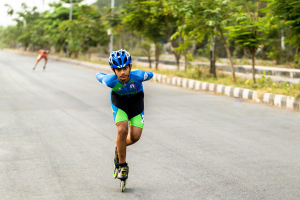
When can a country truly call itself a sporting nation? When facilities are easily accessible even to the rural athlete and the marginalized, when athletic medals carry the heft of professional legitimacy, and when sports become a financially viable occupation. Most of all, we become a sporting nation when athletics are accepted and respected as a viable career, not a mere hobby for schoolchildren. We still have a long way to go there.
The numbers tell a rather stark tale – only about 1,00,000 playgrounds for roughly 350 million students; fewer than 50 international‑standard stadiums; a few dozen swimming pools, and even fewer shooting ranges or indoor stadiums for badminton, weightlifting, boxing, gymnastics, and other sports, and perhaps 200 universities, 500 schools, and some clubs with infrastructure large enough for various games.
There is a yawning gap between official rhetoric and execution, and the National Sports Policy 2025 seeks to address it by calling for integrating sport with education and creating viable dual‑career pathways for young athletes. The Khelo India University Games have given thousands of student‑athletes a national stage. But policy can create a pathway only if institutions are willing to rebuild themselves around it.



Leave a Reply