

India is a tea-drinking country, or so the cliche goes. But as all stereotypes go, this paints only one part of a much larger picture. The other half tells us that coffee had seeped into the bloodstream of the country long before chai became bound with its identity.
Right from the colonial era, coffee was coveted by wealthy sophisticates in clubs and refreshment rooms, a couple of which were owned by Armenians, or hawked by kahwewalas, Muslim street vendors of Indian, African or Arab origin; natural, since the city was peopled by Muslim traders from countries such as Aden, in which coffee was extraordinarily popular. Most popular, though, were the itinerant coffee vendors who roamed the streets of cities like Mumbai with a pillar of stacked coffee cups which they clanged like castanets, together with a stove and a kettle made of copper or tin.
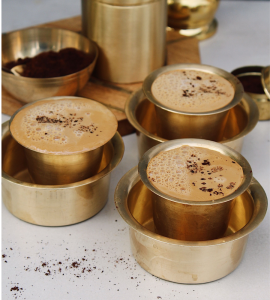
Still, it had not yet conquered the mainstream, especially since many Indians looked upon it with disfavour as a corrupting, ‘Western’ influence. A few canny Indians did hop on the coffee train as soon as they realized its potential. For instance, Indian dairy purveyors Polson’s marketed ground coffee to the Europeans from 1887. Meanwhile, coffee traveled to South Indian states such as Tamil Nadu and Karnataka, ensconcing itself into the country’s culinary fabric through the famous milky South Indian filter coffee.
The next big shift came about when the Coffee Board opened coffee houses – this became a tremendously successful initiative in cities such as Kolkata, where the space became an adda for anti-colonial-minded young Bengalis – by 1948, there were at least forty-three outlets across the country.
Then, in the 1990s, economic liberalisation opened India to the world, and coffee piqued the interest of a brand new generation of entrepreneurs and consumers. A cafe felt modern and fresh in a way that India had never seen before, and brands like Cafe Coffee Day and Barista became the faces of that era.
They were the precursors to Starbucks, which shouldered its way into the country in 2012. Eventually, these big companies would pave the way for a swathe of homegrown specialty roasters: stylish passion projects such as Blue Tokai, Third Wave Coffee, Subko and others.
The coffee industry likes to talk about itself in waves: coffee as a raw commodity, then the rise of the modern café, then a focus on origin and craft, then the arrival of science and precision brewing. Some in the industry now argue India has brewed its way forward to the fifth wave, one built around taking genuinely good specialty coffee and scaling it up.
All of these brands have fuelled a wave in coffee cultures around the country. Young people in Indian cities used to build their social lives around malls, multiplexes and nightlife. Now the café has taken that spot. People go there to work, to meet friends, to relax away from family; the coffee is almost beside the point.
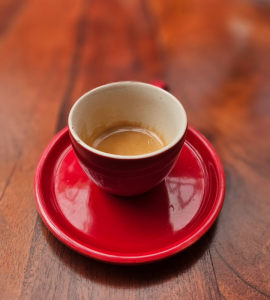
Some of this can be attributed to the aesthetics of a well-designed cafe, built with social media in mind, with comfortable seating meant for laptops and long stays, and somewhat affordable coffee for the long-stayers. Again, thanks to social media, matcha and cold brew jostle comfortably together on the same menu as a simple espresso or black coffee. Even things like alcohol-free ‘Coffee Raves’, daytime dance events fuelled by caffeine, show how differently young Indians are choosing to socialize.
And while major urban centers such as Delhi, Mumbai, Bengaluru and Jaipur still lead the scene, smaller cities are no slouch when it comes to specialty coffee either with demand for specialty coffee has been climbing steadily in tier 2 and tier 3 towns; a clear function of a burgeoning middle class with more aspirational spending capabilities.
India’s coffee ambitions aren’t staying inside the country. Blue Tokai, Subko, Nothing Before Coffee and Roastery Coffee House have all opened cafés abroad in the last few years, in Japan, the UAE, Portugal and Finland, alongside growing e-commerce operations overseas.
Most recently, Odisha-based roaster and café chain Kruti Coffee opened its first overseas outlet in London. The store serves espresso drinks and a rotating pour-over menu, all sourced from Kruti’s Bhubaneswar roastery. In July 2026, Kruti became one of the first Indian businesses to ship goods to the UK under the newly signed India-UK Comprehensive Economic and Trade Agreement, a deal that could make it easier for other Indian roasters to follow.
Meanwhile, North America appears to be shuffling in another direction. Remote work and narrower budgets are elbowing more and more people to drink home-brewed coffee rather than at a cafe: a recent U.S. National Coffee Association survey found 85% of Americans who drank coffee the day before had done it at home, the highest share since 2012.
Even so, US coffee is abuzz with experiments. The latest craze appears to be health, in the form of protein-sluiced caffeine (a trend that shows up in India’s Starbucks as well) and mushroom coffee, made with ingredients like lion’s mane and reishi (once a mainstay of niche wellness stores). Following the trend of savory cocktails, coffees too are mixing miso with caramel, pistachio with salt, and even spring onion. And a cheering trend (one that is reflected in smaller coffee initiatives in India as well) is sustainability; brands like Nespresso are now partnering with the Rainforest Alliance on regenerative farming.
Two countries, two different coffee moments: one rediscovering the café as a place to be, the other pulling back into the kitchen. Either way, coffee in 2026 is doing more than keeping people awake. It’s shaping how they spend their time, what they think of themselves, and increasingly, where a cup of coffee can travel to from its country of origin.



Leave a Reply