

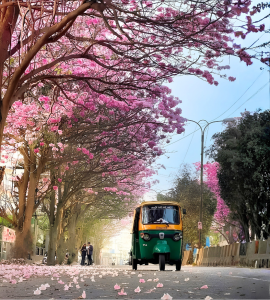
Every March, your feed turns pink. Streets carpeted in petals, trees bursting into colour — like someone dropped springtime straight into Bengaluru. It’s easy to think of cherry blossoms in Japan, but this isn’t Tokyo. This is Indiranagar. Or Jayanagar. Or some unassuming street corner where a Tabebuia tree just decided to show off.
So why does Bengaluru bloom like this?
Turns out, it’s not just luck. The city’s reputation as the Garden City isn’t just about a few parks — it’s baked into its very design.
As the city expanded, successive rulers and administrations continued adding to this landscape. What looks today like a naturally leafy city was partly the result of generations of deliberate planning: tanks, gardens, avenues, orchards and shaded public spaces were built into Bengaluru’s growth. The city’s famous green character was cultivated long before it became a technology capital.
One of the most important early examples was Lalbagh, which harks back to the time of Haidar Ali band Tipu Sultan. Ali grew the garden in the 18th century, and Tipu Sultan expanded it, turning it into a place not simply for pleasure but for horticultural experimentation. Two mango trees still remain of those times, believed to be planted by Tipu Sultan in the 1770s. Several years later came Cubbon Park, born in 1870 in colonial Bangalore by a British commissioner of that name; it initially covered around 100 acres before pushing even further into the built city.
Bengaluru is equally indebted to Krishna Raja Wodeyar IV, whose long reign in the early 20th century saw the birth of a further wave of parks, gardens and lakes across the city. Cubbon Park itself was formally renamed for the Wodeyar family (even though it is still colloquially known as Cubbon Park today).
In the early 1900s, a German horticulturist named Gustav Hermann Krumbiegel — the man behind much of Lalbagh — introduced something called ‘serial blooming’. He planted flowering trees with different bloom cycles so that something would always be in flower. That’s why just as the pink Tabebuias start to fade, the purples of Jacaranda take over. Then come the flaming reds of Gulmohar in summer. It’s a quiet relay race of colour.
Add to that Bengaluru’s mild weather, decent rainfall, and reasonably fertile soil — perfect conditions for trees to thrive. Colonial-era city planners, with their love of ornamental landscaping, brought in exotic species that adapted surprisingly well here. Over time, they became part of the city’s personality.
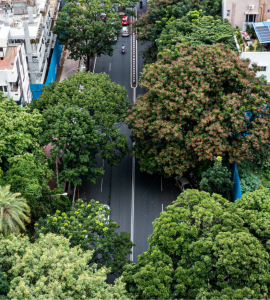
There is another reason the trees feel so deeply woven into the fabric of the city: rather than fencing them into gardens, Bengaluru’s early planners built tree-limned streets and shaded homes and institutions, softening (and cooling) a dense, urban space. The gardens and lakes, once essential infrastructure that undergirded the city, grew into its visual identity as well.
But it’s not just about the past. Residents today still fight to keep the city green. From neighbourhood tree planting drives to citizen-led protests against deforestation, there’s a quiet but steady push to protect what’s left. And maybe part of why people care so much is because these trees aren’t just ‘green cover’. They’re memory markers. Anyone who’s lived in Bengaluru long enough has a story set under one of them.
And the numbers explain the urgency. An IISc study found that Bengaluru’s green cover has fallen to around 3 percent of the city today, down from roughly 70 percent in 1970. Over the same broad period, the city’s built-up area expanded more than tenfold — from about 8 percent of the land in 1973 to over 93 percent by 2023.
A galaxy of citizen-led initiatives have risen up in revolt of these numbers. Amongst the foremost is Heritage Beku, campaigning to protect trees, parks and historic landscapes. Its #KillBill campaign opposing proposed changes to Karnataka’s tree-protection legislation gathered more than 50,000 signatures. And the flowering trees themselves have become a form of cultural heritage. Heritage Beku’s own initiative, Hoovu Habba seeks to honor the city’s serial blooming cycles by hosting walks, lectures, readings etc.
Neralu is a citizen-run tree festival held in Cubbon Park that spearheads tree-mapping drives together with tree walks, talks, art workshops, storytelling and film screenings.
Bengaluru is abloom with similar initiatives: from Hasiru Usiru, an older environmental collective to Gubbi Labs (organizers of citizen-science tree-mapping and identification workshops) to Namma Bengaluru Foundation’s tree advocacy (in one instance, volunteers surveyed more than a hundred trees along a proposed suburban rail route to identify which could be saved from felling) and Vruksha Foundation and Parisarakagi Navu.
Not every gathering under Bengaluru’s trees is explicitly about activism. Cubbon Reads, a silent reading community that meets every Saturday morning in Cubbon Park, started with six people in 2022 and has since grown into a large recurring gathering, inspiring similar reading meetups in parks elsewhere.
The city’s blooms aren’t just pretty. They remind us of another Bengaluru — before the flyovers and the office parks, when the city was slower, sleepier, and maybe even a little bit softer. They carry a kind of nostalgia that’s hard to describe but easy to feel.
And that’s probably why we photograph them so much. Not just because they’re beautiful, but because they feel like something we don’t want to lose. In a city that’s always rushing toward the future, the flowers are a pause button.
So the next time you see a tree throwing pink across the street, maybe stop and look up. This didn’t happen by accident. Someone planted that, years ago, thinking it might make your day better.





Leave a Reply