Always, it is in some way, a reflection of the economy, of the society of its time.
Take Indipop for example. Its emergence in the 1990s and early 2000s was inextricably linked to the economic liberalization of India in 1991 that ushered in a whole new age of consumerism. Color TV and cable (MTV!) entered homes with fanfare, and McDonald’s and Domino’s outlets popped up across major metros. Kids began hankering after Reebok and Nike shoes, and the ‘mushroom’ haircut became the style du jour.
Before liberalization, India’s music scene largely revolved around the film industry, with actors lip syncing vocals sung by professional singers. Indipop, on the other hand, passed the mike to the singers themselves.
Alisha Chinai was a huge musical star in 1990s India | in.pinterest.com
MTV and Channel [V] (the local MTV) imported a fresh grammar of Western self-expression to an India still mired in some way in socialism. Indipop music videos were shot like slick Vogue fashion editorials and entire personas were created around the singers (Bally Sagoo, for instance or Alisha Chinai). The music changed too, fusing Western styles such as hip hop and reggae with Indian vocals. In short, Indipop was cool.
This was the context in which VIVA was born — India’s first all-female pop group. Their breakout hit, Hum Naye Geet Sunayein (Let’s sing new songs) was equal parts girl power and bubblegum gloss, calculated to appeal to the urban, English-educated, upper-and-middle-class — the same demographic that benefited first and most visibly from economic reform. They were, in some ways, the Spice Girls of India.
Something similar is happening again.
W.i.S.H. — launched by Sony Music India in 2024 with their single Lazeez — is being pitched to the country as India’s answer to K-pop and J-pop. The band is built on a K-pop-style playbook of voice training, choreography, and export-ready branding. The aim now though? To export I-Pop to an increasingly-globalized world, rather than import a musical aesthetic.
And then there’s Gilithigreams. Launched in 2026, the four-member group from Arunachal Pradesh calls itself India’s first A-pop act. It is a self-funded group from a region rich in musical discourse (but largely written out of mainstream media). Gilithigreams represents a step beyond; big opportunities reaching past the metros, thanks to the democratizing platforms of streaming services and social media.
VIVA was India’s first girl pop group. | in.pinterest.com
No matter which decade we choose though a girl group is one of pop culture’s most efficient shorthands for a country’s economic mood. Whether the economy is opening up or growing even further, it is pointing young women towards a path of (marketable) self expression. And voila! A girl group appears. VIVA appeared together with the optimism of early liberalization. W.i.S.H. and Gilithigreams are part of an India negotiating its next chapter of growth, digital access, and regional visibility. The resemblances in all cases are striking: although the momentum of growth is slowing, there is strong macroeconomic stability sitting.
Different decades and different soundtracks but the instinct stays the same: a widening economy, and pop culture selling the current moment back to us as a song.
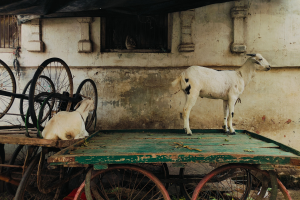
The city is often the wildest space. Take Mumbai, for instance. Corpulent canines loll in front of stores, hoping for a spare snip of food, clowders of cats prowl atop crumbling city walls, pigeons and crows alight on kitchen windows, kites swoop screeching from treetops, and bats flit past buildings in search of an abandoned piece of fruit.
And yet, a stroll down a London lane might reveal, at most, an ambulatory fox, slipping quickly behind a garbage can. Similarly, in Chicago, an aggressive gull might swipe the sandwich from your unsuspecting hands, but that would be the extent of your encounter with any free-living wildlife.
None of this is an accident of geography or climate. It is the visible result of three very different cultures of thought, about which creatures belong in public spaces — and India’s cities are now the site of a fierce legal and societal battle over whether that older, more porous relationship between humans and animals can survive.
www.pexels.com
Britain has a genuine, long-standing enthusiasm for wildlife — birdwatching is one of its most popular pastimes; gardens are landscaped to attract hedgehogs and songbirds; and shy foxes have become more common visitors on suburban doorsteps, elbowed into the city by increasing urbanization. But this affection runs alongside rigid classificatory lines: not all animals are equal. A fox in a film is charming, a fox in the backyard is a pest, and a fox in the country is merely prey to be hunted. A pet dog is charming, a hunting dog is fine, and a free-roaming dog is something to be whisked into a shelter.
This after all is the same culture that gave us the Kennel Club, made dog ownership a default idea, and a matter of canine pedigree. Formal breeding, like the codification of fox hunting as an aristocratic pursuit, helped cement the idea that an animal’s worth is related solely to some specific human purpose or owner. An animal without a collar and/or pedigree and/or landowner’s sign-off simply had no justification within the system. Throughout much of the Western world therefore, it is normal to think anyone who lets an animal outside the home without supervision is neglectful or even cruel.
“
This human-animal coexistence has lasted, somewhat fitfully, through the centuries, and was upended mostly thanks to colonization.
”
This is reflected in the broader North American approach to urban space; it is designed to be legible and orderly. An owner-less animal disrupts that legibility. It is a ‘stray’ a term that by definition frames the free-roaming bird or animal as out of place. Municipal codes treat unaccompanied animals as a public-safety problem resolved through capture, shelters, and historically euthanasia. Consequently, the public realm in the American city is remarkably animal-free by world standards. This after all, is the age of the Anthropocene, a new human-dominant geological time in which people have altered the environment in titanic ways.
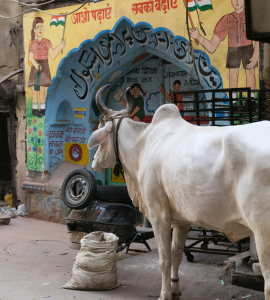
Meanwhile, in India, it is virtually impossible to thread your way through the streets without glimpsing a wandering cow or two, a posse of puppies. This human-animal coexistence has lasted, somewhat fitfully, through the centuries, and was upended mostly thanks to colonization, when the British attempted to impose the British classificatory system on India in 1813, terming free-living dogs as ‘pariahs’, subject to impoundment and slaughter.
When the slaughter began in Mumbai, residents rose in revolt. Hindus and Jains held caring for stray dogs and other living creatures as an act of piety. But the Parsis were the angriest of all (their eschatology held the dog sacred), and soon all citizens – Hindus, Jains, Ismaili Muslims – led by the normally peaceable Parsi community, surged against the colonials in an incident later called the Bombay Dog Riots.
unsplash.com
This tenuous co-existence continued until much later. Under national policy dating to 2001, all dogs were legally entitled to life in public spaces.
But in 2025, something changed. Both in July 2025, when the Bombay High Court enforced a ban on feeding pigeons at Mumbai’s historic kabutarkhanas, citing health hazards, and in August, when the Supreme Court ordered that all stray dogs in Delhi be rounded up and permanently institutionalized, thanks to the spectre of rabies (a spectre largely debunked by a close scrutiny of government reports).
So what is the message? That animals are a menace, a nuisance, an eyesore, a threat. Which is the same tune that was played by the British.
Ever since, the country hasn’t always been particularly kind to animals. There are sudden rashes of intolerance; newspapers are clamorous with heart-crippling incidents of stray dogs being poisoned, starved, and beaten to death.
“
But in 2025, something changed. Both in July 2025, when the Bombay High Court enforced a ban on feeding pigeons at Mumbai’s historic kabutarkhanas, citing health hazards, and in August, when the Supreme Court ordered that all stray dogs in Delhi be rounded up and permanently institutionalized.
”
And yet, the world has constantly opened up oases, treating human-animal coexistence as something to accommodate rather than eliminate.
In Rio, animal-friendly drinking fountains have been installed in all parks and squares. Dubai has piloted an experiment with AI-enabled feeding stations for stray cats. In Italy, many centuries-old public fountains are designed with low spouts and shallow basins, allowing for animals to drink from them, alongside humans.
This then might be the most modern thing of all. To learn lessons about sharing the city with other creatures might help incubate an ethos of mutual tolerance. An ethos that might well be a stepping stone towards a more environmentally-diverse planet, one in which all flora, fauna and humans can co-exist more peacefully.
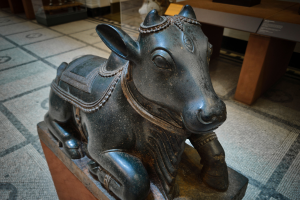
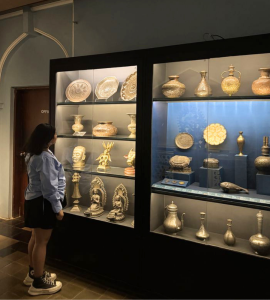
Anyone with even the slightest inkling of the histories of the colonized world will recognize the klaxon call to decolonize the museum. It is a documented fact that many of South Asia’s historical artefacts have been pillaged by colonizers and are now languishing behind the glass fronts of Western museum cabinets.
The heart of the problem lies in the fact that the collections, no matter how beautifully curated and preserved, can symbolize tremendous historic trauma, even in the way collections are described and catalogued. What gets seen and what remains curtained in museum basements reinscribes imperialist visions. Quite often, these histories are inaccessible to their own communities.
In fact, the very institution of the museum seems at odds with the idea of a post colonial world; the dawn of the museum came, in part, via colonialism after all. Many of its exhibits reached their European or North American homes through violence, or outright theft – it was quite common, for instance, that the British simply swiped artefacts from archaeological digs in India and across large parts of Africa. Some communities, such as the First Nations and the Maori, have been appalled at coming face to face with the physical remains of their ancestors, and treasure that they deem sacred.
www.pexels.com
So why then, knowing all this, are we still drawn to these bastions of imperial legacies?
The obvious answer is that museums are still mantled in the aura of learning. As disseminators of cultural and anthropological histories, there is still something essentially valuable about them. Their ability to position objects beyond particular cultural identities, curate them within a broader lineage, and situate them within a wider, richer framework of relationships still feels crucial.
Besides, as possessors of enormous purloined wealth, museums such as the British Museum still hold massive collections of artefacts that are beautifully preserved and presented for our consumption. Could we say the same of a smaller museum situated in a country whose resources have been plundered by the British? Debatable.
What then, might be the way to reconcile the two?
One way of course, is restitution. US museums have been more forthcoming with their permissions – for example, the American Museum of Natural History has returned a large collection of Māori and Moriori ancestral returns to New Zealand Te Papa Tongarewa. Meanwhile, much UK heritage legislation appears to have been inked with the specific purpose of preventing the return of priceless items taken during colonialism. For instance, the British Museum Act of 1963 bars all repatriation without exception, only allowing for a temporary transfer of objects to other institutions.
While Government machinery sluggishly inches forward, a host of individuals have begun sleuthing and advocating for the return of these artefacts to their ancestral homes.
in.pinterest.com
A few examples. As part of the research team of Recover, Restore, and Decolonize, Dr Dolly Kikon and Dr Arkotong Longkumer are working to repatriate ancestral Naga remains from the Pitt Rivers Museum. The activist group, India Pride Project, has long been campaigning for the return of Indian artefacts plundered during (and after) colonialism. Jarat Chopra, the great-great-great-grandson of the former ruler of the southern Punjab, has been petitioning to get back a sword that his ancestor Diwan Mulraj Chopra surrendered to General William Whish. Slok Gyawali of the Nepal Pride Project and Sanjay Adhikari were instrumental in the return of sacred statues to Kathmandu.
Another way might be to plough funds into existing or new institutions in previously colonized countries, perhaps through a public-private initiative. For example, the Museum of Black Civilisations in Dakar, Senegal opened its gates in 2018, with capacity for about 18,000 objects, alongside a clear demand for some of that space to be filled by items currently housed in European museums.
For museums situated in the Western world, access should be free to all (as it is at the British Museum) and at the very least, the curators of exhibits should represent the communities whose artefacts they are curating.
Most important of all though, museums needs must position themselves as learning communities, not impenetrable centres of self-validating authority. If they do not, museums run the risk of becoming culturally irrelevant artefacts.
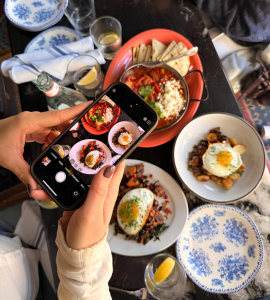
Every meal at a restaurant begins the same way. The waiter sets the plate down with a flourish. You ready your cutlery, lay your napkin on your lap, and reach out to spoon the food onto your plate. Suddenly, there’s a flash, and then another, as your dining companion takes photo after photo for their Yelp or Tripadvisor review. The food grows cold. But the verdict? Already ready.
Reams have been written about food and travel influencers and reviewers; chefs, restaurateurs and hoteliers have freely bandied their opinions, online and off. A nuanced, well-thought-out judgement by a fully informed reviewer, they opine, is rare. On the other hand, critics of this critique believe that these online reviewers have a real role to play in a democratized media environment. On balance, social media is a force for the better, they believe.
in.pinterest.com
Does the same hold true for platforms such as Yelp and TripAdvisor? These are platforms built from the ground up on mass public opinion; their entire operation is premised on the fact that the aggregated public has a voice that is more useful than any lone one, including that of a trained, paid critic.
But even they don’t seem to trust every opinion. TripAdvisor regularly weeds out nearly 10 per cent of the reviews on its own website, citing paid placements, reputation manipulation, and reviews with no firsthand basis as the cause. Yelp operates in largely the same way, elbowing reviewers away from fraud and coerced opinions by suppressing reviews that the site believes do not come from an actual visit, to the point of splitting opinions into ‘recommended’ and ‘not recommended’ sections
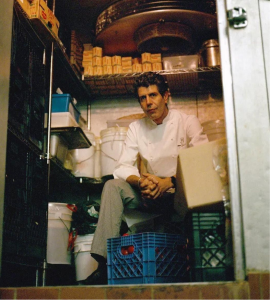
Quite famously, Anthony Bourdain, opined that the Yelp Elite reviewer was the lowest creature, the most loathsome of all. “There’s really no worse, or lower human being than an elite Yelper,” he said. “They’re universally loathed by chefs everywhere. They are the very picture of entitled, negative energy. They’re bad for chefs, they’re bad for restaurants. You know, you open a restaurant, you struggle for a year to put together the money, you work your heart out, and then 10 minutes after opening, some miserable b-stard is tweeting or Yelping, ‘Worst. Dinner. Ever.’
It’s like, dude. That ain’t right. Nah, no sympathy there. And I think you’d have a very hard time finding a chef who has anything nice to say about elite Yelpers. It’s a contradiction of terms. It’s like jumbo shrimp. How can you be elite and a Yelper?”
On the other hand, he believed Instagram and Twitter to largely be a force of good, a “fully democratic bathroom wall” on which reviewers etched their points of view, and viewers were welcome to believe or reject them.
Whether Yelp agreed with this devastating critique or not (they didn’t) wasn’t the point. The point is that democratization might not always be the answer – bad ratings on Yelp can impact revenues, not necessarily of fancy restaurants or big chains, but certainly that of the lone neighborhood mom-and-pop eatery.
Anthony Bourdain set off a torrid discourse about Elite Yelp reviewers | in.pinterest.com
And this age-old kerfuffle stems from a bigger question. That is, who holds the right to judge someone else’s work?
Is might not always right? Is the collective voice not better than that of the individual? Who then, is a reliable reviewer? Should the onus lie only on the trained critic, sipping expensive wine in rarefied restaurants? Shouldn’t every voice carry an equal weight? Multiple reviews simply meant a platform (or influencer) had tremendous reach; it didn’t necessarily mean that the critique was right. All opinions therefore, were not equally valid, unless they were trained opinions. While the platforms weed out undesirable critiques, perhaps the solution is to credential each reviewer so readers can assume some context behind each review. The judge can therefore be judged.
This doesn’t mean the crowd-sourced reviews are worthless. Word of mouth still holds tremendous weight in the hospitality industry, and certainly far more than that of any elite restaurant critic. This is the power of the public in its purest form. But it’s equally important to remember that volume doesn’t immediately equal authority. Sometimes, volume is just volume.
For those who live for the love of books, bookshops end up becoming much more a retail space. The longer the legacy, the more they serve as repositories of memory, conversations, and culture. These are spaces in which generations of readers have stumbled upon new ideas, entered unfamiliar worlds, and found refuge in the companionship of books or people who are regular customers. Across India, a few such bookstores have transformed into cultural landmarks in their own right.
A few have stood firmly in the same spot for decades, witnessing monumental changes such as the country’s independence, or changing reading habits, and the rise of digital commerce. Others have reinvented the traditional bookstore by transforming themselves into community spaces that host literary festivals, author interactions, and public discussions.
From the chilly hills of Darjeeling to the busy streets of Mumbai, these bookstores reflect the literary character of the cities that they are found in. Whether they specialize in rare academic texts, second-hand treasures, or beautifully curated contemporary titles, each offers a distinct experience. Here are five iconic bookshops across India that deserve a place on every reader’s travel itinerary.
Photo credit: Avijit Chakraborty
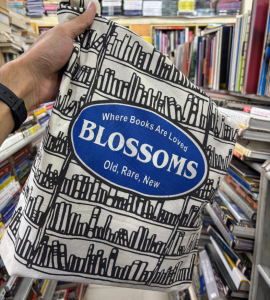
Blossoms Book House, Bengaluru
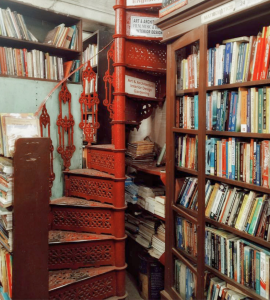
Located on Church Street in Bengaluru, Blossoms Book House is a paradisiacal venue for readers who believe that every book deserves a second chance at life. The first iteration of Blossoms was born in 2002 in a small 200 sq ft space in Brigade Garden, with a humble collection of second-hand books. In a span of two years, it had amassed a collection large enough along with a matching revenue to occupy a space twice the area in Brigade Garden itself. This was the brainchild of Mayi Gowda.
The multi-storeyed bookstore, as it stands today, is famous for its vast collection of new and pre-owned books spanning almost every topic under the sun. Towering shelves packed tightly together create an atmosphere of delightful chaos, encouraging visitors to lose themselves for hours in search of unexpected treasures. One of Blossoms’ defining features is its buyback programme, which allows readers to sell books back to the store after reading them. This approach has enabled the bookstore to build one of India’s largest collections of second-hand books while making reading more affordable for students and avid readers alike.
The bookstore has become such a cultural landmark that Bengaluru-based production house, Last Bench Studio produced a four-part documentary film exploring its significance within Bengaluru’s literary landscape. Their work succeeds in capturing not just the immense scale of the collection but also the emotional relationship many readers share with the store.
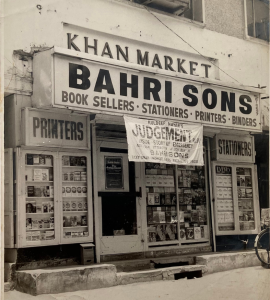
Bahrisons Booksellers, New Delhi
Few independent bookstores have shaped Delhi’s literary culture as profoundly as Bahrisons Booksellers. Founded in 1953 by Balraj Bahri Malhotra in Khan Market, the bookstore quickly established itself as one of the capital’s most sought after destinations for serious readers. Behind the establishment lay a story of resilience and resettlement, as the proprietor of the shop had been forced to relocate from the newly-created state of Pakistan to India during partition. The story of the bookshop can be found in a volume titled ‘Bahrisons: Chronicles of a Bookshop’ written by the oral historian Aanchal Malhotra and her father, Anuj Bahri.
New Delhi’s upscale Khan Market was much smaller and more modest back in the day. Bahrisons, over the decades, built a reputation for thoughtful curation, stocking an extensive range of literature, history, politics, philosophy, biography, and international fiction alongside contemporary Indian writing.
The bookstore has long attracted academics, diplomats, journalists, writers, and students, making it an informal meeting place for the city’s intellectual circles. Recently, the Chandigarh branch of the store became a backdrop for Imtiaz Ali’s partition drama, Main Vaapas Aunga, where Nirvair Grewal (Diljeet Dosanjh) is seen going to Bahrison’s to learn more about the history of his own family. Aashna Malhotra, who’s a third generation bookseller at the shop says that it’s quite significant that Nirvair would choose to go to Bahrisons to learn more about the Partition given the history of the bookshop itself!
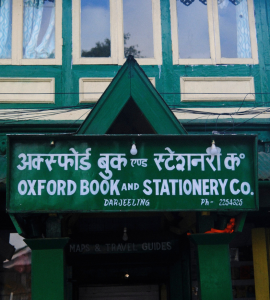
Oxford Bookstore & Stationery Co., Darjeeling
Standing along Darjeeling’s famous Mall Road, Oxford Bookstore & Stationery Co. is among the hill town’s most beloved institutions. The façade of the shop is painted dark green, like the other shops that stand beside it. Above the bookstore, there’s a boutique hotel that goes by the name of Chalet Hotel. Established during the colonial period, the bookstore’s collections include a plethora of works on mountaineering, Buddhism, Himalayan ecology, Nepali literature, and the colonial history of Darjeeling. That makes it an invaluable stop for anyone seeking to understand the region if one has to go beyond the tea gardens and breathtaking views of the hills. It is here that tourists often discover rare local publications that are difficult to find elsewhere in India. The store itself feels like a time capsule, preserving the atmosphere of an earlier era when browsing was an unhurried activity. The shop also sells souvenirs and stationery items for those who are seeking them.
in.pinterest.com
Dasgupta and Co., Kolkata
Established in 1886, Dasgupta & Co. is one of India’s oldest surviving bookstores. It is also hard to choose one bookstore over others in the area, because this shop is located on the legendary College Street, which is home to one of the world’s largest second-hand book markets, and the flagship stores of generations of publishers who have shaped Bengali literary culture. The founder of the shop, Girish Chandra Dasgupta found that luck was on his side, when he managed to secure a shop opposite the Hindu college, paying a rent of Rs 5 per month. The Hindu College changed its name to Presidency University in the years to come, and College Street is generally considered to be a cerebral sweet-spot for it also is the area in which many of the country’s first educational institutions were established.
Historically renowned for academic publishing and educational books, the bookstore has supplied textbooks, scholarly works, dictionaries, and reference materials to countless students attending nearby institutions. In 2023, it was accorded a Grade II Heritage Status by the Kolkata Municipal Corporation, and also turned a part of its premise into a free library.
Kitab Khana, Mumbai
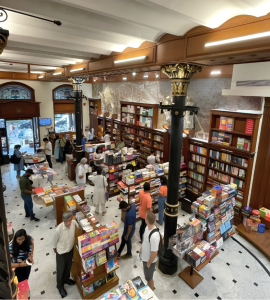
Located on the ground floor of a restored nineteenth-century heritage building named Somaiya Bhavan in Mumbai’s Fort district, Kitab Khana holds space for both literary culture and architectural heritage. Opened in 2010, the interiors of the shop are visually similar to Daunt’s Bookstore in Marylebone, London. The ceilings are high for it accommodates a second level of shelves on a balcony. One finds polished wooden interiors, and an abundance of natural light coming in through the doors in the front.
The collection at Kitab Khana ranges from Indian literature and translated works to art, architecture, photography, children’s books, and academic publishing. One also finds an impressive collection of works written in Marathi and Gujarati. The store’s location is also quite integral to its charm, as it is surrounded by some of Mumbai’s most historic institutions, making it an essential pitstop for anyone exploring the Fort precinct. Right outside the store, one can catch a glimpse of a newly restored Flora Fountain. Visitors could potentially plan a trip to Kitab Khana with nearby landmarks such as the Chhatrapati Shivaji Maharaj Vastu Sangrahalaya or the heritage buildings of Fort.
Beyond selling books, Kitab Khana has established itself as one of Mumbai’s most active literary venues. Its calendar regularly features book launches, author conversations, poetry readings, storytelling sessions, and panel discussions that bring together writers and readers from across the country.
Just before August 2026 arrived, one of India’s most popular home-grown café franchises, Cafe Coffee Day, dropped hints about going purple. On their social media handle, they shared pictures of purple coconuts, zebras, jalebis and even traffic lights! A big colorful addition to their menu cards—but before purple, the urban centres of India have already undergone a green wave, with people becoming eager to find the best cup of matcha in town. Matcha had the internet divided last year, and we might even consider it to be the predecessor to the purple colored substance that might soon be taking over Indian cafés– ube.
So what is the new purple culinary craze that the country might just be waking up to?
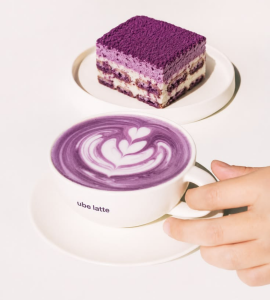
Ube, or the purple yam, has been a staple ingredient in Filipino cuisine as it is native to the Philippines. Its rich violet pigment lends its colors to a large number of dishes, but its inclusion in dessert recipes of various kinds is what made it start traveling the world. With its harvest season in spring, food stores across North America and Europe offer ube-based drinks as a seasonal feature over the spring and summer seasons, much like pumpkin-spiced drinks are popular during fall. Pumpkin-spice might not become a trend in India owing to its tropical climate and the notable absence of an autumn, but ube is certainly more versatile.
in.pinterest.com
For the last few years, the largest Starbucks Reserve store in Chicago has been offering drinks that are topped with ube-flavored cold foams during the summers. Other popular chains like Costa, Pret, and Black Sheep Coffee also have ube on their menu. In India, the coffee franchise from Greece, Coffee Island which launched multiple stores across the country last year, introduced ube to their drinks. In Kolkata, Scarlet Café has started offering Ube milkshakes, and iced coffees with ube flavors. In Hyderabad, outlets such as Big Star Cafe and Bagel Brigade have been catching up with the trend. Turns out, the color of the drink itself goes a long way in catching the attention of the consumer.
Looking at North America, another arena that might play a hand in the popularity of ube, are the Asian grocery stores — where ube flavored ice creams are a raging hit. Ube is used for flavoring mochi ice creams, and many brands — including Trader Joe’s — offer a version of the sweet but earthy flavored, purple ube ice cream. A popular and earlier version of an Ube dessert served on the streets of Manila, is called sorbetes, which is made by combining purple yams, and the milk sourced from carabaos, a species of water buffaloes indigenous to the Philippines. The other classic dessert is called the ube halaya — which is a creamy yam-based jam. While many ube-flavored edibles are sold as packaged products, it is also sold as a fresh ingredient in local stores run by migrants.
“
Its rich violet pigment lends its colors to a large number of dishes, but its inclusion in dessert recipes of various kinds is what made it start traveling the world.
”
A preliminary round of research suggests that Indians are no strangers to the growth of these tubers. Locally, they go by different names: ratalu, kand, neeli kachalu or konfal, while scientifically they go by dioscorea alata. As many as eight years ago, a man from Thiruvananthapuram managed to harvest a bunch of purple yam that weighed 82 kilograms! The Malayalam name for the vegetable is mulkkizhangu, but it is now rarely cultivated in the state of Kerala, although its surrounding areas have a rich history of cultivating this plant. These yams have been used for cooking savory dishes, and other curries. They are typically used for making chaats, sabzis and also for making paranthas that use kand as a stuffing. However, it seems that its usefulness in desserts has remained uncharted territory.
Ube’s rise to popularity could be compared to the omnipresent nature of matcha based drinks in Indian cafés, but what it also meant for its country of origin, Japan. The rising demand for matcha led to a shortage of the supplies, with stores in Uji, the matcha capital of Japan witnessing massive footfalls, and shelves full of matcha powder tins being swept clean within minutes of shops opening their doors to customers in the morning. Noticing a sustained interest in this green-tea powder, the Indian state of Assam took the initiative of growing matcha in their own backyard, as Japan has been struggling to keep pace with soaring global demand for matcha.
in.pinterest.com
While the demand for ube is on the rise, there seems to be a problem with the supply chains in the Philippines too. In 2025, nearly 1.7 million kilograms of ube products were exported globally by the country, and nearly half of that amount was received by the United States of America alone. This has put a strain on the country’s agricultural landscape, as the amount of purple yams grown in the country has dropped from 15 million kilograms to 14 million, in a span of five years, according to the New York Times.
In recent years, other countries in the region, such as China and Vietnam, have decided to consolidate their efforts to ramp up the growth of purple yams on their soil. Given the fact that Assam has taken the initiative to grow matcha in India itself, what could possibly be stopping farmers in India from tapping into the production of purple yams, especially when many parts of the country provide conditions that are conducive to their growth? To see it take on shapes and forms that have been in the making in other parts of the world? The 21st century has largely projected to be the Asian century, with Asian influences overtaking the world. We have several reasons to believe that this projection is true—as we hop from one colorful global food trend to the next — all to be traced back to the culturally rich and diverse countries of Asia.
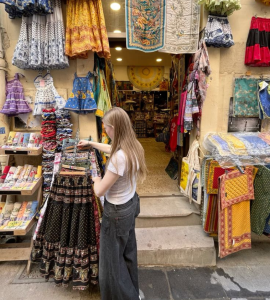
For decades, Indian fashion retail lived in separate worlds. There were market stalls, standalone neighborhood shops and local tailors, where prices were often negotiable. There was a scatter of indie, homegrown stores selling boho chic styles. Somewhat more recently, an explosion of malls has altered the country’s retail-scape.
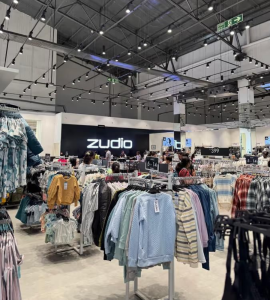
That’s changing though. Over the last decade, a wave of value-fashion retail has swept through Indian cities, offering affordable prices but with all the spit and polish of an upmarket shopping experience: shiny lights, glass-plated windows, air conditioning, constantly-renewing fresh stock, trendy garments, and a guarantee of quality. It’s now one of the fastest-growing corners of Indian consumer business, and it’s shifting not just what people wear, but where and why they choose to buy it. Budget brands like Trends and Zudio are now offering goods at the same price point as the bazaar, but with a vastly fancier shopping experience.
in.pinterest.com
Tata’s Zudio has become the market leader, selling 350 million garments last year alone, with a ceiling price of ₹999 on anything in the store. Reliance, through Isha Ambani’s Reliance Trends and its broader Reliance Retail arm, is pushing just as hard, alongside Dubai-based Landmark Group’s Max Fashion. Vishaal Mega Mart and Tata’s upmarket chain Westside round out the value end, while platforms like Meesho, Flipkart, Nykaa Fashion’s Likha label, and homegrown ethnic-wear players such as Indya are chasing the same mid-income shopper online.
The change has been immense and rapid. Zudio ballooned from seven stores in 2018 to 765 in 2025. Meanwhile, in the same time period, Westside merely doubled its store count.
Clearly then, purchasing power has grown steadily over the past 25 years, and the shoppers who were previously priced out of branded fashion, are now a crucial market. They are aspirational customers, yet value-conscious; and they’ve simply transferred their wallets from the local mom-and-pop shop to posh-looking stores.
Fashion, for a growing number of young, aspirational shoppers, has become closer to routine grocery shopping — pick up a few trendy pieces on impulse because the low cost and easy returns remove the anxiety of buying wrong.
Research done by Deloitte India also gestures to something else. Around 30 percent of people who were polled said that the in-store experience drew them to the offline shopping space. This isn’t just about the ambience (although that was a factor) but also logistics i.e. the availability of a proper fitting room. Therein lies the appeal of stores like Zudio: it isn’t just about the price, it’s equally about how the stores and their sales staff make the shopper feel.
Another driver? The rapid turnover of inventory, the very marker of fast fashion, that is urging customers to the store every few weeks.
Perhaps the biggest shift comes to us via Tier-II and Tier-III cities. Rising disposable incomes, expanding highway infrastructure, and greater digital connectivity are encouraging brands to open stores along regional transport corridors rather than fight for expensive real estate in metros such as Mumbai.
in.pinterest.com
But who will pay the bill for this flood of convenience and affordability?
The mom-and-pop neighborhood stores of course, whose custom is dwindling. Even stores such as Pantaloons, Max, and Lifestyle (the middle tier of organized retail) are being squeezed. And as is the way of all fast fashion, the environmental toll is immense. India’s textile sector is now the third-largest contributor to the country’s dry municipal solid waste, trailing only plastics and paper, with barely a quarter of that waste getting recycled. While some brands are folding sustainability into their supply chains, large-scale change remains a distant prospect.
For now, though, style and savings are winning out over sustainability — especially in India’s smaller towns, where much of the country is only just climbing onto the fast-fashion bandwagon.
For generations in India, a full-figured person was automatically perceived as someone with privilege, someone who could afford to eat well. Curves were ‘in’, while being thin signaled that you didn’t have enough.
Cut to contemporary India, where that perception is shifting.
Recent National Family Health Survey numbers tell us that one in sixteen Indian women, and one in twenty-five men is obese. A quarter of young Indian women and just over a fifth of young men, now weigh more than what is considered a normal range. The trend line, across five rounds of the survey since 1992, points steadily upward.
www.pexels.com
From an Indian perspective, this makes eminent sense; as certain sections of society grow wealthier, their weight correspondingly rises. The oddness comes when you compare India to Western countries. In many other countries, the data reveals that the more money a household has, the fitter its members tend to be. This is consistently true in the United States, Britain, Germany, and wealthier parts of Asia such as South Korea. But when economists have split that data by gender, an odd asymmetry shows up. Wealthy women are reliably thinner than poor women. Wealthy men, though, are not much different from poor men — plenty of both are overweight. The conventional explanation is that in rich countries, heaviness has become, in effect, a marker of scarcity: too little money for good food, too little time for the gym, too little flexibility in a low-wage schedule to plan meals or exercise.
Swelling incomes in urban India increasingly equal greater convenience: the ability to buy a car, using a delivery app instead of stepping to the neighborhood corner store, a fridge stocked with rich, heavy food, and access to multiple household staff. In the country, therefore, having purchasing power equals the power of not having to move.
This greater convenience is paired with the transformation of the urban Indian diet, where traditional home-cooked meals are giving way to colas and burgers thanks to burgeoning fast food chains.
Meanwhile, the culture that surrounds the body has been rewriting itself just as quickly. That old grammar, in which plumpness read as good fortune, is being overwritten by a newer one, imported largely through globalization, in which fitness has become the visible proof of means — visible proof that a person has the time and money to stay in shape. Ultra wealthy people such as Yash Birla and Ramona Narang now show off their muscles and their fitness regimes, on Instagram. Indian films, once happy to cast healthier-figured actresses, now cast very slim actresses and hyper muscular men.
in.pinterest.com
That inversion of meaning reveals something. In a wealthier country, where a larger majority of citizens are affluent, thinness has become embedded as a cultural marker of privilege, since it is achieved through gyms, trainers, and carefully curated diets that only money and leisure can buy.
In India, affluence is newer, and for the moment it is expressing itself as the opposite: not the discipline to eat less, but the freedom, finally, to eat more, and to eat in the effortless, sedentary Western style that convenience has made possible before the cultural backlash to it has fully arrived. The rich world’s thinness gap and India’s weight gap may turn out to be two chapters of the same story, simply read at different points in time — one where a population has already absorbed the anxieties of plenty, and one that is still, for the first time, getting used to having enough.
None of this is necessarily a matter of individual willpower. It is the result of infrastructure, food, work and culture changing faster than our bodies can adapt—a transformation that is playing out across entire nations.
There was a time when visiting Indian museums was a drag.
Many were dimly lit. The signboards were barely legible, and even the most basic presentation of art or antiquities wasn’t cohesive. The complaint was that India never had a proper museum-going culture. But were the museums worth going to?
“The big challenge was not just to draw people in, but also engage them so they come again and bring friends along,” says Sabyasachi Mukherjee, director of Mumbai’s Chhatrapati Shivaji Maharaj Vastu Sangrahalaya (CSMVS), formerly the Prince of Wales Museum. After all, cultural spaces need large numbers of visitors for their survival and to assert their cultural significance.
in.pinterest.com
For years, museums tried to make themselves more accessible.
A decade ago, as digital technology grew more affordable, they began introducing interactive elements. CSMVS was one of the pioneers. In the early 2000s, viewers could read more about an artwork, or even zoom in to see an object’s details on digital kiosks. Some stations offered quizzes and simple games.
But it wasn’t enough. They still had students and rural tourists coming in, but the urban locals stayed away, buying expensive tickets to visit museums and exhibitions abroad, but not in their own cities.
The big change came about five years ago. The Van Gogh 360° exhibition traveled across cities. People complained that the digital presentation was not at par with a similar show abroad; nevertheless, they still queued up for it. People were hungry for such experiences, and happy to pay the (relatively high) price of the ticket. Art spaces took note.
The pandemic accelerated the shift. Covid-19 made even the old-schoolers realize that it was time to engage and interact with audiences to help draw in the crowds and, importantly, to gain repeat viewers. Equally significant, museums had to give the digital generation something that was Gram-worthy and had a gripping story. A static work on a wall would not cut it anymore.
“
As the corporations and collectors behind these places vied to establish a social legacy, art programs became more dynamic, immersive, interactive and interesting.
”
Digital technology and social media changed museum and gallery programming, but so did the influx of several private museums designed as immersive spaces. They opened with giant screens, 360-degree projections, online archives and art lessons. As the corporations and collectors behind these places vied to establish a social legacy, art programs became more dynamic, immersive, interactive and interesting. The private spaces pushed more, perhaps thanks to better funding and more autonomy.
The Museum of Art & Photography (MAP) in Bengaluru and Goa’s Serendipity Arts Festival floated the idea of art dates. Art is an easy conversation starter, after all. The Kiran Nadar Museum of Art (KNMA) also has a special ‘dine-in with your favourite work of art’ feature on its roster. Its weekend music gigs — pop, rock, indie, fusion — are big hits with Gen-Z.
Just last month, Nature Morte hosted an ‘Artcade Night’. A game designer created games that complemented the Dear Tiger exhibition by contemporary artist Zimbiri. It was sold out in a couple of days.
On the other end is Sarmaya. They invite Arabic calligraphers and coin collectors to hold workshops and talks. They also have ‘networking over art’ events.
These spaces are also building communities of like-minded people, of all those who turn up every week for Art Night Thursdays in Mumbai or Defence Colony art evenings in Delhi.
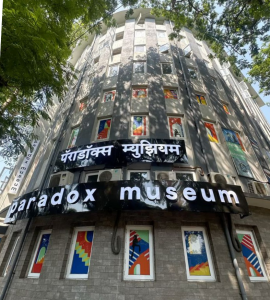
Mumbai’s Paradox Museum provides a deeply immersive experience. | in.pinterest.com
And this may be the biggest change. Museums and galleries are no longer simply places to look at things. They are becoming places to meet people, learn something new, spend an evening, discover a new artist or simply have a conversation. Art is becoming part of a social life.
It took India some time, but we finally understood that heritage isn’t just preservation; it’s participation.
Because when people participate in heritage and art, they appreciate its value, which, in turn, promotes its upkeep and builds a robust infrastructure. A museum needs more than a collection. It needs an audience that cares about the collection.
We finally have well-lit displays, legible labels and, perhaps most importantly, the beginnings of a museum-going, gallery-hopping culture. The museum is no longer somewhere you have to go. It is somewhere you might actually want to.