

For generations, astrology in India has shaped the calendar of ordinary life. Naming ceremonies, business launches, and wedding dates all run, at least in part, through the positions of planets. For many people, astrology is less a fringe belief than an ordinary part of everyday life, shaping decisions both large and small.
It is also evolving. What is changing is the culture built around it, and who is doing the building.
Scroll through Instagram on any given day and you will find a kundli meme sitting three posts above a tarot reading, which sits two posts above a skincare tutorial. Young Indians living in cities are exchanging screenshots of birth charts the way an earlier generation passed around personality tests. They joke about being emotionally unavailable because of their rising sign and, in the same breath, consult an astrologer before signing a lease. The irony and the sincerity coexist without much friction, which is itself telling.
The more interesting question is not whether people believe in astrology. It is what they are using it for.
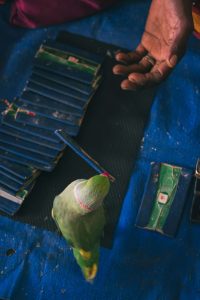
India’s relationship with the stars goes back further than any single tradition can claim. Vedic astrology, or Jyotish, is one of the oldest continuously practiced systems of astrology in the world and remains deeply influential today. Bejan Daruwalla, a former English professor, helped bring horoscopes into the Indian mainstream through widely syndicated newspaper columns that drew on Vedic astrology, tarot, numerology, palmistry, and the I Ching. Astrology’s place in Indian public life did not begin with Instagram. What Instagram changed was the form it takes and who gets to participate in it, just as it has for so many other things.
Ayushi Sahni began practicing as a healer full time in 2022. Based in Delhi, she works with clients across what she describes as the gap between spiritual and mental health services, two domains that, in her experience, often lead people to ask similar questions. “In both cases, people reach out when they are going through something difficult,” she says. “Spiritual tools can offer meaning, but they can also provide psychological support.” She is careful to add that, as with therapy, people should seek qualified and certified practitioners.
For Kriti S., a 35-year-old entrepreneur, tarot has been part of the picture since her teenage years, though the way she uses it has changed. “I consult my healer before most major decisions now,” she says. “Sometimes, if I have a bad feeling, I’ll even ask about something as simple as booking a flight. It helps soothe my anxiety.”
She postponed the launch of a business after her healer advised that the timing was unfavorable. A month later, the pandemic began. “Whether by coincidence or intuition, that experience deepened my trust,” she says.
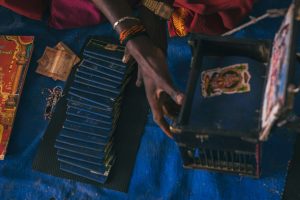
Dimpy Ahuja, a banker in Gurgaon, takes a lighter approach. She uses AstroTalk when she is feeling uncertain about something. “Sometimes I agree with what I hear and sometimes I don’t,” she says. “But I like having the option of putting my worries out there. When I’m indecisive, it feels like I have a cosmic ear to turn to.”
That phrase, a cosmic ear, may be the clearest description of what contemporary astrology offers. It does not promise certainty. It offers a place to put uncertainty.
To understand why this particular moment has been so receptive to astrology, it helps to understand what has changed in the past decade. India has the world’s largest population of Gen Z and millennials by raw numbers, many of whom came of age amid economic uncertainty, the pandemic, rapid urbanization, and an always-on media environment. Psychologists and cultural theorists have long observed that people gravitate toward systems of meaning during periods of instability. Astrology is unusually flexible. It can function as entertainment, ritual, sincere belief, or ironic shorthand, sometimes all at once.
The digital transformation accelerated all of this. Apps like AstroTalk made it possible to consult an astrologer at midnight, in private, for less than the cost of dinner. A study found that women account for 60 percent of digital astrology platform users in India, with 63 percent of female users falling between the ages of 18 and 30. The subjects they most often seek guidance on are relationships and major life decisions. The privacy these platforms offer may be just as important as the guidance itself.
The aesthetics shifted alongside access. Western birth chart discourse found an audience that was already fluent in kundlis and comfortable holding multiple frameworks at once. Rather than displacing Vedic astrology, the internet blended it with tarot, crystal healing, Human Design, and Western sun sign culture into something distinctly contemporary. Today it is not unusual to see references to Saturn return and Sade Sati appear in the same Instagram caption.
For some young Indians, these newer forms of astrology are not replacing older traditions so much as offering something those traditions were never designed to provide.
Uday, a marketing professional in Delhi whose name has been changed to protect his privacy, grew up in a family that consulted an astrologer regularly. As a queer person who had not yet come out, those sessions were often uncomfortable. “Whenever we visited our astrologer, conversations inevitably drifted toward marriage and children,” he says. “I wasn’t out to my family at the time, and those conversations added pressure to an already stressful situation.”
Working with independent healers gave him a space to discuss relationships and the future without those assumptions. “When I was thinking about getting serious with someone, or eventually coming out to my family, those conversations felt much easier to have,” he says. “I was a believer all along. I just needed a safe space to share.”
A 2025 Pew Research Center survey in the United States found that LGBTQ+ adults consult astrology at roughly twice the rate of the general population and are significantly more likely to use what they learn to inform actual decisions.
None of this exists outside the marketplace. The commercial layer of contemporary astrology is impossible to ignore. Manifestation journals, crystal sets, subscription readings, and algorithmically optimized content have become part of the ecosystem. The Indian astrology app market attracted virtually no institutional investment in 2015. By 2024, that figure had reached $50 million, and AstroTalk alone was valued at $300 million.
Reducing the phenomenon to branding, however, misses something important. Mercury retrograde has become shorthand for communication gone wrong. A Saturn return offers a way to talk about upheaval. A difficult transit can become permission to acknowledge that life feels difficult. Whether or not people believe those ideas literally, they have become part of a shared vocabulary.
Whether the stars have any bearing on what happens to us is almost beside the point. What they clearly offer many young Indians is a set of stories that helps make the present feel a little more navigable, without demanding certainty about the future.



Leave a Reply