Blog

  • The Rise of Sober Curiosity in Urban India

    For much of the past decade, alcohol functioned as shorthand for social fluency in cities around the world. Rooftop lounges in Mumbai, weekend brunches in New York, and club nights in Madrid were as much about signalling ease as they were about what was in the glass. To drink was to belong. To refuse a round, even for personal reasons, often came with questions.

    That assumption is beginning to loosen, though not everywhere, and not in the same way. Among Gen Z, shifts in drinking habits and social rituals are becoming more visible. This change is not about wholesale teetotalism. It is about curiosity and choice.

    In recent years, a growing number of people globally have begun questioning their relationship with alcohol. Not by quitting outright, but by asking smaller, situational questions: Do I actually want a drink tonight? Do I need it to socialize? To unwind? To feel like I belong? This orientation has come to be known as sober curiosity, a loosely defined movement that encourages moderation, intentional drinking, or opting out altogether, without moralizing abstinence.

    In the United States and Europe, sober curiosity emerged largely as a response to excess. Youth drinking declined, wellness culture took hold, and the pandemic reshuffled ideas of productivity and self-care. Choosing not to drink became associated with control, mindfulness, and even moral clarity.
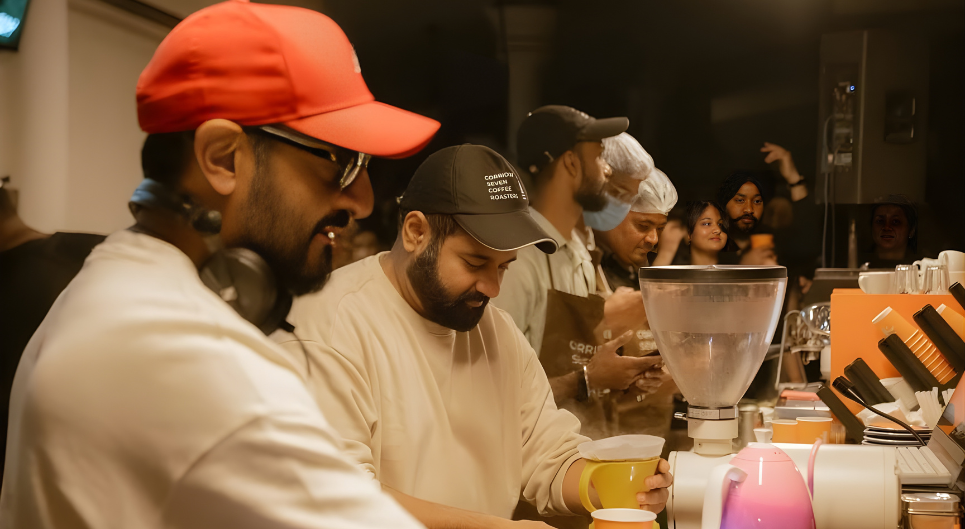
     

    A coffee rave underway at Corridor Seven Coffee Roasters in Nagpur | Image Credit: Mithilesh Vazalwar on Instagram


    India’s version looks different. For much of the past decade, alcohol in India’s major cities also functioned as a social shortcut, but under different conditions. Drinking was not just about taste or leisure. It was about urban fluency. To drink was to signal modernity and belonging in spaces that were already classed, gendered, and regulated.

    Now, across metros and increasingly in tier-2 cities, young professionals are opting out of alcohol situationally rather than ideologically. They are skipping rounds without apology, leaving earlier than expected, or choosing only daytime socializing. This is not prohibition, and it is not a backlash. It is conditional participation. Alcohol is no longer an automatic assumption for a social hang. 


    Across cities like Pune, Indore, Nagpur, and parts of Mumbai, early-morning 'coffee raves' are drawing crowds that once would have gathered at nightclubs.


    Globally, this behaviour fits under the banner of sober curiosity. In India, it arrives with complications. Unlike Western markets, where sobriety often signals restraint from abundance, India’s relationship with alcohol has always been uneven. Large sections of the population abstain for religious, cultural, or economic reasons. What is new is not sobriety itself, but who gets to frame it as personal choice. 

    In English-speaking, urban spaces, not drinking is more acceptable now. That shift is visible in the market. India’s non-alcoholic and zero-proof beverage industry, valued at roughly ₹1.37 lakh crore in 2023, is projected to cross ₹2.10 lakh crore by the end of the decade. Bars in Mumbai and Delhi now offer zero-proof cocktails priced like their alcoholic counterparts, complete with garnish, glassware, and ceremony. The point is not abstinence. It is equivalence. You can opt out without opting out socially.

    But the more revealing shift is not happening in bars. Across cities like Pune, Indore, Nagpur, and parts of Mumbai, early-morning ‘coffee raves’ are drawing crowds that once would have gathered at nightclubs. Loud music, packed dance floors, caffeine instead of alcohol, and an exit time before noon. Similar sober daytime parties exist in New York or London, but in India their appeal is structural. They replace nightlife rather than supplement it. They fit around long workdays, shared housing, family expectations, and cost. 

    This is where India diverges sharply from Western sober-curious narratives. The appeal is not only wellness or mindfulness. It is also efficiency. Alcohol costs time. Hangovers interfere with already compressed schedules. Late nights disrupt routines in cities where commutes are long, private space is scarce, and burnout is ordinary. In this context, sobriety reads less as self-denial and more as control. Not drinking is not about virtue. It is about being functional.

     

    A bottle of Pomegranate Kombucha | Image Credit: Shannon Nickerson on Unsplash


    Choosing not to drink is celebrated when it appears intentional. It is far less visible when abstention is expected or imposed. Women in India have long navigated sobriety without praise. Working-class abstention has rarely been framed as lifestyle. The current moment becomes visible largely because a certain class or caste can afford to turn moderation into identity.

    That tension is what makes India’s sober curiosity worth paying attention to. This is not a wholesale rejection of drinking culture. Alcohol remains central to many social scenes. What is changing is the default. Refusal no longer requires justification everywhere. Social life is slowly learning to accommodate absence.

    It reflects a change in how people gather, celebrate, and belong. In a culture where participation has long demanded conformity, opting out without disappearing is a meaningful shift.


  • The Serial Connection: Why African Audiences Can’t Get Enough of Indian TV Melodrama

    On weekday evenings in Lagos, Dar es Salaam, and Nairobi, living rooms flicker to life with the faces of Indian television stars. Not Bollywood blockbusters or slick Netflix thrillers, but family sagas, slow-burn betrayals, and long-lost twins reunited after years of presumed death. Shows like Kyunki Saas Bhi Kabhi Bahu Thi, Jodha Akbar, and Kumkum Bhagya are being watched and deeply felt across Africa. Dubbing them into Swahili, Hausa, or Amharic makes them legible, but it also makes them intimate. Characters speak in familiar rhythms, kinship terms translate cleanly, and emotional beats land without the friction of subtitles.

    Indian soap operas, with their high-drama arcs and intergenerational moral tensions, have found fertile ground across African markets for over two decades. The connection is as much about language or geography as it is emotion. Where Western programming often values irony, detachment, or realism, Indian serials offer something else entirely. It offers its own kind of sincerity. Grand declarations of love, devotion to family, and a clearly marked moral universe in which tradition wrestles with modernity (and usually wins). It is a recognition of shared social rhythms, an affection for the dramatic, and an understanding of generational duty that travels easily across continents. What once felt like a quiet, enduring exchange is now entering a new phase, defined by scale, localisation, and co-creation.


    A still from Iss Pyar Ko Kya Naam Doon or Strange Love


    For many African viewers, this familiarity runs deep. Research on audiences in Ghana has found that Indian films and television have remained popular for decades, in part because of their emphasis on family, morality, and emotional intensity, themes that closely align with local storytelling traditions. Scholarly work on media circulation in West Africa similarly notes that Indian film and television cultures have long been embedded in everyday life, from music and performance to communal viewing practices, often reinterpreted through local contexts rather than consumed as foreign imports. This cultural proximity is visible in everyday ways too, with Indian television actors occasionally engaging audiences in local languages like Twi, reflecting how deeply these shows have entered public life.

    For many viewers, these stories feel deeply familiar, with characters often compared to figures within their own extended families, and conflicts echoing everyday domestic life. But how did we get here? The pipeline was first laid by satellite television in the early 2000s, with networks like Zee World and StarTimes curating dubbed Indian serials for African audiences. What began as an experiment became a mainstay. Today, Zee World broadcasts across dozens of African countries, with Indian serials frequently occupying prime-time slots. These syndicated imports have since evolved into a full-scale distribution system, with Indian networks operating across multiple markets and languages, embedding themselves deeply within local viewing ecosystems.

    Indian soap operas’ resonance has quietly built a new kind of cultural alliance. For a country often preoccupied with Western recognition, the impact in Africa offers a different model, one in which India is not a junior partner in a global entertainment order, but a storyteller with its own gravitational pull.


    <IMAGE>


    The pull can be powerful enough to shape life choices. Shiv, who grew up in Tanzania, told us, “My grandmother initially refused to move from India. She didn’t know the language, didn’t think she’d have a community, and just did not want to start over in her retirement.”

    “Then she learned her favourite serials would be on television there. She moved. Those shows became a bridge. They became a way to connect with strangers in grocery store lines and on park benches, a shared script that made a foreign city feel familiar to her.”

    The influence moves through audiences as much as it moves across screens. Across African markets, viewers engage with Indian television in ways that extend beyond viewing, reinterpreting characters, storylines, and cultural cues within local contexts. Online fan communities dissect plotlines, swapping predictions and reactions in real time. In places like Ghana, elements of Indian fashion and ceremony have begun to appear in urban weddings. Historical and academic research in places like Ghana shows that Indian media has long been absorbed into everyday cultural life, particularly through music, performance, and communal viewing practices.

    There are, of course, questions of context. Indian shows are deeply heteronormative, and often reinforce caste and class hierarchies. But in many African markets, these nuances translate differently, or are reframed entirely. What gets transmitted is the emotional architecture of duty, longing, family loyalty, and the weight of history. The viewers tend to adapt these values, not adopt them. So, they localise them and make them their own.


    QUOTE


    As streaming platforms take centre stage, the model is evolving. Shows like Anupamaa and Yeh Rishta Kya Kehlata Hai are now available online, extending their reach beyond traditional broadcast. But the shift has also changed its scope from just influence. In some cases, it has begun to move into direct adaptation. Pavitra Rishta, for instance, was set to be reworked with African broadcasters into a locally produced series featuring actors from Kenya, Ghana, and Nigeria, retaining its core storyline while translating it into new cultural contexts. Across the industry, this signals a shift from export to collaboration, where storytelling formats are no longer simply transmitted, but rebuilt.

    The world we live in is often fixated on the Emmys, Oscars, and Rotten Tomatoes scores. But the India–Africa soap opera connection is a reminder that influence does not always wear prestige. What we are seeing is a reinvention across markets. Sometimes it wears sindoor, cries in temple courtyards, and cuts to commercials just as the truth is about to be revealed. It is messy, emotional, and deeply effective. But more importantly, it shapes global taste, one slow zoom at a time.

  • The Rise of the Bandra Girl

    She’s walking her dog in Dior slides. Sipping iced matcha through a glass straw. She has Pilates at 7am and still makes it to Soho House by sunset. She doesn’t need a job. Her job is being herself, or at least a version of herself that fits neatly inside Instagram’s soft-focus universe. Or at least that’s what the memes suggest.

    In Mumbai, she’s the Bandra Girl. In New York, she’s the Brooklyn Girl. On the internet, she’s everywhere.

    The Bandra Girl began as a joke, a shorthand for a very specific kind of girl with a very specific kind of privilege in one of Mumbai’s most gentrifying neighbourhoods. But like most jokes the internet finds useful, she didn’t stay contained. She spread. The caricature softened, flattened, and then hardened into something else entirely.

    But that shift matters more than one thinks. Because the Bandra Girl is no longer just someone we laugh at. She’s someone we recognize, replicate, and sometimes even aspire to. A soft-lit fantasy of privileged urban womanhood that feels effortless and endlessly watchable.


    Why does she go viral? Why do we keep reproducing her in memes, reels, Pinterest boards, and lifestyle content? Why is there a Bandra Girl and a South Delhi Girl and a Brooklyn Girl, but no Nalasopara Girl, no Vikhroli Girl, no Bronx Girl?

    The answer has less to do with humour and more to do with how platforms reward familiarity.

    Algorithms are built to amplify what is instantly legible and widely palatable. The Bandra Girl fits that slot perfectly. She’s stylish but safe. Privileged but non-threatening. Posh, yet familiar enough to feel attainable. 

    Repetition does the rest. The more recognizable the archetype becomes, the more the algorithm rewards it. Familiarity turns into circulation, and circulation into desirability. Over time, what began as a stereotype acquires cultural authority.


    That’s what makes the Bandra Girl more than a punchline. She isn’t a real person, and she isn’t a villain. She’s a composite, shaped by repetition and reward.


    But like most internet aesthetics, this one is deeply rooted in classism.

    She can be a meme because she’s also a moodboard. Her minimalism, her matcha, her quiet (or very loud) luxury are all underwritten by money. The internet knows how to romanticize her because it already believes her life is worth romanticizing.

    You don’t see memes about the Nalasopara Girl because the internet doesn’t know how to aestheticize working-class femininity. It doesn’t know how to filter it into something aspirational. This is why the Bronx Girl aesthetic on TikTok is overtaken by the Brooklyn Girl look, even though both are real places, full of real women. One fits neatly into vintage lenses, curated mess, and algorithmic warmth. The other doesn’t fit that fantasy.

    Every global city produces its own version. The Shoreditch Girl. The Marais Girl. The South Delhi Girl. These figures aren’t real women so much as cultural shorthand. They help platforms learn what ‘cool’ looks like, what desire looks like, what a commodified version of womanhood should resemble.

    And when culture is built through curation, only certain lives survive the edit. The kind that looks good in natural light. The kind that can be parodied without discomfort. The kind that doesn’t ask for too much space.


    Image Credit: marrosassv on Instagram


    That’s what makes the Bandra Girl more than a punchline. She isn’t a real person, and she isn’t a villain. She’s a composite, shaped by repetition and reward.

    What began as a joke has acquired authority. Not because it’s the most accurate representation of urban life, but because it’s the easiest one for the internet to recognize, amplify, and sell.

    The Bandra Girl doesn’t reflect who we are. She reflects what platforms know how to see, what advertisers know how to package, and what culture has learned to reward.

    Everything else remains present.

    It just doesn’t make the edit.