

If you live in India, you’ve definitely spent a moment (or many) stuck behind a truck on the highway and you’ve likely noticed its vividly-colored back — hand-painted with instructions like “Horn OK Please” or “Use Dipper at Night”, often framed by floral vines, rising suns, peacocks, tigers, gods, or movie stars. Some trucks are adorned with beaded tassels dangling from side mirrors, fringed mud flaps, reflective stickers, even hand-scrawled poetry. It’s loud, layered, and alive.
This is truck art, one of India’s most under-celebrated forms of public folk expression. Truck art is not just paint on metal; it is identity, memory, pride, and protection — all in motion.
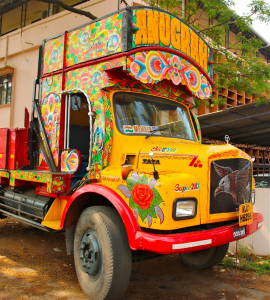
The tradition began to bloom in the mid-20th century. These trucks first drove onto Indian roads during World War II, pressed into service as military vehicles. Naturally, in the way of all military vehicles, they were drab camouflage-colored creations. But after the Second World War, these trucks were released to the public and refashioned for civilian purposes. Canny local artists immediately spotted an opportunity, transforming the trucks’ formidable look into the vibrant creations that we see today.
Today, many drivers and owners spend months on the road, far from home. Adorning their vehicles became a way to carry a piece of that home with them — a protective charm, a source of joy, even a declaration of identity. A driver might honour a deity for safe passage, or paint his children’s names on the bumper. Political slogans, shayari, religious symbols — all share space. The truck becomes a canvas, a shrine, a mobile memory-keeper.
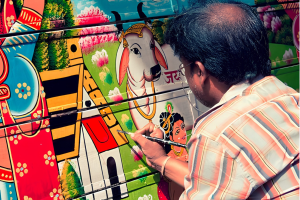
These artworks are typically crafted by self-taught artists working out of roadside studios near truck stands or dhabas. In places like Uttar Pradesh, Rajasthan, and Maharashtra, small communities of painters keep the tradition alive using enamel paints, stencils, and sheer muscle memory. The work is fast but detailed and often done overnight while the truck is parked, ready to hit the road again by morning.
Across the country, the art shifts with region and road. In Punjab and Rajasthan, you’ll see camels and similar desert motifs. In Bengal, lotuses and expressive eyes. In the South, mythological figures share space with cinema stars. In Maharashtra, floral borders and geometric symmetry abound. And nearly everywhere, you’ll see the iconic warning: “Buri Nazar Wale Tera Muh Kala” (“May the evil-eyed one be shamed.”)
It isn’t just visual. These trucks are multisensory: the jingle of mirror tassels, the scent of agarbatti from a dashboard altar, the glow of string lights flickering during nighttime drives.
But this folk art is fading. As fleets become corporatized and brand-conscious, hand-painted trucks are giving way to mass-produced decals that are easy to stick on. Uniformity is prized. Artistry is optional. And the roadside painters, once vital artisans, now struggle to find work.
Still, echoes remain. A lone peacock feather curling under a bumper. A faded ‘India is Great’ half-covered by a sponsor’s logo. These fragments remind us that art doesn’t need white walls or spotlights. Sometimes, it speeds past you on the highway — gritty, bright, and definitely alive.
To preserve truck art is to honour the creativity of the everyday — art born not in galleries, but in grease-streaked garages and under open skies. Art that reflects how people live, move, and believe.



Leave a Reply