

In today’s world of Uber Eats and algorithm-driven dining, the idea of a slow-cooked meal shared with strangers, feels quietly radical. Across Indian cities, a new kind of dinner table is emerging. And it’s not in a restaurant.
Imagine this. You ring the doorbell of a stranger’s home. The door opens. The dining table is full, the room warm with chatter and the occasional clang of serving spoons. You sit down with people you don’t know yet; a few faces you’ll forget, maybe one or two you won’t. The air is thick with the aroma of coconut-sluiced curries, fluffy Basmati rice, perhaps a drizzle of locally sourced olive oil over fresh salad greens. There’s no maître d’, no laminated menu, only a handwritten note at your place setting, telling you what you’re about to eat, and a host who treats you less like a customer and more like family.
This is the new face of fine dining in India. And yet, it feels remarkably familiar.
A Culture Remembered And Reimagined
While the world might call it a supper club, in India, the idea of communal dining isn’t new. From sprawling wedding daawats to community feasts where plates are shared and hierarchy dissolves, the act of breaking bread together has always held cultural weight. What’s changing today is the form: more curated, more intimate, more narratively driven. Supper clubs in India are experiences — and they’re quietly redefining what it means to dine well.
Globally, supper clubs have long been a rebuttal to the stiffness and formality of fine-dining restaurants — think Eleven98 in London, the Mumba Milano in Milan, The Gathering Table in New York or Roti Mami in Berlin — where strangers meet for a home-cooked meal and conversation. In India, the idea is finding fertile ground, not as a rebellion against fine dining, but as an evolution of it.
Today’s Indian supper clubs focus on intimacy over grandeur. They unfold in private, invite-only settings — a sunlit studio, a tucked-away terrace, a chef’s own apartment — often hosting no more than a dozen guests. The person welcoming you is also the one who cooked the meal — walking you through where each ingredient came from. Maybe it’s millets their grandmother made in Karnataka, or tomatoes grown in someone’s rooftop garden in Mumbai. There’s a story behind every bite.
The food is often hyper-local, seasonally driven, and deeply personal. It’s an extension of the larger global moment towards farm-to-table and slow food, but with Indian accents: indigenous grains, old community recipes, hyper-regional techniques. From Má Là Kitchen in Bengaluru (a Sichuan supper club) to The LOST Table in Gurgaon (run by husband-and-wife duo Natasha and Archit Agarwal), bring together excellent cooking with new social connections.
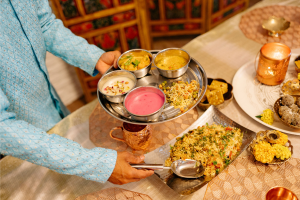
In Kolkata, Bengal Soiree is a community supper-club collective that brings people together for curated Bengali meals in intimate settings, offering a contemporary yet nostalgic take on the region’s rich culinary legacy.
A Cultural Continuum
At a deeper level, supper clubs tap into something inherently Indian: the act of hosting. And increasingly, that hospitality is rooted in the local. Across the country, there’s a growing pull toward ingredients grown nearby, recipes passed down through generations, and flavours tied to a single neighborhood or farm. Hosts and chefs are plucking basil leaves from their tiny balcony garden, painstakingly making their own ghee — like it’s always been done.
Because in many parts of India, food is more than what’s on the plate. It’s how you’re welcomed. Bohri Muslim families eat together from one big thaal, a gesture of kinship and communion. In the South, elaborate meals are served on banana leaves. Sikh gurdwaras have long embodied the spirit of community meals through the langar. And in Parsi homes, hospitality is almost theatrical: steaming curry and rice arrives with tangy onion kachumber, washed down with raspberry soda, and finished with a nut-studded baked custard.
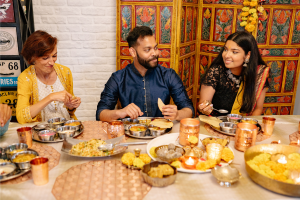
Supper clubs are simply reinterpreting these traditions for an urban, globally aware audience that craves connection as much as they crave flavor. In an era of Zomato and Swiggy, sitting down for a slow, home-cooked, shared meal feels radical. It feeds the human desire for stories, for slowness.
The Rise of the Hyper-Local Plate
In a globalized world, the new marker of sophistication isn’t internationalism — it’s specificity. Knowing which village your saffron came from, which grandmother perfected that chutney. Supper clubs allow for that kind of detail, that kind of intimacy. What they’re really offering isn’t just food — it’s belonging. A way to feel rooted in a world that often feels too fast, too polished, too transactional.
And clearly diners are craving more than just convenience. A 2024 Zomato survey found that nearly two-thirds of diners in cities like Delhi, Mumbai, and Bengaluru said they preferred ‘intimate, offline dining experiences’ over traditional restaurants or delivery apps. The Godrej Food Trends Report echoes this shift, predicting a rise in ‘intentional eating’ and ‘micro-community meals’ across Indian metros. But this doesn’t mean India’s love for convenience is fading — quite the opposite. The food delivery market is still booming, expected to double from $6.3 billion in 2023 to $13.5 billion by 2029. What’s changing is this: curated, offline meals and algorithmic convenience are no longer opposites. They’re coexisting — two sides of how we now want to eat.
Of course, there are downsides. Menus are not always affordable — a reflection of curation, but also a potential barrier to inclusivity.
Yet, in stepping into a stranger’s home, breaking bread together, and sharing stories over seasonal, soulful dishes, we’re participating in a tradition as old as India itself — one that reminds us that eating together has always been about more than just satisfying hunger. It’s about satiating the spirit.





Leave a Reply