If you had to visit Five Spice, a wildly popular chain of Chinese restaurants in Mumbai, you might be somewhat disconcerted to find the following items on the menu: Chile Crispy Potatoes, Red Hot Fish, Lamb in Burnt Chile Sauce, Pepper Blasted Fish and Dragon Chile Fried Rice. Similarly, at Mainland China, another popular Chinese restaurant chain, you’ll find Chile Cottage Cheese, Hot and Sour Soup and Crispy Corn Cubes.
In China, diners might lurch away in shock at such unrecognizable Chinese dishes. In India, they’re the true taste of Chinese cuisine. This is India’s most famous hyphenated cuisine – Indo-Chinese food – plucking flavors from both countries.
Honey Chile Potato – a beloved Indo-Chinese dish. / in.pinterest.com
Once Upon a Long Time Ago
To tell this story properly, we must scroll back hundreds of years ago. Amongst the biggest immigrant communities in colonial India were the Hakka and Cantonese Chinese – the earliest likely stepped foot in Kolkata in the late 1700s, and just a few decades later in Mumbai. These low-pitched, languidly flavored cuisines were India’s introduction to Chinese food; Kolkata’s first Chinese eatery opened in the 1850s, and Bombay followed in its wake just a few years after. Although the Chinese communities have slowly dwindled since, their food remains as a legacy.
“
But at the forefront of Indo-Chinese cooking stood Nelson Wang, culinary giant with Kolkata origins and once-proprietor of the Chinese restaurant at the Cricket Club of India.
”
The Birth of Indian Chinese
But it was only after Independence, in the 1960s, that the cabinet of curiosities, Indo-Chinese food, really grabbed center stage. Sino-Indian chefs, long settled in India and thus wise to local tastes, began to ease the unfamiliarity of their ‘home’ cuisines with the addition of Indian ingredients like ginger-garlic and Indian chiles. In Mumbai, this wave was possibly urged on by Camellia Panjabi, who introduced Sichuan cooking via the Golden Dragon, to the Taj Mahal Hotel in Mumbai. Inaccessible to most of the population, it nevertheless did its job in introducing the city to these vivid new flavors.
By the turn of the next decade, you were guaranteed a few standard dishes, no matter which Chinese restaurant you turned to – Sweet and Sour pork, Sweet Corn soup, Chopsuey, Garlic Chile Prawns and Chile Chicken. And there were already plenty – Nanking, Kamling, Mandarin, Flora, Ling’s Pavilion, to name just a handful.
But at the forefront of Indo-Chinese cooking stood Nelson Wang, culinary giant with Kolkata origins and once-proprietor of the Chinese restaurant at Mumbai’s Cricket Club of India. He is often credited as the ingenious inventor of Indian Manchurian cooking – drifts of deep-fried mixed vegetables or chicken or paneer, plunged into a glutinous soup of soy and chile and cornflour, and served steaming. If legend is to be believed, Wang tossed together boneless chicken in soy sauce and spice to sate the rumbling bellies of some diners who wanted something unique. (This origin story has since been disputed by other chefs, who believe he was simply reaching into the collective hive mind of the time.)
Chicken Manchurian is arguably India’s most famous Chinese dish. / in.pinterest.com
His most famous dish, the rumbustious Chicken Manchurian, got its lick of heat from garlic, ginger and green chiles. Other iterations are vegetarian i.e. paneer Manchurian and cauliflower Manchurian — all fugues on a single theme. Wang would soon become the zeitgeist. His restaurant, China Garden, hurtled onwards and upwards at a furious clip. His dishes cleaved to familiar Indian flavors while inflecting them with a touch of Chinese, authenticity be damned. The staff was elegantly attentive, the plating was contemporary, and the restaurant was modern and stylish as opposed to the fading Chinoiserie of earlier restaurants. Everyone from Goldie Hawn to Imran Khan thronged there.
China Garden’s unbelievable success shook loose a daisy chain of copies serving a bacchanal of desi Chinese classics, all equally flippant with authenticity. These included bite-sized pieces of cauliflower, paneer or chicken plopped into gravies such as the giddy orange Schezwan (not Sichuan!) sauce, the self-explanatory Sweet and Sour sauce, the Chile Garlic sauce and the Hot Garlic sauce. The heat was muted by drifts of steamed or fried hakka noodles or fried rice.
“
Perhaps the true sign of Indian-Chinese food’s acceptance is that, today, India is carpeted with vendors crisply dispensing all sorts of delicious concoctions.
”
On the Sidewalk
Perhaps the true sign of Indian-Chinese food’s acceptance is that, today, India is carpeted with vendors crisply dispensing all sorts of delicious concoctions (after all, it is on the streets that innovation often quickens).
Behold! The spring dosa, with noodles and stir-fried ‘Chinese’ vegetables stuffed in its crispy folds, served with the obligatory coconut chutney and sambhar. The Chinese bhel, a tousle of deep-fried noodles stained orange, then buttressed with stripes of carrot, spring onion, cabbage and peppers and slapped with a spicy sauce — perfect for a little crackle, a little chew. The famous Triple Schezwan, a palimpsestic dish of fried rice, noodles and Schezwan-sauced vegetables. Although it is beloved across Mumbai, filaments of Kolkata can be seen here too — after all, Schezwan sauce might have been invented in Kolkata by the Huang family, owners of Eau Chew restaurant.
Side by side, another phenomenon occurred: the Chinese restaurant business slipped out of the hands of the Chinese-Indian community. Today, Punjabis own a big chunk of Chinese restaurants, and more Nepalis are chefs at Chinese restaurants than Chinese.
Across the Oceans
Naturally, Indian-Chinese food has also sailed across the oceans. The influx began in the early 1960s, during the Indo-China War when relations between the two countries curdled and many innocent Indian Chinese fled to China, the UK, the USA, and Australia. Today, eateries such as Moghul Express in New Jersey, NYC, Dragon House in NSW, Australia (run by a Hakka Chinese family from India), and London’s Bombay Chow all serve the classics, Hakka noodles, Fish Manchurian, Chile Chicken et al, although, in a bid to appeal to Western tastes, some of them have gentled the Indian spice levels. And so the cuisine completes its transformation — irreverent and shape-shifting but delicious as ever.
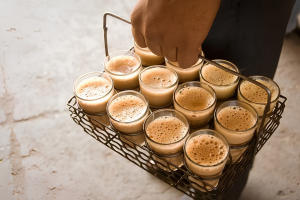
There is a particular kind of embarrassment that attaches to the chai stall in the Indian imagination. Not shame, exactly, but a sense that the stall belongs to a category of things that are real and indispensable and somehow not quite speakable in polite company. You stop there between appointments. You drink in a glass or a kullad, standing or squatting on a low stool, and you go. The exchange is quick by design, because nothing about the stall, no chair, no table, and no surface to rest a phone on, suggests you are welcome to occupy it longer than the tea takes to cool. People do linger, often. Politics gets argued there, gossip moves, a second round gets ordered. But the lingering happens despite the architecture, not because of it. Nobody designed the chai stall for your comfort. They designed it for your thirst.
India is often described as a tea culture. In one sense it plainly is. The country produces more tea than almost anywhere on earth, drinks it compulsively, and has built an entire informal economy around its distribution. The chai wallah at the railway platform, the office peon making rounds with a tray, and the gas burner going in the corner of every small shop are all a part of an infrastructure. But infrastructure is not the same as culture in the way the word gets used when people talk about coffeehouses. A culture implies a room. It implies you are allowed to stay.
America’s version of this story begins with an act of vandalism. In December 1773, colonists dressed as Mohawk people threw 342 chests of East India Company tea into Boston Harbour, making tea politically untenable almost overnight. John Adams, writing to his wife Abigail the following year, declared that tea “must be universally renounced” and that he had taken to drinking coffee every afternoon, bearing it, as he put it, “very well.” The tone of reluctant conversion is instructive. People did not suddenly prefer coffee. They decided, or were persuaded, that preferring it was the correct thing to do. Over the decade of the Revolution and through the Civil War, when Union supply lines made coffee far easier to distribute to soldiers than tea, the habit hardened into identity. By the time the war was over, coffee was simply what Americans drank.
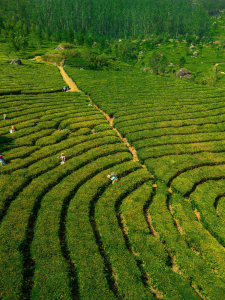
Aerial view of vibrant green tea plantations with workers in picturesque Munnar, India. / www.pexels.com
Coffee was no more native to America than tea was to India. It arrived through trade, became meaningful through politics, and was cemented by war and commerce. What made it American was accumulation, the stories told about it, the rooms built around it, and the version of the national self that became attached to the cup. The Boston Tea Party may not have made Americans love coffee, but it certainly made them decide that loving coffee was who they were.
What Americans then did with coffee is where the story gets interesting, because the drink itself was almost beside the point. The room it came with was the thing.
Sociologist Ray Oldenburg published a book in 1989 called The Great Good Place, in which he named what he called the “third place,” the informal social space that is neither home, which he called the first place, nor work, which he called the second. Third places are where democracy actually happens, where neighbors become neighbors rather than just people who share a street, where the social fabric gets woven in ordinary time. Coffeehouses qualify, and so do pubs, barbershops, and diners. What they share is accessibility, a tendency toward leveling rather than hierarchy, and conversation as the main activity.
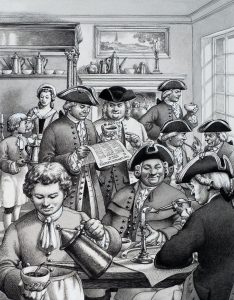
The coffeehouse had been doing this work long before Oldenburg named it. In seventeenth-century London, a penny bought you a cup of coffee and entry into a room where you could read the newspapers, conduct business, and argue about politics for as long as you liked. They were called “penny universities” because the information circulating inside them was otherwise unavailable to anyone without money or connections. The same model crossed the Atlantic and took root in the colonies, where the Green Dragon Tavern in Boston became known, without much irony, as the Headquarters of the Revolution.
16th cc English coffeehouse ( penny university) / in.pinterest.com
Tea generally occupied a different kind of social space. In England, tea came with a different set of social meanings, the drawing room and the fixed hour, the hostess and the tiered stand of sandwiches. It was domestic and feminized and, by all accounts, delicious, but it was not a space you could walk into off the street and stay until you had figured something out. In America, without even the drawing room tradition to fall back on, tea became a specialty, an occasion, a hotel amenity, something you ordered when you were under the weather or feeling wistful about somewhere else.
In India, meanwhile, tea was becoming something else entirely, and the mechanism of that transformation is fascinating precisely because it was not organic.
Tea cultivation in India began as a British colonial project in the 1820s and 1830s, when the East India Company identified Assam as a promising site for commercial tea cultivation and set about breaking China’s monopoly on global supply. For most of the nineteenth century, the tea being grown in India was being exported, largely to Britain. Domestic consumption remained limited for much of the nineteenth century. Across much of the subcontinent, people relied on a wide variety of regional drinks, including milk-based beverages, buttermilk, and water, while coffee had long-established traditions in the south that predated British arrival.
What changed this was advertising. The British-owned Indian Tea Association, anxious to create a domestic market for what was an enormous and growing supply, ran a campaign in the early twentieth century to introduce tea breaks into factories, textile mills, and mines. Chai wallahs were stationed at railway platforms. Tea was positioned not as a luxury but as a worker’s drink, cheap and energizing and available everywhere. The spices that transformed it into masala chai emerged through local adaptation, with vendors adding ingredients such as ginger, cardamom, cinnamon, and cloves according to regional taste.
in.pinterest.com
The result was a beverage that felt indigenous when it wasn’t, that felt ancient when it was barely a century old in its popular form, and that became genuinely social without ever quite becoming a salon. Chai, like coffee in America, accumulated its identity rather than inheriting it. Both drinks arrived from elsewhere, both got claimed as native, and both became social infrastructure. What they built with that infrastructure is where they diverged. America built rooms. India built a distribution network, and a very good one, but a network all the same.
The room finally arrived in India in 1996, and it did not serve chai.
Café Coffee Day opened its first outlet on Brigade Road in Bengaluru that year, founded by VG Siddhartha on coffee from his own estates, priced at twenty-five rupees a cup, with air conditioning and internet terminals and the implicit promise that you could sit there for two hours without anyone asking you to leave. It was aimed at a generation that had grown up watching liberalisation transform what Indian cities looked like and what they were for, and it succeeded almost immediately. Within two decades, CCD had more than 1,700 outlets across 243 cities. The tagline, “A lot can happen over coffee,” was less a description of the product than of the room. The coffee was incidental. What was being sold was the permission to occupy space without justification.
What Siddhartha understood, and what the chain’s early success confirmed, was that the third place India had never really built for chai, the room where you could stay without purpose, where time became social rather than productive, was a gap that a drink could fill only if the right architecture came with it. The drink signaled the room. The room was always the point.
This is the same logic, running in reverse, that explains what is now happening in America.
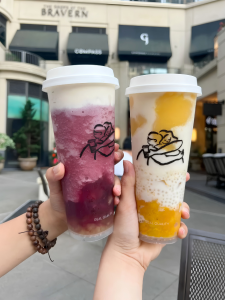
Heytea, which helped invent the premium milk tea category in China and now has roughly 4,000 stores there, opened three dozen American locations between 2023 and 2025, including a flagship in Times Square where lines have regularly stretched out the door for drinks topped with cheese foam. Chagee, another Chinese tea brand, listed on the Nasdaq in May 2025 and opened its first American stores in Los Angeles. Luckin Coffee, which has three outlets in China for every one Starbucks, opened several Manhattan locations. These companies are not coming to America because they believe Americans have been waiting for premium tea. They are coming because the Chinese food and beverage market has become, in the words of one industry investor, a condition of “severe oversupply,” with margins being ground down by a price war among hundreds of thousands of competing outlets. The United States offers better margins and room to breathe.
Heytea / in.pinterest.com
But the business rationale does not fully account for the cultural question, which is whether this wave of premium tea brands can do something that two hundred and fifty years of history have conspired to prevent, make tea a genuinely everyday social drink in America, not a niche or a novelty or an afternoon indulgence, but the thing you go somewhere specifically to drink with other people and you do it often, if not every day.
Tea enters a very different American market today than it did even a decade ago. Bubble tea, which originated in Taiwan in the 1980s and reached American cities through Asian immigrant communities before going mainstream with younger consumers in the 2010s, has done important preparatory work. It normalised the idea of paying café prices for a tea-based drink, of waiting in line for it, of treating it as an experience rather than a beverage. There are now more than 9,000 bubble tea shops in the United States, and surveys suggest that 94 percent of consumers in their twenties bought boba in a recent three-month period. That is not a niche. It is a category, and one that has already done the cultural labor of making tea something you seek out rather than something you settle for.
The Chinese chains arriving now are betting they can build on that foundation, offering something more refined, a drink you take seriously, and one that belongs to the same register as a pour-over or a natural wine. While Heytea brews loose-leaf tea rather than using powder or syrup, Chagee has positioned itself carefully as an “American-born Chinese” brand, hiring specifically for that cultural translation. Both understand, at least implicitly, that the drink alone will not be enough. You need the room.
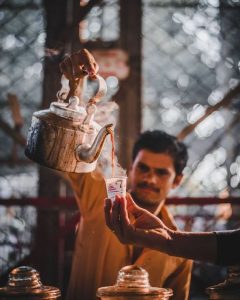
Chai tapri / in.pinterest.com
Its success will depend on something no amount of branding can manufacture, which is whether the third place these chains are trying to create feels like it belongs to the people inside it, or like a product being tested on them. Starbucks spent decades building that sense of belonging, and even then Oldenburg, who coined the term third place, declined when the company asked him to endorse their stores. The room, he seemed to be saying, has to mean something that cannot be franchised.
People adopt a drink when it comes attached to a world they want to inhabit, and they build that world when it represents a version of life they find worth performing. Coffee took root in America not because it tasted better than tea but because it became the drink of a certain kind of person, then a certain kind of citizen, then a certain kind of worker, and each time it shifted it brought the room with it. Chai became India’s drink because a colonial marketing apparatus decided it should be, and what Indians made of that imposition was something genuinely their own, warmth and community compressed into something fast, everything except the room.
What a café sells, whether it is CCD in Bengaluru in 1996 or Heytea in Times Square in 2024, is not the drink. It sells the hours inside it, the version of yourself you get to be while you’re sitting there, between the first place and the second, in the space that doesn’t ask you anything except what you’d like. The drink was never the point. It was always the excuse to build the room.
A Taylor Swift friendship bracelet costs almost nothing to make. A few inches of elastic and a handful of plastic beads, the kind of thing you might find in a school art room. It takes minutes to assemble and can be replaced for under a dollar. Yet, for thousands of fans, it becomes one of the most carefully kept objects they own, worn, traded, photographed, and preserved.
Its value has very little to do with the materials it is made from. It comes from what the bracelet represents, a concert, a community, a memory, or simply a relationship with an artist and her music. Once you notice that, you begin to see the same pattern elsewhere. People buy vinyl records they rarely play, carry tote bags advertising cafés they have already visited, hunt for limited-edition collectibles that spend their lives on shelves, and pay extra for special editions of books they already own in digital form.
The question is not why these objects exist. It is why they seem to matter more at a moment when so much of culture has become intangible.
The obvious explanation is identity. A cap or a tote or a tour hoodie is a social signal, a way of saying something about who you are and what you care about without saying it aloud. There is truth in this. Objects have always announced affiliation, university sweatshirts, football scarves, band T-shirts from the 1970s, none of this is new.
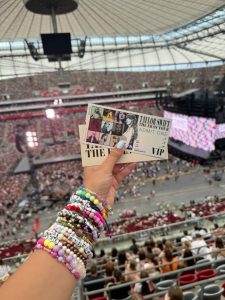
A Taylor Swift friendship bracelet / in.pinterest.com
What identity signalling does not explain is the timing. Merchandise has, in the last decade, escaped its traditional domains and become the default move for almost every kind of cultural producer, from stand-up comedians to independent coffee shops, from literary journals to software companies, from newsletters to museum gift shops that now account for a meaningful share of institutional revenue. People who already have access to the music are buying the vinyl. People who stream every episode are buying the cast’s branded candles. Something structural changed, and the identity argument, on its own, does not account for it.
To explain the timing, we have to start with what changed.
For most of the twentieth century, the relationship between culture and ownership was straightforward. If you wanted music, you bought it, a record, then a cassette, then a CD. If you wanted a film, you bought or rented it. If you wanted to read something, you bought the magazine or the book. Culture was scarce in a particular sense, access required a financial transaction that produced a physical object, and the object and the experience arrived together.
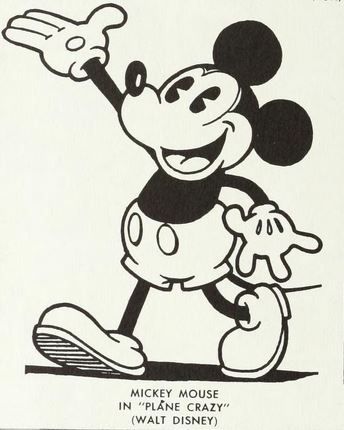
Merchandise existed alongside all of this, of course. Walt Disney began licensing Mickey Mouse’s image in 1929, and by the mid-1930s that licensing was generating hundreds of thousands of dollars annually. Rock bands have sold T-shirts since the 1970s. But merch operated at the edges of culture, an appendage to the main transaction. You bought the album, the T-shirt was optional.
Mickey Mouse (1929) / in.pinterest.com
Then, over roughly a decade beginning in the early 2010s, the relationship between culture and ownership began to reverse. Music moved to streaming, films and television moved to subscription services, journalism moved online and then into newsletters, video games shifted toward digital licenses and live service models, photographs moved to clouds, and even books acquired a second form that lived in a device, one the platform could alter or restrict under certain conditions.
Access became cheap and ownership became complicated, often without anyone quite noticing the shift. You do not own your Spotify library. If the service changes its terms or loses the licensing rights to something you love, it disappears. What you have is access, not possession. The relationship with culture became real but left no object behind.
Streaming is convenient, often affordable, and has genuinely expanded access to culture around the world. But it produced a vacuum alongside those gains. For the first time, non-ownership became the dominant mode of consuming culture rather than the exception. Radio and libraries had always offered access without possession, but they were the margins. Streaming became the default, and something moved in to fill the space that physical ownership had vacated.
The bracelet is a tangible anchor for a relationship with a song, a community, a version of yourself that stood in an arena and felt something. That matters, because plenty of people buy merch without attending events, without even a fixed memory to attach to the object. What they are buying is not a record of something that happened. It is evidence of something they belong to.
The consumer psychologist Russell Belk spent decades arguing that people experience their possessions as literal extensions of their identity, a theory he published in the Journal of Consumer Research in 1988 and the field has drawn on ever since. Kavita M., a counsellor who works with young adults, puts it more plainly, “Objects help us navigate social worlds and anchor feelings that would otherwise stay invisible.” A stream can carry enormous meaning and leave no trace in the physical world. An object carries that meaning outward, into a room,or onto a shelf, across a decade.
blue tokai tote bag / in.pinterest.com
Objects age in ways that streams do not. They can be touched and lost and found again. A scratched vinyl record carries history, a worn tour hoodie carries memory. This may also explain what initially seems like a paradox, vinyl sales have grown for eighteen consecutive years in the United States, reaching $1.4 billion in 2024, levels not seen since the mid-1980s, in an era when music has never been more accessible. The people buying records are not doing so primarily because the audio quality is superior, a claim that tends to be overstated. They are doing so because a record is something you can own. It exists in space, it can be shelved and retrieved and held. At a moment when the rest of your library is a column of text in an app, a record is the music made tangible.
The same logic runs through special editions of books in the Kindle era, through photocards and plushies in fandoms built on streaming platforms, through the café tote bag and the podcast mug and the newsletter’s branded notebook. The content is often free, or close to it. The object is the part you can keep.
What makes this moment different from earlier eras of merchandising is not that merch exists but that scarcity has moved.
In the twentieth century, scarcity lived in the media itself. A limited pressing of an album was rare, but the album was already a finite, physical thing. Today, producing and distributing a song costs almost nothing. Scarcity has been manufactured elsewhere, in tour merchandise available only at the venue on the night, in blind boxes where the figure inside is unknown until opened, in numbered editions, exclusive colourways, and drops announced with forty-eight hours’ notice and sold out within minutes. The mechanism is one luxury brands have used for decades, but it has migrated into categories that once had no pretension to exclusivity at all.
The Labubu makes this visible. A designer toy created by the Hong Kong artist Kasing Lung and sold by the Chinese company Pop Mart in blind boxes, it became one of the more improbable cultural objects of the mid-2020s, with some limited editions selling on secondary markets for several times their retail price. There are Labubu collectors in Delhi, Jakarta, São Paulo, and London. The toy is not licensed from a film or a band, and it is not a souvenir of any particular experience. Owning it is the experience. The object has become its own event. Merch began as the residue of an experience, and in some of its most contemporary forms, has become the experience itself.
Labubu / in.pinterest.com
In India, this shift has arrived with particular speed. For decades, the country’s merchandising ecosystem was largely confined to cricket and Bollywood licensing, categories with existing infrastructure and mass audiences. What has changed is who is in the business of selling objects. Prateek Kuhad releases vinyl, Blue Tokai sells canvas tote bags, Stand-up comedians sell tour hoodies, and independent creators launch stationery, journals, and apparel. This is not India catching up to something Western. It is India participating in the same structural shift, where audiences that once consumed culture and moved on are now looking for something to hold. The coffee is the content. The tote is the proof you were there.
This is why the most effective creator merchandise does not look like corporate merchandise. It does not push a logo. It encodes a reference, an in-joke, a lyric, or a specific moment, things that mean something only to people who were paying attention. The object functions as a credential, telling anyone who recognises it that you were in on this, and telling the person wearing it something more private. It tells them that this mattered enough to keep.
It would be easy to read all of this as a story about loss, as though we owned our culture and then surrendered it to subscriptions, and the hoodies are compensation. That reading misses what is actually happening. People are not buying merch because they are grieving. They are buying it because they have become more deliberate about what they choose to possess. A library of CDs owned by someone who half-listened to most of them is not obviously a richer relationship with music than a Spotify account and one carefully chosen vinyl that means something real. What has changed is the selectivity, not the impulse to own.
We once bought culture itself because access required it. Now access is cheap and widely available, and what we choose to own is the object that stands in for a relationship, the thing that makes a fleeting experience tangible and a digital affiliation visible. The friendship bracelet is the only part of that night the fan can carry home and still have in ten years. That is what we are paying for. Not the song, but proof that it mattered to us.
Every few months, a startup announces that it is building for Bharat. The press release mentions tier 2 and tier 3 cities, the next billion users, and the untapped potential of non-English-speaking India. The deck has a slide with dots in Lucknow and Coimbatore and Bhubaneswar, and the intentions are often genuine. The product, when it eventually ships, works beautifully on an iPhone in Gurgaon.
Bharat, for those unfamiliar with the term, is shorthand for the India that exists beyond the country’s major metros, the roughly 886 million people who were active internet users as of 2024, of whom 55% live in rural areas and 72% come from outside the country’s largest cities. This is the majority of India’s internet population, and it is growing faster than the urban slice, with nearly all of it, about 98%, accessing the internet primarily in languages other than English.
Many of the products built for this population are designed by teams based in India’s major metros, whose assumptions about connectivity, language, and digital literacy do not always match those of the users they hope to reach.
www.pexels.com
That is the actual problem, and it sits upstream of every specific failure that gets catalogued in design postmortems. It is not primarily a translation problem, though bad translation is everywhere. It is not merely a localization problem either, though localization is frequently an afterthought. It is an imagination problem, and it is structural. The designers, product managers, and engineers building these apps were trained on frameworks developed in Silicon Valley, schooled in case studies from American and European companies, and are themselves fluent English speakers who live in Indian metros and use high-end smartphones on reliable 4G networks. They are not lazy or malicious, but simply unable to picture, with any precision, the person they are designing for, because nothing in their professional formation required them to.
“There was one app where ‘Order Now’ was translated as ‘Abhi Aadesh Do,’” says Shruti Yadav, a product designer working on agri-tech tools in Madhya Pradesh. “Nobody talks like that. People thought it was a scam.” The word aadesh carries the register of an official command, the kind issued in a courtroom or a military briefing, grammatically correct but socially absurd, the equivalent of an app asking an American user to unironically “Procure Item Forthwith,” when ordering a mug online. The error is in the assumption that translation is a technical operation rather than a cultural one, an assumption that was never examined because the people who made it had never needed to.
“
It is an imagination problem, and it is structural.
”
This pattern repeats across every layer of product design. A search bar assumes literacy, a cart icon assumes prior experience with e-commerce, log-in code verification assumes a reliable network and a phone number that receives texts promptly, and email-based signup assumes that the user has and regularly checks an email account. These are choices that made sense for a particular kind of user in a particular context, imported wholesale into products targeting people for whom none of those conditions reliably hold.
But occasionally a product gets it right. WhatsApp, which now has roughly 535 million users in India and functions as the country’s de facto communication infrastructure, did not achieve this by targeting India specifically. It achieved it by being designed around constraints that happened to match Indian realities, among them minimal data consumption, no email requirement, voice messaging as a first-class feature rather than an add-on, and an interface simple enough to work across generations. It fit the realities of Indian users without requiring those users to adapt to it.
Most Bharat-first products have not managed the same.
“You cannot rely on minimalist design,” says Ankit Mishra, co-founder of a regional news app focused on Uttar Pradesh and Bihar. “In English apps, fewer words and clean UI means credibility. But here, users want more context. They want to see faces, videos, and explanations. More importantly, they want to see people who look like them using the product.”
unsplash.com
The idea quickly shifts from a tech issue to a trust issue. And trust in a first-time digital user looks very different from trust in someone who has been using apps for a decade. For the latter, a clean interface signals competence, and for the former, it can signal emptiness, a space that has not bothered to explain itself.
The few companies that have genuinely cracked this have done so by treating the design constraints of non-metro India not as obstacles to work around but as the actual brief. Meesho, which now serves 213 million users with 87% of them from outside India’s eight largest cities, built its early product around the fact that its users were already conducting commerce through WhatsApp and Facebook groups, and that the trust required to complete a transaction came from personal relationships rather than polished interfaces. It did not try to teach its users to behave like e-commerce consumers. It met them where they already were. Kuku FM and ShareChat made similar calculations about content, with regional languages and voice-forward interfaces designed for intermittent connectivity and shared devices.
Changing that starting assumption requires changing who is in the room when the assumptions are made. A product team staffed entirely by urban, English-educated designers working from a Bengaluru office is going to reproduce, even with the best intentions, the imaginative limits of that room. Field research and user interviews help, but there is a difference between visiting a user and being accountable to one, and most product teams in India are accountable upward, to investors and metrics, rather than outward, to the people the product is supposed to serve.
The market for Bharat is already here. The harder task is designing as though the default user is the person holding the phone, not the person building the app.
Think about the last time you imagined a city of the future. There were probably towers, glass and steel, screens embedded in surfaces, a sky interrupted by elevated transit, and neon bleeding into wet pavement at night. The scale was vertical. The palette was dark or cold or both. Almost certainly, it did not look like anywhere you actually live.
One way to understand this convergence is through what the psychologist Joseph Henrich calls prestige-biased cultural learning, the human tendency to copy the behaviors and styles of people and institutions that appear successful rather than evaluating each choice from first principles. “At an individual level, this is efficient,” says Kavita M, a Delhi-based counsellor who studies cultural psychology. “At a cultural scale, it produces convergence.” Countries and industries imitate perceived leaders, and over time those borrowed choices begin to reinforce one another.
“That is why financial districts around the world feature broadly similar towers, and why the visual language of economic power has become so standardized that you can often identify a building’s function before you can identify its country,” says Anurag T, a Delhi-based architect. Science fiction, in this reading, simply extrapolates that convergence to its imagined endpoint, mistaking a historical tendency for an inevitability.
Architecture has always been one of the clearest ways that power makes itself legible. The historian Thomas Metcalfe, writing about the British Raj, observed that the public buildings erected under colonial rule were charged with the explicit purpose of representing empire itself. The architecture was intended to make imperial authority visible and durable, turning the built environment into a statement of political power.
Similar dynamics appeared elsewhere, where centralized authority used architecture to project legitimacy and permanence. Science fiction inherited this association almost without noticing. When a story needs to depict an all-powerful state or corporation, it reaches instinctively for visual sameness, rows of identical towers, anonymous crowds, reflective surfaces that express nothing beyond scale. The dystopia looks the way it does because audiences have learned, through long familiarity with how power presents itself, to read visual uniformity as control.
That reading has a specific cinematic genealogy. In 1982, Ridley Scott’s Blade Runner drew its visual grammar from Hong Kong’s neon-lit commercial districts, Fritz Lang’s 1927 Metropolis, and the work of Syd Mead, the film’s credited visual futurist, who described his approach as layering new technology onto the accumulated wear of a city that could no longer afford to replace itself.
Fritz Lang’s 1927 Metropolis / in.pinterest.com
The film failed at the box office and became one of the most influential things ever put on screen. William Gibson, whose novel Neuromancer would help define the cyberpunk genre the following year, toldThe Paris Review in 2011 that he had avoided watching Blade Runner in theaters because he feared it would be better than what he had imagined. It was, he said, and even the first few minutes were better.
In one important sense, Blade Runner did more than imagine a future. It gave other filmmakers a visual language they no longer had to build from scratch. By 1988, Katsuhiro Otomo’s Akira had extended that language into anime, building Neo-Tokyo from neon and rubble and towers so tall they required a thousand floors to feel proportionate to the dread the story needed. Ghost in the Shell followed in 1995, its director Mamoru Oshii drawing on Hong Kong’s layered urban landscape to imagine a city where the past and the technological future occupied the same streets simultaneously. By the time The Matrix arrived in 1999, the grammar was so established that it functioned as shorthand, legible without explanation to audiences who had absorbed it across two decades of film without necessarily knowing they had.
The images became the genre, and the genre became, for many people, the template for what the future was supposed to look like. Which is why what Hannah Beachler did for Black Panther in 2018 registers as more than a production design achievement.
BLACK PANTHER 2018 / in.pinterest.com
Beachler spent eight months traveling across sub-Saharan Africa before she began designing Wakanda. She compiled a 515-page document she called the Wakanda Bible, detailing the architecture, topography, textiles, languages, and cultural logic of a fictional African nation that had never been colonized and had therefore developed entirely on its own terms. What she was practicing, deliberately and with considerable research behind it, was Afrofuturism, a movement that asks what African and diasporic cultures would have built, imagined, and become in the absence of the history that was actually imposed on them. The result was a future city that looked genuinely unlike most previously imagined ones, curved rather than angular, warm in its materials, drawing on rondavel rooflines, Zaha Hadid‘s fluid structures, and textile traditions from across the continent.
Audiences responded with something that looked as much like relief as admiration. Beachler became the first African American to win the Academy Award for Best Production Design. The question worth asking is whether that response pointed to something the dominance of the cyberpunk aesthetic tends to obscure. The generic sci-fi city is not a reflection of universal human intuitions about what progress looks like. That is difficult to square with the diversity of ways in which different cultures have imagined technology, cities, and social life. Instead, it reflects which stories got made, by whom, with whose resources, and whose existing imagery they drew from.
It became the default because those particular films were seen everywhere and their influence compounded, not because they captured something true about where all of us are headed. When we imagine the future, we imagine it from somewhere. That somewhere shapes everything, from the scale of the buildings and the logic of the streets to whether density reads as vitality or danger, whether ornament signals care or excess, and whether the future feels like it belongs to everyone. We have simply mistaken one visual language for the future itself.
Walk into a bank in New York, a venture capital office in Bengaluru, an Apple Store in Shanghai, or a luxury skincare boutique in Paris and you will notice something curious. Many of the world’s most powerful institutions now look uncannily alike.
The colors are restrained, the logos are simple, there is space between objects, and almost nothing appears accidental. That convergence matters for more than aesthetic reasons. As AI tools increasingly generate the websites, interfaces, and brand identities we encounter every day, they are also learning what authority is supposed to look like, and reproducing those assumptions at scale.
It would be easy to read this as convergence on good design. It is more interesting to ask how one particular visual language came to feel like the obvious choice in places with very different histories and aesthetic traditions.
The story does not begin with any single person or manifesto. In the early twentieth century, European architects and designers began arguing, with real conviction, that ornament was wasteful, that simplicity was honest, and that form should follow function. That argument took institutional shape in the Bauhaus in Germany, in the clean geometry of Swiss typography, and in the postwar corporate design of American companies that needed their identities to travel across borders without losing legibility. As these ideas moved into advertising, technology, publishing, and retail, they gradually stopped looking like ideas at all.
Swiss Style began in Switzerland during the 1940s and 1950s. / in.pinterest.com
A style had become so widespread that it no longer appeared to be a style.
Once that happened, everything else acquired a kind of unearned baggage. A dense page came to seem confusing rather than rich, decoration began to imply excess rather than care, and bright colors read as unserious. Ornate typography suggested nostalgia or kitsch. None of those associations are inherent to the things themselves. They accumulated through a particular history, in particular places, and then traveled further than the history did.
You can feel the distance between traditions most clearly when you look at visual cultures that developed along different lines.
In the truck art of Pakistan and northern India, surfaces invite prolonged attention, layered with floral borders, Urdu calligraphy, mirrored panels, and painted birds. The gopuram towers of Madurai’s Meenakshi Amman Temple rise above the city with thousands of sculpted figures across their facades, encouraging repeated viewing rather than instant comprehension. Across much of South Asia, a wedding invitation that arrives without layering, gilding, and detail often reads not as elegant but as indifferent, as though the occasion did not merit the effort. In these traditions, visual abundance is often not a sign of disorder. It can communicate care, celebration, craftsmanship, or social importance.
Truck art from Pakistan / in.pinterest.com
The point is not that one tradition is more sophisticated than another. It is that what reads as sophisticated depends on what you have been trained to read, and most of us absorb those trainings so early and so completely that they feel like perception rather than preference.
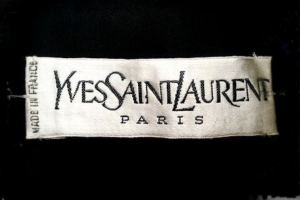
Brands have understood this instinct, even without naming it. During the 2010s, some of the most recognizable names in luxury fashion abandoned their distinctive heritage lettering for nearly identical clean sans serif wordmarks. Saint Laurent dropped the founder’s curved script in 2012, Balenciaga followed in 2017, Burberry in 2018, with Balmain and Celine close behind. The redesigns were defended as cleaner and more contemporary, better suited to digital screens. What attracted less commentary was that genuinely different houses, each with a distinct history and country of origin, had come to look surprisingly similar. One industry publication called it “blanding.” A few years later, Burberry reinstated its equestrian knight and Saint Laurent brought back the Cassandre monogram first designed in 1961. The reversal suggested that distinctiveness still had value.
The forces pushing in the opposite direction, however, have only grown stronger.
AI design tools can now generate interfaces, logos, landing pages, and brand systems in seconds. Their outputs often converge on familiar patterns, generous white space, restrained typography, muted palettes, and similar button styles. One frequently cited example comes from Tailwind CSS, whose creator chose indigo as the framework’s default accent color because it looked polished and professional. That decision influenced countless developers and templates and has since become emblematic of how quickly design defaults can spread across the web.
in.pinterest.com
Researchers and designers have increasingly warned that these systems can reinforce existing conventions rather than expand them. When models are trained on large collections of contemporary websites and branding, they are likely to reproduce the patterns that already dominate those datasets. The risk is a feedback loop in which familiar aesthetics become even more dominant.
Consumers respond to these signals in ways that tend to run beneath conscious awareness. Researchers studying what psychologists call processing fluency, the ease with which the brain handles visual information, have found that simpler and more legible presentations can produce a sense of cognitive ease that people then associate with trustworthiness and quality. We do not only read design. We tend to infer credibility from it before engaging with the content itself.
Those impressions carry cultural assumptions that frequently go unexamined, and they are now being reinforced by tools capable of producing design at enormous scale.
Minimalism did not become dominant because everyone agreed it was the most beautiful way to design. It became dominant because it came to look like the absence of style, the visual equivalent of common sense. The difference now is that those assumptions are no longer transmitted only by schools, brands, or institutions. They are increasingly embedded in the software that helps design the next generation of interfaces, logos, and websites, making one cultural preference feel ever more universal.
Open your front camera. Pick a filter. You still look like yourself, just smoother, sharper, lighter. You didn’t ask for an upgrade, but the algorithm gave you one anyway.
Face filters seem harmless, right up until you examine what they’re doing, and who they’re built for. Behind each digital ‘enhancement’ is a machine learning model trained on data that largely skews to a Western model. When these models are applied to South Asian faces, they automatically lighten skin, narrow noses and straighten jaws.
Platforms such as Instagram and Snapchat rely on facial recognition tools developed primarily in the West. In one study from MIT Media Lab, facial analysis algorithms had an error rate of just 0.8% for light-skinned men, but up to 34.7% for dark-skinned women. That’s not just about identification. It also signals who the system sees clearly and who it reshapes.
The effect isn’t always obvious. Many Instagram filters don’t announce themselves because they’re baked into the default camera settings. A light blur here, some auto-slimming there; you post the selfie because the camera automatically makes you look good.
“
In one study from MIT Media Lab, facial analysis algorithms had an error rate of just 0.8% for light-skinned men, but up to 34.7% for dark-skinned women.
”
Globally, over 1.5 billion people use augmented reality filters every day. In India, with its 200+ million Instagram users, the numbers aren’t broken out — but scroll for five minutes and you’ll see it. A filter-fed aesthetic is slowly becoming the norm. Eventually, unfiltered faces start to feel almost unnatural.
India already had a complicated relationship with beauty. Caste, class, and colourism have long defined desirability. What filters do is scale those ideas. Preferences become presets. Bias becomes baseline.
www.pexels.com
You could argue this isn’t new. After all, fairness creams and nose jobs have been telling us what to fix for decades. But tech makes it frictionless. You don’t have to choose change anymore. The camera does it for you.
When Snapchat launched its ‘beauty’ lens in 2020, users across Asia pointed out how it lightened skin and Europeanized features. Tiktok installed on South Korean and Japanese phones automatically whitened users’ skin, gave them smaller faces and plumped up their lips.Some have pointed out that their Japanese TikTok, when used with a Japanese SIM, wouldn’t let them record anything without a beauty filter. The app’s “Bold Glamour” filter uses AI so precise it doesn’t glitch when you move your face or dance around the room. It works so well that it doesn’t feel like a filter any more, it feels like a suggestion.
“
When Snapchat launched its ‘beauty’ lens in 2020, users across Asia pointed out how it lightened skin and Europeanized features.
”
India’s creator economy is responding. Filter makers are designing AR effects that lean into regional features, brown skin tones, and desi humour. But platform discovery still rewards what’s already working. And what’s working is what fits global defaults.
If beauty is becoming a tech product, we have to ask: who’s writing the code? Who trained the model? How many Indian faces were in the dataset?
The face in the mirror is yours. The one on the screen might be the platform’s version of you. The real question is, will we keep editing ourselves until we match it?
In a flat in Kalyan, a satellite town about 45 kilometers northeast of Mumbai, a retired bank manager named Vijay Surwade keeps B.R. Ambedkar’s dentures in a shirt box. Next to them are gold-rimmed spectacle frames, a broken violin string, and a gold-plated Movado watch. Surwade spent five decades, evenings mostly, building what is now considered one of the world’s largest personal archives dedicated to the man who wrote India’s constitution, the country’s first law minister, and its most prominent Dalit rights leader. Ambedkar studied at Columbia University and the London School of Economics. His legacy reached institutions. Surwade spent decades ensuring that the objects surrounding it did too.
“This is our history,” Surwade has said. “No one else will preserve it.”
That sentence, simple and almost resigned, is also the operating principle behind a growing network of independent archivists across India who are collecting what formal institutions have long decided isn’t worth the shelf space. They are not librarians, mostly. They are filmmakers, lawyers, activists, and people who simply found themselves in possession of things that felt too important to throw away.
www.pexels.com
Formal archives everywhere tend to reflect the priorities of whoever funded them. In India, that has typically meant state papers, elite correspondence, published texts, the records of movements that won, and the biographies of people who were already famous. What falls through is everything else, the pamphlets distributed outside a factory gate, the court affidavit filed by someone who came out as gay when doing so carried a criminal risk, or the feminist protest poster that was never meant to last beyond the march.
The Queer Archive for Memory, Reflection and Activism, known as QAMRA and based at the National Law School of India University in Bangalore, began almost by accident. In 2013, India’s Supreme Court reinstated a colonial-era law, Section 377 of the Indian Penal Code, that criminalized same-sex relations, overturning a landmark 2009 judgment that had struck it down. When the court described queer Indians as a “minuscule minority,” filmmaker T. Jayashree, who had been documenting queer life and activism since 2000, recognized a problem. There was evidence of an entire movement but no permanent place for it to live.
“
Formal archives everywhere tend to reflect the priorities of whoever funded them.
”
By 2017, that footage, over a thousand hours of it, along with court documents, activist papers, diaries, manuscripts, and five-language newspaper clippings from Sangama, a Bangalore-based sexuality-rights organization, became the founding collection of QAMRA. The archive holds the case files and affidavits from the legal challenge to Section 377, records of Pride marches and community consultations, and the private journals of individuals who shared their stories at considerable personal risk. India finally decriminalized homosexuality in 2018, in a second Supreme Court ruling. The archive predates that victory and documents the decades of organizing that made it possible. Without QAMRA, much of that record would exist only in people’s memory, or not at all.
Across the country, similar efforts are taking shape under different conditions and with different materials. Zubaan Books, a feminist publishing house in Delhi founded in 2003, runs an archival project called Poster Women, a collection of feminist protest posters from the 1970s onward, materials that were produced to be carried in a march or pasted on a wall, not preserved behind glass. Their newer project, Our Stories, Our Words, documents the histories of women from communities that have been historically excluded from the official record of India’s women’s movement, actively involving researchers and writers from those communities in telling their own stories.
The logic behind all of these projects is roughly the same, though the materials differ. Objects and documents that were never intended to survive often reveal the most about how people actually lived, what they feared, what they organized around, and what they celebrated. A protest poster printed for a single march, a court affidavit filed in the course of an ordinary legal proceeding, or a shirt box full of photographs saved by one person over decades can preserve details that rarely make it into official records.
Image credit: Meher Mirza
What these archives preserve is not just content but texture, the everyday experiences that formal histories often condense or overlook altogether.
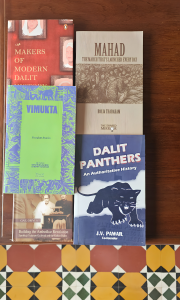
The importance of these efforts becomes especially visible in the preservation of Dalit history. Dalits, who sit at the bottom of the Hindu caste hierarchy and have historically been designated “untouchable,” have faced discrimination that has structural parallels to the experience of Black Americans, a comparison that Ambedkar himself drew when he visited the United States in the 1940s and met with W.E.B. Du Bois. The Dalit Panthers movement of the 1970s, which modeled itself explicitly on the Black Panther Party, produced pamphlets and broadsides that are now scattered across private homes, surviving because individuals held onto them rather than because any institution thought to.
Surwade is one of many. Scholars estimate there could be thousands of informal Dalit archivists across India, most self-trained and working without institutional support, preserving material that academic collections have largely ignored. Their work expands the historical record with documents and objects that might otherwise have been lost, making it easier to trace the lives, movements, and ideas that official collections have not always captured.
The most interesting thing about these projects is not what they save, but the assumptions they challenge about what saving means. Most of them operate without climate-controlled rooms, without metadata consultants, without the infrastructure that the word ‘archive’ usually implies. While Surwade uses shirt boxes and concertina files, QAMRA began in a filmmaker’s studio, and Poster Women lives online. The barrier to entry is low, which is part of the point. Taken together, they challenge the assumption that preserving history is the exclusive domain of large institutions.
“
The most interesting thing about these projects is not what they save, but the assumptions they challenge about what saving means.
”
Many of these collections also resist the standard archival logic of the single authoritative curator. QAMRA’s model involves community contributions, with participants deciding what gets prioritized. Zubaan’s projects engage the communities being documented as co-creators rather than subjects. The line between who keeps the archive and who is archived becomes blurry, deliberately so.
There is also a shift in what counts as a primary source. A WhatsApp message thread documenting a grassroots campaign, a voice memo, or a Dalit wedding card from the 1970s featuring Ambedkar’s photograph can all become archival material. Together, they suggest that history is not preserved only in official records but also in the everyday documents people create for one another.
History, the official kind, is always also a selection. Someone decided what to keep and what to let go, which movements mattered and which were marginal, whose testimony counted as documentation and whose was just hearsay. Independent archives are a long argument against those decisions.
They are also, in a more immediate sense, insurance. When Surwade started collecting, he did it because he believed no one else would. He was right. Fifty years later, the shirt boxes and concertina files in his Kalyan flat have become a destination for scholars from around the world.
He thought someone should do it. Then he thought that someone should be him.
There is a problem with everything being available. After a while, nothing feels necessary. Theatre has always resisted that logic. It asks for a particular kind of attention that no other medium quite produces. It is not the passivity of a streaming platform, and it is not the distracted watching of a phone in hand. It is the knowledge that what is happening in front of you is happening only once, that the actor on stage is aware of you as you are aware of them, and that the experience will not be available for replay.
For decades, this quality was treated as theatre’s limitation. It is increasingly looking like its advantage.
Streaming platforms have trained us to treat culture as inventory, something to be browsed, sampled, abandoned, and returned to later, or never. The algorithm optimizes for the next thing, which means it undermines the experience of being fully inside the current one. You cannot pause a play, you cannot watch it at 1.5 speed, and you cannot look at your phone without missing something that will not recur. Constraints that once seemed inconvenient have begun to feel, for many people, like relief.
Prithvi Theatre / in.pinterest.com
This is goes beyond being nostalgia for analog experience and often turns into a desire for an encounter that makes a genuine claim on your presence, one that treats your attention as something worth having rather than something to be captured and monetized. Theatre does this by necessity. Liveness is not an added feature of the form. It is the form.
The appetite for that kind of experience is showing up well beyond the stage. Live Nation reported 151 million attendees across its events in 2024. Book festivals, running clubs, supper clubs, and Saturday morning food markets are flourishing in the same cultural moment. They offer something a screen cannot replicate, the experience of being physically present with other people inside something unfolding in real time.
A stadium concert may tolerate divided attention. A theatre, at least most theatre worth attending, does not.
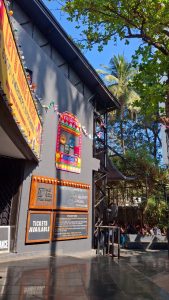
In India, the signs of this shift are visible in ways that would have been harder to predict a decade ago. Prithvi Theatre in Mumbai has long been one of the country’s most reliable cultural barometers, staging more than 640 performances each year while sustaining average attendance of around 80 percent. Its audiences have always been loyal. What feels newer is the sense that people who never thought of themselves as theatregoers are beginning to find their way into these spaces.
“
In India, the signs of this shift are visible in ways that would have been harder to predict a decade ago.
”
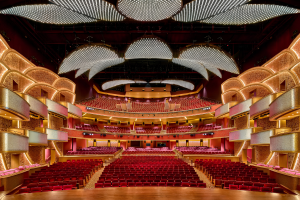
The Nita Mukesh Ambani Cultural Centre, which opened in Mumbai in 2023, welcomed more than one million visitors in its first year, hosted over 700 performances, and staged India’s first Broadway musical. Whatever one makes of private cultural patronage at that scale, the centre has signaled that live performance remains worth investing in and capable of attracting audiences well beyond traditional theatre circles.
Smaller venues across Mumbai, Delhi, and Bengaluru appear to be experiencing a similar shift in interest, even if comprehensive attendance data remains difficult to come by. The people arriving are not always seasoned theatre enthusiasts. Many are looking first for an evening out, the social ritual of leaving home and sharing an experience with strangers, and discovering that theatre offers something their regular media diet does not. As Ishita, a Mumbai-based writer, recently put it, “If I wanted to half-watch something, I would watch it on Netflix. But I want to go out and get away from a screen. So I watch a play instead. We’re watching one nearly every week now.”
The remark contains more than it first appears to. It is not merely a preference between two art forms. It is a description of what going out has come to mean. Choosing, together, to be in a room and pay attention to something has become an experience in itself. The togetherness matters. The commitment matters. So does the knowledge that this particular evening, with this audience and these performers, will never happen in exactly the same way again.
The Nita Mukesh Ambani Cultural Centre / in.pinterest.com
Whether this develops into a lasting shift remains uncertain. Infrastructure takes time, and audiences have to become habits. The informal circuit that sustained Indian theatre through leaner decades is not automatically equipped to scale, and scaling without losing what made those spaces distinctive is a genuine challenge. There is also the question of whether new funding encourages experimentation or rewards safer forms of cultural programming.
Those are important questions. But they are the questions of a living art form rather than one in retreat.
The interesting thing about liveness is that it cannot be optimized. You can improve the production, the acoustics, and the sightlines. You cannot eliminate the possibility that something unexpected will happen, whether it is a missed cue, an inspired improvisation, or a moment of connection that exists only for the people in the room that night.
That unpredictability is not a flaw to be engineered away. For audiences who spend much of their lives inside systems designed for convenience, personalization, and endless replay, it may be the very thing worth leaving the house for.
The 2026 FIFA World Cup is unfolding across sixteen stadiums in three countries. None of those venues was built for the tournament. Once the final whistle blows, they will return to hosting league matches, concerts, and other live events, a reminder that the modern stadium has become something much larger than a home for sport.
The idea that stadiums exist primarily to host sports is becoming harder to defend. The buildings still bear the names of teams, and the teams still play inside them. But the financial logic driving billions of dollars in stadium construction and renovation is no longer organized around the ninety minutes on the pitch or the three hours on the field. It is organized around everything that happens before, after, and between games.
A June 2026 report from Addleshaw Goddard, a law firm that advises on major venue developments across Europe and North America, found that more than 300 stadium construction and renovation projects began globally in 2025. It also reported that European clubs that own their stadiums derive 76 percent of their commercial revenue from non-matchday activity, according to Estates Gazette’s coverage of the research. Hotels, conference centers, restaurants, concerts, corporate events, and weddings have all become part of the business model. Sport increasingly serves as the anchor tenant of a much larger enterprise.
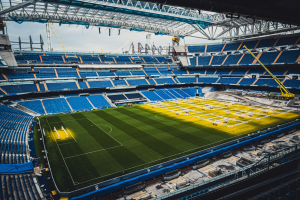
Santiago Bernabéu Stadium in Madrid / www.pexels.com
This shift has been building for years, but several trends have accelerated it. Television revenue, once considered the industry’s most dependable income stream, has become less predictable as streaming fragments audiences and media rights negotiations grow more complex. Construction costs have climbed sharply, making it difficult to justify venues that sit empty for most of the year. The result is a stadium designed to stay busy, one that functions as an entertainment destination rather than a building that opens only on game day.
The question worth asking is why this model has become so compelling at a moment when almost everything a stadium once monopolized, watching a match, listening to music, or following a team, can be experienced from a screen at home. The answer may lie in the one thing digital life still struggles to reproduce, the feeling of being there.
Tottenham Hotspur Stadium offers one illustration. Built with a retractable grass pitch and a synthetic surface beneath it, the venue can switch from Premier League football to NFL games in roughly a day and has also become one of London’s busiest concert venues. SoFi Stadium in Los Angeles, one of this summer’s World Cup hosts, sits at the center of the 300 acre Hollywood Park development, alongside apartments, retail, hospitality, and entertainment spaces. The stadium itself hosts only a limited number of NFL games each year, but it is active far more often than that. Beyoncé performed five nights there in May.
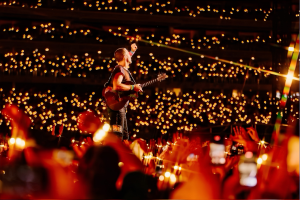
A similar pattern is visible in India. Coldplay’s two January 2025 concerts at the Narendra Modi Stadium in Ahmedabad drew more than 220,000 attendees and generated an estimated ₹641 crore in economic impact for the city, underscoring the growing role of large venues as year-round entertainment destinations.
“
The question worth asking is why this model has become so compelling at a moment when almost everything a stadium once monopolized… can be experienced from a screen at home.
”
The concert business helps explain why. Pollstar reported that average gross revenue from stadium concerts reached $7.11 million per show in 2025, up 19 percent from the previous year, while average ticket prices rose 18 percent. Taylor Swift’s Eras Tour became the highest grossing tour on record. Those figures illustrate why developers continue investing in venues that can accommodate music, festivals, and other large gatherings alongside sport.
Demand for live experiences appears to be growing as well. Eventbrite’s 2026 Social Study, surveying adults aged 18 to 35 in the United States and Britain, found that 79 percent planned to attend more live events than they had the previous year. People are paying for more than the match or the concert itself. They are paying to occupy the same physical space as thousands of strangers reacting in real time, an experience that remains difficult to replicate online.
The World Cup itself fits neatly into that logic. FIFA did not require a fleet of newly built arenas. It relied on existing venues that could be upgraded to tournament standards and continue generating revenue long after the competition ends. Renovations across the host stadiums are expected to leave behind infrastructure that supports concerts, conventions, and other events for years to come, extending the commercial life of each building well beyond football.
Coldplay concert / in.pinterest.com
The model is not without tradeoffs. Ticket prices have risen steadily across many major leagues, making attendance less accessible for some supporters. Economists have long questioned whether public subsidies for stadium projects deliver returns that justify their cost, and local businesses can lose foot traffic when visitors spend their time and money inside integrated entertainment districts rather than in surrounding neighborhoods.
There is also a cultural cost that is harder to quantify. For generations, stadiums brought together people who might otherwise have had little in common beyond allegiance to a team. They stood in the same queues, sat in the same sections, and reacted together. Premium clubs, private lounges, and hospitality suites do not eliminate that atmosphere, but they redistribute it across different tiers of access.
Researchers and designers have long argued that densely packed supporter sections contribute meaningfully to the character of a match. Borussia Dortmund’s Yellow Wall, one of football’s most famous standing sections, is often cited as evidence that architecture shapes atmosphere as much as the game itself. Clubs understand this. Even as hospitality expands, many preserve vocal supporter areas because they remain essential to the experience the venue is selling.
What is emerging in city after city is a different kind of civic space, one built to host concerts, conferences, festivals, restaurants, and football in equal measure, and to remain active throughout the year. In an increasingly digital world, developers are making a remarkably consistent bet that people will continue to place value on gathering in person, and will keep paying for places that make those gatherings possible.