

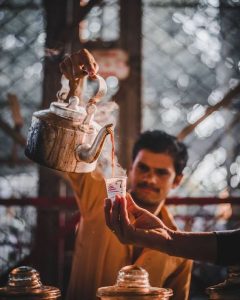
There is a particular kind of embarrassment that attaches to the chai stall in the Indian imagination. Not shame, exactly, but a sense that the stall belongs to a category of things that are real and indispensable and somehow not quite speakable in polite company. You stop there between appointments. You drink in a glass or a kullad, standing or squatting on a low stool, and you go. The exchange is quick by design, because nothing about the stall, no chair, no table, and no surface to rest a phone on, suggests you are welcome to occupy it longer than the tea takes to cool. People do linger, often. Politics gets argued there, gossip moves, a second round gets ordered. But the lingering happens despite the architecture, not because of it. Nobody designed the chai stall for your comfort. They designed it for your thirst.
India is often described as a tea culture. In one sense it plainly is. The country produces more tea than almost anywhere on earth, drinks it compulsively, and has built an entire informal economy around its distribution. The chai wallah at the railway platform, the office peon making rounds with a tray, and the gas burner going in the corner of every small shop are all a part of an infrastructure. But infrastructure is not the same as culture in the way the word gets used when people talk about coffeehouses. A culture implies a room. It implies you are allowed to stay.
America’s version of this story begins with an act of vandalism. In December 1773, colonists dressed as Mohawk people threw 342 chests of East India Company tea into Boston Harbour, making tea politically untenable almost overnight. John Adams, writing to his wife Abigail the following year, declared that tea “must be universally renounced” and that he had taken to drinking coffee every afternoon, bearing it, as he put it, “very well.” The tone of reluctant conversion is instructive. People did not suddenly prefer coffee. They decided, or were persuaded, that preferring it was the correct thing to do. Over the decade of the Revolution and through the Civil War, when Union supply lines made coffee far easier to distribute to soldiers than tea, the habit hardened into identity. By the time the war was over, coffee was simply what Americans drank.
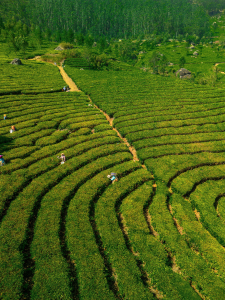
Coffee was no more native to America than tea was to India. It arrived through trade, became meaningful through politics, and was cemented by war and commerce. What made it American was accumulation, the stories told about it, the rooms built around it, and the version of the national self that became attached to the cup. The Boston Tea Party may not have made Americans love coffee, but it certainly made them decide that loving coffee was who they were.
What Americans then did with coffee is where the story gets interesting, because the drink itself was almost beside the point. The room it came with was the thing.
Sociologist Ray Oldenburg published a book in 1989 called The Great Good Place, in which he named what he called the “third place,” the informal social space that is neither home, which he called the first place, nor work, which he called the second. Third places are where democracy actually happens, where neighbors become neighbors rather than just people who share a street, where the social fabric gets woven in ordinary time. Coffeehouses qualify, and so do pubs, barbershops, and diners. What they share is accessibility, a tendency toward leveling rather than hierarchy, and conversation as the main activity.
The coffeehouse had been doing this work long before Oldenburg named it. In seventeenth-century London, a penny bought you a cup of coffee and entry into a room where you could read the newspapers, conduct business, and argue about politics for as long as you liked. They were called “penny universities” because the information circulating inside them was otherwise unavailable to anyone without money or connections. The same model crossed the Atlantic and took root in the colonies, where the Green Dragon Tavern in Boston became known, without much irony, as the Headquarters of the Revolution.

Tea generally occupied a different kind of social space. In England, tea came with a different set of social meanings, the drawing room and the fixed hour, the hostess and the tiered stand of sandwiches. It was domestic and feminized and, by all accounts, delicious, but it was not a space you could walk into off the street and stay until you had figured something out. In America, without even the drawing room tradition to fall back on, tea became a specialty, an occasion, a hotel amenity, something you ordered when you were under the weather or feeling wistful about somewhere else.
In India, meanwhile, tea was becoming something else entirely, and the mechanism of that transformation is fascinating precisely because it was not organic.
Tea cultivation in India began as a British colonial project in the 1820s and 1830s, when the East India Company identified Assam as a promising site for commercial tea cultivation and set about breaking China’s monopoly on global supply. For most of the nineteenth century, the tea being grown in India was being exported, largely to Britain. Domestic consumption remained limited for much of the nineteenth century. Across much of the subcontinent, people relied on a wide variety of regional drinks, including milk-based beverages, buttermilk, and water, while coffee had long-established traditions in the south that predated British arrival.
What changed this was advertising. The British-owned Indian Tea Association, anxious to create a domestic market for what was an enormous and growing supply, ran a campaign in the early twentieth century to introduce tea breaks into factories, textile mills, and mines. Chai wallahs were stationed at railway platforms. Tea was positioned not as a luxury but as a worker’s drink, cheap and energizing and available everywhere. The spices that transformed it into masala chai emerged through local adaptation, with vendors adding ingredients such as ginger, cardamom, cinnamon, and cloves according to regional taste.
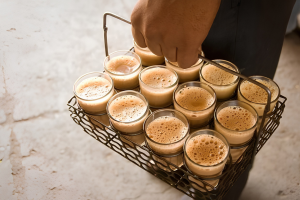
The result was a beverage that felt indigenous when it wasn’t, that felt ancient when it was barely a century old in its popular form, and that became genuinely social without ever quite becoming a salon. Chai, like coffee in America, accumulated its identity rather than inheriting it. Both drinks arrived from elsewhere, both got claimed as native, and both became social infrastructure. What they built with that infrastructure is where they diverged. America built rooms. India built a distribution network, and a very good one, but a network all the same.
The room finally arrived in India in 1996, and it did not serve chai.
Café Coffee Day opened its first outlet on Brigade Road in Bengaluru that year, founded by VG Siddhartha on coffee from his own estates, priced at twenty-five rupees a cup, with air conditioning and internet terminals and the implicit promise that you could sit there for two hours without anyone asking you to leave. It was aimed at a generation that had grown up watching liberalisation transform what Indian cities looked like and what they were for, and it succeeded almost immediately. Within two decades, CCD had more than 1,700 outlets across 243 cities. The tagline, “A lot can happen over coffee,” was less a description of the product than of the room. The coffee was incidental. What was being sold was the permission to occupy space without justification.
What Siddhartha understood, and what the chain’s early success confirmed, was that the third place India had never really built for chai, the room where you could stay without purpose, where time became social rather than productive, was a gap that a drink could fill only if the right architecture came with it. The drink signaled the room. The room was always the point.
This is the same logic, running in reverse, that explains what is now happening in America.
Heytea, which helped invent the premium milk tea category in China and now has roughly 4,000 stores there, opened three dozen American locations between 2023 and 2025, including a flagship in Times Square where lines have regularly stretched out the door for drinks topped with cheese foam. Chagee, another Chinese tea brand, listed on the Nasdaq in May 2025 and opened its first American stores in Los Angeles. Luckin Coffee, which has three outlets in China for every one Starbucks, opened several Manhattan locations. These companies are not coming to America because they believe Americans have been waiting for premium tea. They are coming because the Chinese food and beverage market has become, in the words of one industry investor, a condition of “severe oversupply,” with margins being ground down by a price war among hundreds of thousands of competing outlets. The United States offers better margins and room to breathe.

But the business rationale does not fully account for the cultural question, which is whether this wave of premium tea brands can do something that two hundred and fifty years of history have conspired to prevent, make tea a genuinely everyday social drink in America, not a niche or a novelty or an afternoon indulgence, but the thing you go somewhere specifically to drink with other people and you do it often, if not every day.
Tea enters a very different American market today than it did even a decade ago. Bubble tea, which originated in Taiwan in the 1980s and reached American cities through Asian immigrant communities before going mainstream with younger consumers in the 2010s, has done important preparatory work. It normalised the idea of paying café prices for a tea-based drink, of waiting in line for it, of treating it as an experience rather than a beverage. There are now more than 9,000 bubble tea shops in the United States, and surveys suggest that 94 percent of consumers in their twenties bought boba in a recent three-month period. That is not a niche. It is a category, and one that has already done the cultural labor of making tea something you seek out rather than something you settle for.
The Chinese chains arriving now are betting they can build on that foundation, offering something more refined, a drink you take seriously, and one that belongs to the same register as a pour-over or a natural wine. While Heytea brews loose-leaf tea rather than using powder or syrup, Chagee has positioned itself carefully as an “American-born Chinese” brand, hiring specifically for that cultural translation. Both understand, at least implicitly, that the drink alone will not be enough. You need the room.
Its success will depend on something no amount of branding can manufacture, which is whether the third place these chains are trying to create feels like it belongs to the people inside it, or like a product being tested on them. Starbucks spent decades building that sense of belonging, and even then Oldenburg, who coined the term third place, declined when the company asked him to endorse their stores. The room, he seemed to be saying, has to mean something that cannot be franchised.
People adopt a drink when it comes attached to a world they want to inhabit, and they build that world when it represents a version of life they find worth performing. Coffee took root in America not because it tasted better than tea but because it became the drink of a certain kind of person, then a certain kind of citizen, then a certain kind of worker, and each time it shifted it brought the room with it. Chai became India’s drink because a colonial marketing apparatus decided it should be, and what Indians made of that imposition was something genuinely their own, warmth and community compressed into something fast, everything except the room.
What a café sells, whether it is CCD in Bengaluru in 1996 or Heytea in Times Square in 2024, is not the drink. It sells the hours inside it, the version of yourself you get to be while you’re sitting there, between the first place and the second, in the space that doesn’t ask you anything except what you’d like. The drink was never the point. It was always the excuse to build the room.





Leave a Reply