

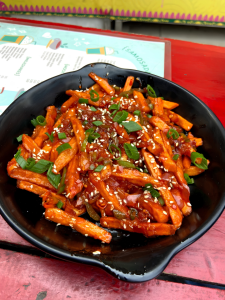
If you had to visit Five Spice, a wildly popular chain of Chinese restaurants in Mumbai, you might be somewhat disconcerted to find the following items on the menu: Chile Crispy Potatoes, Red Hot Fish, Lamb in Burnt Chile Sauce, Pepper Blasted Fish and Dragon Chile Fried Rice. Similarly, at Mainland China, another popular Chinese restaurant chain, you’ll find Chile Cottage Cheese, Hot and Sour Soup and Crispy Corn Cubes.
In China, diners might lurch away in shock at such unrecognizable Chinese dishes. In India, they’re the true taste of Chinese cuisine. This is India’s most famous hyphenated cuisine – Indo-Chinese food – plucking flavors from both countries.
Once Upon a Long Time Ago
To tell this story properly, we must scroll back hundreds of years ago. Amongst the biggest immigrant communities in colonial India were the Hakka and Cantonese Chinese – the earliest likely stepped foot in Kolkata in the late 1700s, and just a few decades later in Mumbai. These low-pitched, languidly flavored cuisines were India’s introduction to Chinese food; Kolkata’s first Chinese eatery opened in the 1850s, and Bombay followed in its wake just a few years after. Although the Chinese communities have slowly dwindled since, their food remains as a legacy.
The Birth of Indian Chinese
But it was only after Independence, in the 1960s, that the cabinet of curiosities, Indo-Chinese food, really grabbed center stage. Sino-Indian chefs, long settled in India and thus wise to local tastes, began to ease the unfamiliarity of their ‘home’ cuisines with the addition of Indian ingredients like ginger-garlic and Indian chiles. In Mumbai, this wave was possibly urged on by Camellia Panjabi, who introduced Sichuan cooking via the Golden Dragon, to the Taj Mahal Hotel in Mumbai. Inaccessible to most of the population, it nevertheless did its job in introducing the city to these vivid new flavors.
By the turn of the next decade, you were guaranteed a few standard dishes, no matter which Chinese restaurant you turned to – Sweet and Sour pork, Sweet Corn soup, Chopsuey, Garlic Chile Prawns and Chile Chicken. And there were already plenty – Nanking, Kamling, Mandarin, Flora, Ling’s Pavilion, to name just a handful.
But at the forefront of Indo-Chinese cooking stood Nelson Wang, culinary giant with Kolkata origins and once-proprietor of the Chinese restaurant at Mumbai’s Cricket Club of India. He is often credited as the ingenious inventor of Indian Manchurian cooking – drifts of deep-fried mixed vegetables or chicken or paneer, plunged into a glutinous soup of soy and chile and cornflour, and served steaming. If legend is to be believed, Wang tossed together boneless chicken in soy sauce and spice to sate the rumbling bellies of some diners who wanted something unique. (This origin story has since been disputed by other chefs, who believe he was simply reaching into the collective hive mind of the time.)
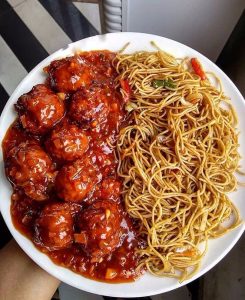
His most famous dish, the rumbustious Chicken Manchurian, got its lick of heat from garlic, ginger and green chiles. Other iterations are vegetarian i.e. paneer Manchurian and cauliflower Manchurian — all fugues on a single theme. Wang would soon become the zeitgeist. His restaurant, China Garden, hurtled onwards and upwards at a furious clip. His dishes cleaved to familiar Indian flavors while inflecting them with a touch of Chinese, authenticity be damned. The staff was elegantly attentive, the plating was contemporary, and the restaurant was modern and stylish as opposed to the fading Chinoiserie of earlier restaurants. Everyone from Goldie Hawn to Imran Khan thronged there.
China Garden’s unbelievable success shook loose a daisy chain of copies serving a bacchanal of desi Chinese classics, all equally flippant with authenticity. These included bite-sized pieces of cauliflower, paneer or chicken plopped into gravies such as the giddy orange Schezwan (not Sichuan!) sauce, the self-explanatory Sweet and Sour sauce, the Chile Garlic sauce and the Hot Garlic sauce. The heat was muted by drifts of steamed or fried hakka noodles or fried rice.
On the Sidewalk
Perhaps the true sign of Indian-Chinese food’s acceptance is that, today, India is carpeted with vendors crisply dispensing all sorts of delicious concoctions (after all, it is on the streets that innovation often quickens).
Behold! The spring dosa, with noodles and stir-fried ‘Chinese’ vegetables stuffed in its crispy folds, served with the obligatory coconut chutney and sambhar. The Chinese bhel, a tousle of deep-fried noodles stained orange, then buttressed with stripes of carrot, spring onion, cabbage and peppers and slapped with a spicy sauce — perfect for a little crackle, a little chew. The famous Triple Schezwan, a palimpsestic dish of fried rice, noodles and Schezwan-sauced vegetables. Although it is beloved across Mumbai, filaments of Kolkata can be seen here too — after all, Schezwan sauce might have been invented in Kolkata by the Huang family, owners of Eau Chew restaurant.
Side by side, another phenomenon occurred: the Chinese restaurant business slipped out of the hands of the Chinese-Indian community. Today, Punjabis own a big chunk of Chinese restaurants, and more Nepalis are chefs at Chinese restaurants than Chinese.
Across the Oceans
Naturally, Indian-Chinese food has also sailed across the oceans. The influx began in the early 1960s, during the Indo-China War when relations between the two countries curdled and many innocent Indian Chinese fled to China, the UK, the USA, and Australia. Today, eateries such as Moghul Express in New Jersey, NYC, Dragon House in NSW, Australia (run by a Hakka Chinese family from India), and London’s Bombay Chow all serve the classics, Hakka noodles, Fish Manchurian, Chile Chicken et al, although, in a bid to appeal to Western tastes, some of them have gentled the Indian spice levels. And so the cuisine completes its transformation — irreverent and shape-shifting but delicious as ever.




Leave a Reply