

In a flat in Kalyan, a satellite town about 45 kilometers northeast of Mumbai, a retired bank manager named Vijay Surwade keeps B.R. Ambedkar’s dentures in a shirt box. Next to them are gold-rimmed spectacle frames, a broken violin string, and a gold-plated Movado watch. Surwade spent five decades, evenings mostly, building what is now considered one of the world’s largest personal archives dedicated to the man who wrote India’s constitution, the country’s first law minister, and its most prominent Dalit rights leader. Ambedkar studied at Columbia University and the London School of Economics. His legacy reached institutions. Surwade spent decades ensuring that the objects surrounding it did too.
“This is our history,” Surwade has said. “No one else will preserve it.”
That sentence, simple and almost resigned, is also the operating principle behind a growing network of independent archivists across India who are collecting what formal institutions have long decided isn’t worth the shelf space. They are not librarians, mostly. They are filmmakers, lawyers, activists, and people who simply found themselves in possession of things that felt too important to throw away.
Formal archives everywhere tend to reflect the priorities of whoever funded them. In India, that has typically meant state papers, elite correspondence, published texts, the records of movements that won, and the biographies of people who were already famous. What falls through is everything else, the pamphlets distributed outside a factory gate, the court affidavit filed by someone who came out as gay when doing so carried a criminal risk, or the feminist protest poster that was never meant to last beyond the march.
The Queer Archive for Memory, Reflection and Activism, known as QAMRA and based at the National Law School of India University in Bangalore, began almost by accident. In 2013, India’s Supreme Court reinstated a colonial-era law, Section 377 of the Indian Penal Code, that criminalized same-sex relations, overturning a landmark 2009 judgment that had struck it down. When the court described queer Indians as a “minuscule minority,” filmmaker T. Jayashree, who had been documenting queer life and activism since 2000, recognized a problem. There was evidence of an entire movement but no permanent place for it to live.
By 2017, that footage, over a thousand hours of it, along with court documents, activist papers, diaries, manuscripts, and five-language newspaper clippings from Sangama, a Bangalore-based sexuality-rights organization, became the founding collection of QAMRA. The archive holds the case files and affidavits from the legal challenge to Section 377, records of Pride marches and community consultations, and the private journals of individuals who shared their stories at considerable personal risk. India finally decriminalized homosexuality in 2018, in a second Supreme Court ruling. The archive predates that victory and documents the decades of organizing that made it possible. Without QAMRA, much of that record would exist only in people’s memory, or not at all.
Across the country, similar efforts are taking shape under different conditions and with different materials. Zubaan Books, a feminist publishing house in Delhi founded in 2003, runs an archival project called Poster Women, a collection of feminist protest posters from the 1970s onward, materials that were produced to be carried in a march or pasted on a wall, not preserved behind glass. Their newer project, Our Stories, Our Words, documents the histories of women from communities that have been historically excluded from the official record of India’s women’s movement, actively involving researchers and writers from those communities in telling their own stories.
The logic behind all of these projects is roughly the same, though the materials differ. Objects and documents that were never intended to survive often reveal the most about how people actually lived, what they feared, what they organized around, and what they celebrated. A protest poster printed for a single march, a court affidavit filed in the course of an ordinary legal proceeding, or a shirt box full of photographs saved by one person over decades can preserve details that rarely make it into official records.
What these archives preserve is not just content but texture, the everyday experiences that formal histories often condense or overlook altogether.
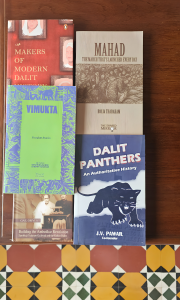
The importance of these efforts becomes especially visible in the preservation of Dalit history. Dalits, who sit at the bottom of the Hindu caste hierarchy and have historically been designated “untouchable,” have faced discrimination that has structural parallels to the experience of Black Americans, a comparison that Ambedkar himself drew when he visited the United States in the 1940s and met with W.E.B. Du Bois. The Dalit Panthers movement of the 1970s, which modeled itself explicitly on the Black Panther Party, produced pamphlets and broadsides that are now scattered across private homes, surviving because individuals held onto them rather than because any institution thought to.
Surwade is one of many. Scholars estimate there could be thousands of informal Dalit archivists across India, most self-trained and working without institutional support, preserving material that academic collections have largely ignored. Their work expands the historical record with documents and objects that might otherwise have been lost, making it easier to trace the lives, movements, and ideas that official collections have not always captured.
The most interesting thing about these projects is not what they save, but the assumptions they challenge about what saving means. Most of them operate without climate-controlled rooms, without metadata consultants, without the infrastructure that the word ‘archive’ usually implies. While Surwade uses shirt boxes and concertina files, QAMRA began in a filmmaker’s studio, and Poster Women lives online. The barrier to entry is low, which is part of the point. Taken together, they challenge the assumption that preserving history is the exclusive domain of large institutions.
Many of these collections also resist the standard archival logic of the single authoritative curator. QAMRA’s model involves community contributions, with participants deciding what gets prioritized. Zubaan’s projects engage the communities being documented as co-creators rather than subjects. The line between who keeps the archive and who is archived becomes blurry, deliberately so.
There is also a shift in what counts as a primary source. A WhatsApp message thread documenting a grassroots campaign, a voice memo, or a Dalit wedding card from the 1970s featuring Ambedkar’s photograph can all become archival material. Together, they suggest that history is not preserved only in official records but also in the everyday documents people create for one another.
History, the official kind, is always also a selection. Someone decided what to keep and what to let go, which movements mattered and which were marginal, whose testimony counted as documentation and whose was just hearsay. Independent archives are a long argument against those decisions.
They are also, in a more immediate sense, insurance. When Surwade started collecting, he did it because he believed no one else would. He was right. Fifty years later, the shirt boxes and concertina files in his Kalyan flat have become a destination for scholars from around the world.
He thought someone should do it. Then he thought that someone should be him.




Leave a Reply