Blog

  • Who Gets to Keep History?

    In a flat in Kalyan, a satellite town about 45 kilometers northeast of Mumbai, a retired bank manager named Vijay Surwade keeps B.R. Ambedkar’s dentures in a shirt box. Next to them are gold-rimmed spectacle frames, a broken violin string, and a gold-plated Movado watch. Surwade spent five decades, evenings mostly, building what is now considered one of the world’s largest personal archives dedicated to the man who wrote India’s constitution, the country’s first law minister, and its most prominent Dalit rights leader. Ambedkar studied at Columbia University and the London School of Economics. His legacy reached institutions. Surwade spent decades ensuring that the objects surrounding it did too.

    “This is our history,” Surwade has said. “No one else will preserve it.”

    That sentence, simple and almost resigned, is also the operating principle behind a growing network of independent archivists across India who are collecting what formal institutions have long decided isn’t worth the shelf space. They are not librarians, mostly. They are filmmakers, lawyers, activists, and people who simply found themselves in possession of things that felt too important to throw away.

     

    www.pexels.com


    Formal archives everywhere tend to reflect the priorities of whoever funded them. In India, that has typically meant state papers, elite correspondence, published texts, the records of movements that won, and the biographies of people who were already famous. What falls through is everything else, the pamphlets distributed outside a factory gate, the court affidavit filed by someone who came out as gay when doing so carried a criminal risk, or the feminist protest poster that was never meant to last beyond the march.

    The Queer Archive for Memory, Reflection and Activism, known as QAMRA and based at the National Law School of India University in Bangalore, began almost by accident. In 2013, India’s Supreme Court reinstated a colonial-era law, Section 377 of the Indian Penal Code, that criminalized same-sex relations, overturning a landmark 2009 judgment that had struck it down. When the court described queer Indians as a “minuscule minority,” filmmaker T. Jayashree, who had been documenting queer life and activism since 2000, recognized a problem. There was evidence of an entire movement but no permanent place for it to live.


    Formal archives everywhere tend to reflect the priorities of whoever funded them.


    By 2017, that footage, over a thousand hours of it, along with court documents, activist papers, diaries, manuscripts, and five-language newspaper clippings from Sangama, a Bangalore-based sexuality-rights organization, became the founding collection of QAMRA. The archive holds the case files and affidavits from the legal challenge to Section 377, records of Pride marches and community consultations, and the private journals of individuals who shared their stories at considerable personal risk. India finally decriminalized homosexuality in 2018, in a second Supreme Court ruling. The archive predates that victory and documents the decades of organizing that made it possible. Without QAMRA, much of that record would exist only in people’s memory, or not at all.

    Across the country, similar efforts are taking shape under different conditions and with different materials. Zubaan Books, a feminist publishing house in Delhi founded in 2003, runs an archival project called Poster Women, a collection of feminist protest posters from the 1970s onward, materials that were produced to be carried in a march or pasted on a wall, not preserved behind glass. Their newer project, Our Stories, Our Words, documents the histories of women from communities that have been historically excluded from the official record of India’s women’s movement, actively involving researchers and writers from those communities in telling their own stories.

    The logic behind all of these projects is roughly the same, though the materials differ. Objects and documents that were never intended to survive often reveal the most about how people actually lived, what they feared, what they organized around, and what they celebrated. A protest poster printed for a single march, a court affidavit filed in the course of an ordinary legal proceeding, or a shirt box full of photographs saved by one person over decades can preserve details that rarely make it into official records.

     

    Image credit: Meher Mirza


    What these archives preserve is not just content but texture, the everyday experiences that formal histories often condense or overlook altogether.

    The importance of these efforts becomes especially visible in the preservation of Dalit history. Dalits, who sit at the bottom of the Hindu caste hierarchy and have historically been designated “untouchable,” have faced discrimination that has structural parallels to the experience of Black Americans, a comparison that Ambedkar himself drew when he visited the United States in the 1940s and met with W.E.B. Du Bois. The Dalit Panthers movement of the 1970s, which modeled itself explicitly on the Black Panther Party, produced pamphlets and broadsides that are now scattered across private homes, surviving because individuals held onto them rather than because any institution thought to.

    Surwade is one of many. Scholars estimate there could be thousands of informal Dalit archivists across India, most self-trained and working without institutional support, preserving material that academic collections have largely ignored. Their work expands the historical record with documents and objects that might otherwise have been lost, making it easier to trace the lives, movements, and ideas that official collections have not always captured.

    The most interesting thing about these projects is not what they save, but the assumptions they challenge about what saving means. Most of them operate without climate-controlled rooms, without metadata consultants, without the infrastructure that the word ‘archive’ usually implies. While Surwade uses shirt boxes and concertina files, QAMRA began in a filmmaker’s studio, and Poster Women lives online. The barrier to entry is low, which is part of the point. Taken together, they challenge the assumption that preserving history is the exclusive domain of large institutions.


    The most interesting thing about these projects is not what they save, but the assumptions they challenge about what saving means.


    Many of these collections also resist the standard archival logic of the single authoritative curator. QAMRA’s model involves community contributions, with participants deciding what gets prioritized. Zubaan’s projects engage the communities being documented as co-creators rather than subjects. The line between who keeps the archive and who is archived becomes blurry, deliberately so.

    There is also a shift in what counts as a primary source. A WhatsApp message thread documenting a grassroots campaign, a voice memo, or a Dalit wedding card from the 1970s featuring Ambedkar’s photograph can all become archival material. Together, they suggest that history is not preserved only in official records but also in the everyday documents people create for one another.

    History, the official kind, is always also a selection. Someone decided what to keep and what to let go, which movements mattered and which were marginal, whose testimony counted as documentation and whose was just hearsay. Independent archives are a long argument against those decisions.

    They are also, in a more immediate sense, insurance. When Surwade started collecting, he did it because he believed no one else would. He was right. Fifty years later, the shirt boxes and concertina files in his Kalyan flat have become a destination for scholars from around the world.

    He thought someone should do it. Then he thought that someone should be him.

  • The Luxury of Live Experiences

    There is a problem with everything being available. After a while, nothing feels necessary. Theatre has always resisted that logic. It asks for a particular kind of attention that no other medium quite produces. It is not the passivity of a streaming platform, and it is not the distracted watching of a phone in hand. It is the knowledge that what is happening in front of you is happening only once, that the actor on stage is aware of you as you are aware of them, and that the experience will not be available for replay.

    For decades, this quality was treated as theatre’s limitation. It is increasingly looking like its advantage.

    Streaming platforms have trained us to treat culture as inventory, something to be browsed, sampled, abandoned, and returned to later, or never. The algorithm optimizes for the next thing, which means it undermines the experience of being fully inside the current one. You cannot pause a play, you cannot watch it at 1.5 speed, and you cannot look at your phone without missing something that will not recur. Constraints that once seemed inconvenient have begun to feel, for many people, like relief.


    Prithvi Theatre / in.pinterest.com


    This is goes beyond being nostalgia for analog experience and often turns into a desire for an encounter that makes a genuine claim on your presence, one that treats your attention as something worth having rather than something to be captured and monetized. Theatre does this by necessity. Liveness is not an added feature of the form. It is the form.

    The appetite for that kind of experience is showing up well beyond the stage. Live Nation reported 151 million attendees across its events in 2024. Book festivals, running clubs, supper clubs, and Saturday morning food markets are flourishing in the same cultural moment. They offer something a screen cannot replicate, the experience of being physically present with other people inside something unfolding in real time.

    A stadium concert may tolerate divided attention. A theatre, at least most theatre worth attending, does not.

    In India, the signs of this shift are visible in ways that would have been harder to predict a decade ago. Prithvi Theatre in Mumbai has long been one of the country’s most reliable cultural barometers, staging more than 640 performances each year while sustaining average attendance of around 80 percent. Its audiences have always been loyal. What feels newer is the sense that people who never thought of themselves as theatregoers are beginning to find their way into these spaces.


    In India, the signs of this shift are visible in ways that would have been harder to predict a decade ago.


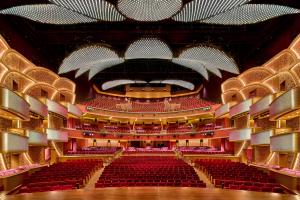
    The Nita Mukesh Ambani Cultural Centre, which opened in Mumbai in 2023, welcomed more than one million visitors in its first year, hosted over 700 performances, and staged India’s first Broadway musical. Whatever one makes of private cultural patronage at that scale, the centre has signaled that live performance remains worth investing in and capable of attracting audiences well beyond traditional theatre circles.

    Smaller venues across Mumbai, Delhi, and Bengaluru appear to be experiencing a similar shift in interest, even if comprehensive attendance data remains difficult to come by. The people arriving are not always seasoned theatre enthusiasts. Many are looking first for an evening out, the social ritual of leaving home and sharing an experience with strangers, and discovering that theatre offers something their regular media diet does not. As Ishita, a Mumbai-based writer, recently put it, “If I wanted to half-watch something, I would watch it on Netflix. But I want to go out and get away from a screen. So I watch a play instead. We’re watching one nearly every week now.”

    The remark contains more than it first appears to. It is not merely a preference between two art forms. It is a description of what going out has come to mean. Choosing, together, to be in a room and pay attention to something has become an experience in itself. The togetherness matters. The commitment matters. So does the knowledge that this particular evening, with this audience and these performers, will never happen in exactly the same way again.


    The Nita Mukesh Ambani Cultural Centre / in.pinterest.com


    Whether this develops into a lasting shift remains uncertain. Infrastructure takes time, and audiences have to become habits. The informal circuit that sustained Indian theatre through leaner decades is not automatically equipped to scale, and scaling without losing what made those spaces distinctive is a genuine challenge. There is also the question of whether new funding encourages experimentation or rewards safer forms of cultural programming.

    Those are important questions. But they are the questions of a living art form rather than one in retreat.

    The interesting thing about liveness is that it cannot be optimized. You can improve the production, the acoustics, and the sightlines. You cannot eliminate the possibility that something unexpected will happen, whether it is a missed cue, an inspired improvisation, or a moment of connection that exists only for the people in the room that night.

    That unpredictability is not a flaw to be engineered away. For audiences who spend much of their lives inside systems designed for convenience, personalization, and endless replay, it may be the very thing worth leaving the house for.

  • The Other Side of the Field: Inside the New Stadium

    The 2026 FIFA World Cup is unfolding across sixteen stadiums in three countries. None of those venues was built for the tournament. Once the final whistle blows, they will return to hosting league matches, concerts, and other live events, a reminder that the modern stadium has become something much larger than a home for sport.

    The idea that stadiums exist primarily to host sports is becoming harder to defend. The buildings still bear the names of teams, and the teams still play inside them. But the financial logic driving billions of dollars in stadium construction and renovation is no longer organized around the ninety minutes on the pitch or the three hours on the field. It is organized around everything that happens before, after, and between games.

    A June 2026 report from Addleshaw Goddard, a law firm that advises on major venue developments across Europe and North America, found that more than 300 stadium construction and renovation projects began globally in 2025. It also reported that European clubs that own their stadiums derive 76 percent of their commercial revenue from non-matchday activity, according to Estates Gazette’s coverage of the research. Hotels, conference centers, restaurants, concerts, corporate events, and weddings have all become part of the business model. Sport increasingly serves as the anchor tenant of a much larger enterprise.


    Santiago Bernabéu Stadium in Madrid / www.pexels.com


    This shift has been building for years, but several trends have accelerated it. Television revenue, once considered the industry’s most dependable income stream, has become less predictable as streaming fragments audiences and media rights negotiations grow more complex. Construction costs have climbed sharply, making it difficult to justify venues that sit empty for most of the year. The result is a stadium designed to stay busy, one that functions as an entertainment destination rather than a building that opens only on game day.

    The question worth asking is why this model has become so compelling at a moment when almost everything a stadium once monopolized, watching a match, listening to music, or following a team, can be experienced from a screen at home. The answer may lie in the one thing digital life still struggles to reproduce, the feeling of being there.

    Tottenham Hotspur Stadium offers one illustration. Built with a retractable grass pitch and a synthetic surface beneath it, the venue can switch from Premier League football to NFL games in roughly a day and has also become one of London’s busiest concert venues. SoFi Stadium in Los Angeles, one of this summer’s World Cup hosts, sits at the center of the 300 acre Hollywood Park development, alongside apartments, retail, hospitality, and entertainment spaces. The stadium itself hosts only a limited number of NFL games each year, but it is active far more often than that. Beyoncé performed five nights there in May.

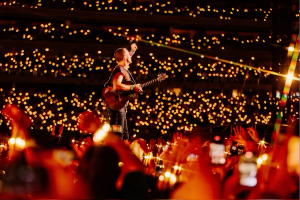
    A similar pattern is visible in India. Coldplay’s two January 2025 concerts at the Narendra Modi Stadium in Ahmedabad drew more than 220,000 attendees and generated an estimated ₹641 crore in economic impact for the city, underscoring the growing role of large venues as year-round entertainment destinations.


    The question worth asking is why this model has become so compelling at a moment when almost everything a stadium once monopolized… can be experienced from a screen at home.


    The concert business helps explain why. Pollstar reported that average gross revenue from stadium concerts reached $7.11 million per show in 2025, up 19 percent from the previous year, while average ticket prices rose 18 percent. Taylor Swift’s Eras Tour became the highest grossing tour on record. Those figures illustrate why developers continue investing in venues that can accommodate music, festivals, and other large gatherings alongside sport.

    Demand for live experiences appears to be growing as well. Eventbrite’s 2026 Social Study, surveying adults aged 18 to 35 in the United States and Britain, found that 79 percent planned to attend more live events than they had the previous year. People are paying for more than the match or the concert itself. They are paying to occupy the same physical space as thousands of strangers reacting in real time, an experience that remains difficult to replicate online.

    The World Cup itself fits neatly into that logic. FIFA did not require a fleet of newly built arenas. It relied on existing venues that could be upgraded to tournament standards and continue generating revenue long after the competition ends. Renovations across the host stadiums are expected to leave behind infrastructure that supports concerts, conventions, and other events for years to come, extending the commercial life of each building well beyond football.


    Coldplay concert / in.pinterest.com


    The model is not without tradeoffs. Ticket prices have risen steadily across many major leagues, making attendance less accessible for some supporters. Economists have long questioned whether public subsidies for stadium projects deliver returns that justify their cost, and local businesses can lose foot traffic when visitors spend their time and money inside integrated entertainment districts rather than in surrounding neighborhoods.

    There is also a cultural cost that is harder to quantify. For generations, stadiums brought together people who might otherwise have had little in common beyond allegiance to a team. They stood in the same queues, sat in the same sections, and reacted together. Premium clubs, private lounges, and hospitality suites do not eliminate that atmosphere, but they redistribute it across different tiers of access.

    Researchers and designers have long argued that densely packed supporter sections contribute meaningfully to the character of a match. Borussia Dortmund’s Yellow Wall, one of football’s most famous standing sections, is often cited as evidence that architecture shapes atmosphere as much as the game itself. Clubs understand this. Even as hospitality expands, many preserve vocal supporter areas because they remain essential to the experience the venue is selling.

    What is emerging in city after city is a different kind of civic space, one built to host concerts, conferences, festivals, restaurants, and football in equal measure, and to remain active throughout the year. In an increasingly digital world, developers are making a remarkably consistent bet that people will continue to place value on gathering in person, and will keep paying for places that make those gatherings possible.

  • Running the Extra Mile

    Do you remember running as a child? 

    Running for the pleasure of the run, arms windmilling, legs a-blur as you careened down the road, running hell for leather, running and collapsing into giggles, running without direction, just running. When was the last time you ran like that?

    We’re all grown up now of course. We have full time jobs, families to caretake, homes to maintain. If we have time to run (or exercise), it is clocked and measured and logged into apps. Ours is an era of utilitarianism in which all acts must be overtly purposeful, their value measurable in some way, else they are deemed a waste of time, dispensable.  

    Let us for instance, take the app Strava. Strava is an app for active people – “Strava athletes upload everything from walks around the block to Tour de France stage wins. If you’re out there going for it, you’re one of us,” says the website. 


    www.pexels.com


    In every way, this is admirable. If there is an app that can propel a largely sedentary population to get off their behinds and move, it can only be a good thing. Similarly, My Fitness Pal is an excellent food tracker, logging meals to help us eat better by tracking calories and macros.  Both are amongst the most downloaded free fitness apps available around the world. 

    The bonus? Most apps (including the two mentioned above) offer community resources to build camaraderie and competition. “I love the connection, I love the encouragement,” says Tamiko G, a My Fitness Pal member. Users log the details of their day, their cycle runs, their meal plans, their Pilates sessions. Thus, they measure the minutiae of their lives against their online fitness community, who cheer them on to get even faster, even thinner, even better.  

    Research on runners inside virtual training clubs has found that people who receive encouragement and recognition for their logged activities tend to run more consistently, than those who don’t. Over time, runners in the same online groups take on similar training habits, syncing pace, distance and frequency with their community. People who engage with fitness-app communities, whether through encouragement from friends and family or friendly competition with strangers, report higher activity levels than those exercising alone. 


    If there is an app that can propel a largely sedentary population to get off their behinds and move, it can only be a good thing.


    The other side of the coin? There’s a particular kind of guilt that didn’t exist a generation ago: the guilt of going for a run and not recording it. “If it’s not on Strava, it didn’t happen” has become something of a running joke among athletes. But when fitness becomes an act that is constantly performed for others, how does that affect our identity and our behaviour?

    As with traditional social media, we begin to chase the thrill of the like, growing ever more virtuous with every post. Segments and personal bests became a kind of currency. We begin to shuttle between the demands of social media and a sense of inadequacy in the face of thousands of people whose lives seem more productive than our own.

    After all, scrolling past an athlete’s effortless-looking long run distorts what a regular workout looks like; most of us aren’t really trying to win the Mumbai Marathon, we’re just trying to stay in shape. 

    However bright a gloss you paint on it, leaderboards and badges can tap into our worst primal instincts: pride in winning, envy at being outdone, vanity at having outdone another. These mechanics aren’t accidental; they’re the same psychological levers that make any social platform sticky.


    www.pexels.com


    Missed goals or broken streaks don’t just disappoint people, they can trigger guilt, shame, anxiety, or a compulsion to ‘make up’ for the lapse later, a pattern that sits uncomfortably close to disordered relationships with food and exercise. Notably, much of this distress gets framed by users themselves as a personal failing rather than a predictable consequence of how these systems are designed to keep people engaged.

    Consequently, an October 2025 study in the British Journal of Health Psychology found that users highlighted “numerous negative behavioral and psychological consequences of these apps, including feelings of shame, disappointment, and demotivation, and subsequent disengagement with apps and health behaviors.” 


    However bright a gloss you paint on it, leaderboards and badges can tap into our worst primal instincts: pride in winning, envy at being outdone, vanity at having outdone another.


    The same social features that can breed comparison and guilt are, for many people, the reason they exercise at all. The honest picture is more like a double-edged sword: the visibility that pulls someone off the couch is the same visibility that can make them feel inadequate once they’re moving.

    What seems to matter most is who that visibility is shared with. People whose feeds consist mostly of peers, friends, and genuinely supportive communities use others’ fitness metrics as fuel. Those who follow professional athletes or influencers report feeling a constant sense of inadequacy tugging at their thoughts; enough sometimes, to stop them from exercising at all. 

    Fitness apps didn’t invent comparison, pride, or the desire to be seen. They simply built a stage for instincts that were already there. Whether that stage helps you move more or makes you feel worse seems to depend less on the app itself, and more on what you choose to watch while you’re on it.

  • The Golden Girls

    Scene 1: Aunty wobbles slowly down a staircase, her leg encased in a thick bandage, wires protruding from her nose. Her foot misses a step, but her son steadies her.

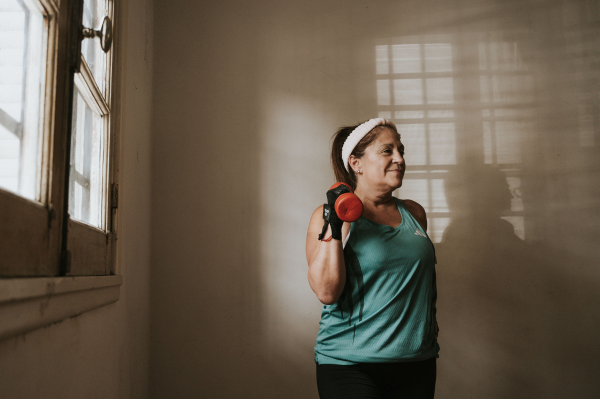
    Scene 2: Aunty is in a gym, wearing a loose salwar kameez and fuchsia pink sneakers. She looks fragile, dwarfed by the thick support belt she has girdled round her waist. Suddenly she bends down, et voila! Aunty has just deadlifted 80 kgs (approximately 175 pounds) with ease. 

    This isn’t the latest Avengers film. This is a reel from the Instagram account maaormannu, managed by the trainer Manish Singh Shakya (via @becomingmannu), featuring his 57-year-old mother Javitri Shakya. What makes Ms Shakya’s journey even more extraordinary is that she has battled cancer, and is missing a chunk of flesh from her leg.

    Scene 1: The camera, all a-blur, focuses on an aunty in a pea-green salwar kameez. Her hair is streaked with white, and she is breathing heavily. Around her, young men with ropy muscled arms, stand around and chat with each other.

    Scene 2: Aunty stretches to get rid of the kinks in her back, then bends down. She has just trapbar deadlifted 110 kgs (pounds) with perfect form.

    These aren’t scenes from the Justice League film. This is a reel from the Instagram account Weightliftermummy, featuring 71-year old Roshni Devi Sangwan, who has been featured everywhere from the South China Morning Post to the BBC. As in Ms Shakya’s case, Ms Sangwan is trained by her son, Ajay Sangwan.


    www.canva.com


    Across India, a slew of older Indian women are picking up heavy pieces of metal in the gym, and skewering stereotypes in the process. Urged on by worried children, many of whom are fitness trainers themselves, these ladies are reversing osteoporosis, calming their cholesterol, and reducing their diabetes. The biggest flex, it turns out, is no longer just your Hyrox trophy. It’s your mother hip thrusting 100 kgs. 

    In a testosterone-steeped country, this is more than just a trend. It gestures to a much larger societal shift. 

    But first, let us examine some numbers. India’s commercial fitness sector is valued at 16,200 crore — roughly US$1.94 billion — with some 46,500 facilities and 12.3 million members. By 2030, that figure is expected to nearly double, to 37,700 crore, with 23.3 million Indians possessing a gym membership. 

    And yet, according to a 2024 report by the Ministry of Statistics and Program Implementation, only 3.9 percent of Indian women under 29 exercise daily. For men in the same age bracket, the figure is 14.8 percent. For every woman exercising in India, nearly four men are doing the same. And it goes without saying that the participation rate drops even further still as women age into motherhood and grandmotherhood. 


    Women are buttressed by the restrictive language of respectability. Is it entirely respectable, patriarchy asks, for a woman to go into a male-dominated space such as a gymnasium, and lift heavy pieces of metal, perhaps with a male trainer?


    Consider what the average Indian woman’s day looks like. She wakes early to cook and pack lunchboxes, to shunt children off to school and husband off to work. A full day of office work later, she returns home to the third shift of the day; cooking, doing the dishes, supervising homework, the endless administration of her household. Studies on time use in India consistently show that women spend three to ten times more hours on unpaid domestic work than men do. 

    Then there is the question of space. Fitness — running, cycling, strength training at the gym — is largely predicated on striding into public spaces. But such spaces are oft seen as the arenas of men; women instead, are buttressed into their homes by the restrictive language of respectability. Is it entirely respectable, patriarchy asks, for a woman to go into a male-dominated space such as a gymnasium, and lift heavy pieces of metal, perhaps with a male trainer? And when it comes to older women, that fear swells, folded into the larger worry of injuries to aging bones and joints.

    Gendered constraints aside, there is also the peculiar problem of plenty. Middle-income families are now glutted with a vast choice of carbohydrate and fat-rich food in restaurants and stores. Traditional Indian food skews towards starch anyway, and without the balance of fitness, older Indian women are amongst the highest at-risk demographic for bone and heart disease. 


    www.pexels.com


    Luckily change is coming, slowly but surely.

    In cities like Bengaluru, Chennai, Mumbai, and Hyderabad, a new crop of women-only fitness spaces has begun to emerge. Pink Fitness, India’s largest all-women fitness chain, is staffed entirely by women: trainers, dietitians, physiotherapists, even housekeepers. Commercial gymnasiums sometimes offer women-only zones. 

    And simultaneously, India’s ‘Silver Economy’ is starting to spike a massive infusion of wealth into age-related fitness services. There are a handful of indications already. For one, even a cursory glance at most newly-developed senior living spaces will reveal that they are endowed with superbly-equipped gyms. Secondly, fitness trainers such as Bhavna Harchandrai, certified in senior citizen fitness, are now hosting training sessions for anyone above 60. An overwhelming majority of students are women. An ecosystem is slowly bricking itself around the aunty.

    Social media is reflecting this change too. A new wave of fitfluencers with names like @young67fit, @fitwithdadi and @barbellaunty are acting as megaphones for a different gym demographic — older, self-assured baddies, entirely comfortable squatting in salwar kameez. 


    India’s ‘Silver Economy’ is starting to spike a massive infusion of wealth into age-related fitness services.


    This revolution is mirrored around the world. In the United States, women like Joan MacDonald — who began lifting at 70, thanks to her fitness-trainer daughter — and Virginia Maccoll — a three-time Ninja Warrior competitor in her seventies — have built vast online (and offline) followings. Catherine Kuehn broke multiple world powerlifting records in her nineties. Meanwhile, in Taiwan, a ‘super-aged’ society with more than 20% of its population aging into their 60s, more and more senior women are finding their way into gyms, proving that their strongest years are ahead of them.

    And so something is stirring. And in the churn of social media and aspirational culture, the image of what an older woman’s body can do is being renegotiated in real time. The sons and daughters of women who never exercised are now fitness trainers, and they are urging their mothers to the gym. Perhaps this is the way that change comes then: not through institutions first, but through families. Not through public policy, initially, but slowly, slowly, through the persuasions of a concerned child. 


  • The New Souvenir Is Hiding in the Grocery Store

    For a long time, the modern souvenir followed a reliable formula. A fridge magnet, a keychain, or a miniature monument reduced to something that could fit in a carry-on and sit quietly on a shelf back home, marking the fact that you had been somewhere else.

    That formula is losing ground, and what is replacing it is stranger and, in some ways, more interesting.

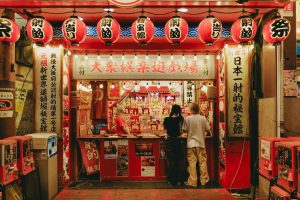
    Travelers are coming home from Japan with FamilyMart socks, from Paris with drugstore skincare, and from supermarkets in countries whose language they barely speak carrying bags full of snacks, spices, and pantry staples they have no recipe for yet. These are objects that were never designed to be souvenirs. They were designed to be used.

    Davneet S. noticed it on a recent trip to Paris. “I came back with skincare,” he says, “and not the fancy kind, the drugstore kind. At the store I kept meeting other travelers doing the same thing, buying for themselves and for people back home. It’s a thing now, apparently.”


    www.pexels.com


    He is not alone in noticing. Ankita S., who traveled to South Korea last year, found that what people asked her to bring back had shifted noticeably from previous trips. Sheet masks, specific ramen flavors, and convenience store basics, items so inexpensive that the requests surprised her at first. “That stuff is so cheap,” she says, “but it was also interesting.” Her sister wanted something entirely different, a Japanese kitchen knife with the kind of reputation that has earned a devoted following among serious cooks. The price was very different. The logic was the same.

    Part of what has made this shift visible is the internet. A generation ago, most visitors had little idea what people in another country actually bought at the supermarket or pharmacy. Today, those recommendations circulate constantly through travel forums, social media, and videos that linger over the shelves of ordinary grocery stores. Convenience stores, neighborhood pharmacies, and supermarkets have become destinations in their own right, and the products on their shelves have joined museums and restaurants as things worth seeking out.

    Japan offers one of the clearest illustrations of where this can lead. FamilyMart, one of the country’s largest convenience store chains, launched its Convenience Wear clothing line in 2021 with Tokyo designer Hiromichi Ochiai of Facetasm. The line’s striped crew socks, priced at 390 yen, or about $2.50, quickly became a bestseller and have since sold more than 20 million pairs. Their appeal lies almost entirely in the fact that they were never intended for tourists at all.


    These are objects that were never designed to be souvenirs. They were designed to be used.


    The regional KitKat arrived at a similar destination by a different route. Its name, pronounced in Japanese, sounds close to “kitto katsu”, or “you will surely win,” leading students to exchange the chocolate before entrance exams long before Nestlé embraced the association. The company eventually built campaigns around the custom and expanded its range of regional flavors, tying varieties to places such as Kyoto and Okinawa. In the process, the chocolate bar became something else as well, an edible reminder of travel that could be carried home and shared.

    Which raises the question of why any of this matters, why the object we carry back from a trip carries meaning at all.

    The literary scholar Susan Stewart argued in On Longing that souvenirs stand in for experiences that cannot themselves be transported. You cannot bring home the atmosphere of a Tokyo convenience store or an afternoon spent wandering Parisian pharmacies, so you bring back something that points toward those experiences instead. What has changed is not the underlying impulse but the objects people trust to do that work.

    Anthropologist Simi K. argues that souvenirs do social work beyond simple remembrance. “Without the object, the trip remains an experience in the traveler’s head,” she says. “The souvenir gives it a physical form that can be passed to someone else.”


    www.pexels.com


    A fridge magnet points to a place. A tube of moisturizer or a pair of socks points to how people actually live there.

    The French sociologist Marcel Mauss would likely have recognized the social logic beneath the trend. In The Gift, published in 1925, he argued that gifts help create and maintain relationships through acts of exchange. A souvenir is not only a reminder for the traveler. It is also a way of including someone else in the journey, of returning with something that says they were remembered.

    India has long had its own version of this practice, even if it has rarely been described in those terms. People return from Pune with Shrewsbury biscuits, from Kerala with banana chips, or from holidays with sweets divided among relatives and colleagues. The gesture often matters more than the object itself. A tin of biscuits is meant to be opened and shared around a table rather than displayed on a shelf.

    That is what the new souvenir seems to be doing everywhere. The memory stays active through use rather than display. Increasingly, the objects people choose to bring home are not the ones made to represent a place. They are the ones that already belonged there.

  • What Happens When Cousin Culture Disappears?

    There was a time when family gatherings had their own unofficial order. In sunlit rooms on Sunday afternoons, adults occupied the sofas and younger children orbited the snack table, usually at full speed. Somewhere in between was a loose, noisy cluster of teenagers and twenty-somethings drifting from cricket matches to gossip to late-night confessions. No one assigned you to a group. You simply aged into it and, for many people, it was the first community they never had to choose.

    For Megha S., an influencer from Jaipur, cousins occupied a space that was difficult to replicate elsewhere. “My cousins were my first friends who were also not my friends,” she says. “As an introvert, those interactions really helped me talk to someone who did not live with me.”

    In many societies where extended families remained central to everyday life, cousins occupied an invisible social layer, close enough to matter and distant enough to breathe. They were not siblings, which meant the intensity was lower. They were not chosen friends, which meant the pressure to maintain the relationship was almost nonexistent. They simply existed in your life because their family was yours.


    www.pexels.com


    Cousins also offered something that is easy to overlook. They were often a family’s first bridge to another place. The cousin who visited from another city or another country arrived with new slang, different music, stories from school, and photographs that made distant lives feel tangible. Long before social media flattened geography, many people learned what another part of the world looked and felt like through relatives their own age.

    Anmol S., an entrepreneur from Delhi, remembers those exchanges vividly. “My cousins lived in the UK, Canada, Dubai, and the US, and when everyone came home for Christmas, it felt like our own version of a mini United Nations,” he says. “We learned about their schools, their friends, the games they played, even the chocolates they liked. I knew what GAP and Lindt were long before they became easy to find in India. Each time they came, they got a bit of their home with them, and they always left with a bit of ours.”

    This experience points to a role cousins often play but rarely get credit for. They can be our first peers outside the immediate family, our first introduction to places we have never visited, and our first reminder that there are many ways to grow up.

    Anthropologist Simi K. describes cousins as a form of horizontal solidarity. “Unlike parents, aunts, or uncles, they are generational peers who share family history without exercising the same authority. They often become emotional safe havens and translators between older and younger generations.”


    Each time they came, they got a bit of their home with them, and they always left with a bit of ours.


    Cousins occupy a distinctive emotional position. She adds, “They witnessed your childhood embarrassments and have no particular reason to hold them against you. The relationship asks almost nothing of you. It can go dormant for months and resume as though nothing happened, sustained by shared history rather than active maintenance. Among friends, there is often some version of yourself that has been edited or curated. Among cousins, that performance is largely unnecessary. They already have the context.”

    Cousin culture also passes on knowledge in ways that often go unnoticed. Younger children get an early glimpse of adolescence before they reach it themselves. Family stories circulate sideways rather than top down. Traditions are absorbed through participation rather than instruction, often without anyone consciously teaching them.

    That ecosystem is slowly shrinking.


    www.pexels.com


    Since 1950, the global fertility rate has more than halved, and demographic research suggests cousin networks will continue shrinking across much of the world. Fewer children mean fewer aunts and uncles, and fewer aunts and uncles mean fewer cousins.

    Urbanization adds another layer. More than half the world’s population now lives in cities, a figure expected to reach 68 percent by 2050, with most of that growth concentrated in Asia and Africa. When families move toward opportunities, relatives scatter. The ancestral home that once served as a gathering point, the summer visit that required no planning because it simply happened, these things do not survive migration in any straightforward way.

    Simi argues that shrinking families are producing what demographers call “beanpole families,” tall rather than wide. As cousin networks thin out, responsibilities that were once shared across a broad family become concentrated within smaller units. Some forms of care and support increasingly move from kinship networks into the marketplace. As she puts it, “People end up buying services that kinship once provided for free.”

    As families shrink, many children are growing up without this intermediate circle. Their social world becomes divided between the nuclear family at home and friendships outside it, with little in between. Many only realize what cousin culture provided when they move abroad or away from extended family and find themselves trying to recreate it through college friends, WhatsApp groups, or what they come to think of as chosen family.


    Traditions are absorbed through participation rather than instruction, often without anyone consciously teaching them.


    What replaces it, if anything, is worth thinking about. Modern life has become unusually good at intentional community. People build networks deliberately, choosing friends, finding online groups organized around shared interests, and sustaining friendships into middle age in ways that would have been logistically impossible for earlier generations.

    But these relationships require continuous effort. They depend on scheduling, on responding, and on mutual investment that has to be renewed. While they are valuable in their own right, cousin relationships, at their best, required almost none of that. They were maintained by birthdays, festivals, weddings, funerals, and long afternoons in grandparents’ homes, occasions that simply arrived.

    Perhaps this is why so many adults feel nostalgia not for any specific holiday but for the feeling of always having someone their own age around. The memory is not really about the place. It is about belonging, and about seeing the world through people who already belonged to yours.

    Of course, cousin culture was never universal. Some families are too small, too fractured, or too geographically dispersed to sustain it. Others reproduce dynamics that make closeness uncomfortable or impossible. The point is not that cousins are inherently better than friends, but that they provided a particular kind of relationship that is becoming rarer and that nothing in contemporary life has quite replaced.

    What we are trying to recreate is not cousins themselves but the kind of belonging they once supplied. A sense of continuity and familiarity that asked very little in return. As families change, that form of connection may become rarer, leaving future generations to build deliberately what earlier ones often inherited by accident.

  • Is AI The New Witch Hunt?

    2026 was the year that changed everything.

    Jamir Nazir’s The Serpent in the Grove was one of the winners of the 2026 Commonwealth Short Story Prize. So were short stories by John Edward DeMicoli and Sharon Aruparayil. Soon after, Harnidh Kaur’s The Girls Are Not Fine began to make its way into Indian bookshops. And around the same time, Olga Tokarczuk, the Nobel Laureate, gave a (somewhat polarising) speech in Poland.

    What threads these seemingly disparate events together? All these writers have faced an online outcry for using AI. Or so the Internet would have us believe.

    There is nothing new about the fears of machine-written texts. But up until now, these fears lurked behind relatively minor niggles about Chatbot-scribed student essays, inflated Amazon reviews and the odd article or two (apparently even the New York Times is not immune). 


    unsplash.com


    But now? The incidents of 2026 have showed us that technology has scythed through the writerly bastions that were once believed to be heavily walled against it. Apparently, nowhere is safe anymore. Any writer, good or bad, publicly putting their work up online is now at risk of being accused of using AI; as creative writers, the subtext goes, we are meant to be better than that. 

    Across social media, posts now pop up like flags — ‘Ways to Spot AI’, ‘How to Tell if AI Has Written This Article’. Carousel after carousel and tweet after tweet point to the use of the em dash, the repeated use of the word ‘delve’ or apparently ‘gamechanger’, the obsession with the use of three (adjectives, phrases), the asking and the answering of a question, the use of the X and Y variables (“it’s not just x, it’s y”), the tedious, bloviating explanations of the most basic ideas. 

    The assumption is that most writing is now steeped in AI. A ravening mob of commentators now prowl the comments sections, lying in wait with pitchforks, only to leap out at the teensiest hint of it. And instead of engaging with the actual content, the writing is dismissed as slop.

    The issue has climbed to such a fever pitch that the Author’s Guild was elbowed into releasing a statement for publishing professionals stating that uploading or inputting a copyrighted work or an author’s personal information into AI systems without permission may constitute a violation of the author’s copyright or right of privacy, and it puts the author’s intellectual property and personal information at risk.


    A ravening mob of commentators now prowl the comments sections, lying in wait with pitchforks, only to leap out at the teensiest hint of AI.


    This is not to dismiss legitimate concerns over AI. 

    The world is in an unprecedented environmental crisis, further stoked by data centers gorging precious ground water and spiking temperatures. (The latest salvo in the ongoing battle against these centers has now been fired by Erin Brockovich herself, who is mapping the footprint of data centers across the USA). 

    There are also very real fears that AI might dim users’ critical thinking and creativity; we may argue that these are the very traits that make us human. 

    But standing against technology-assisted writing does not equal supporting the AI author witch hunts. 

    Many of the accusations made are supposedly baseless. Aruparayil for instance, has strenuously denied using any kind of AI for her stories. Tokarczuk has since clarified her loose comments on using AI as well, stating that none of her texts, including the novel that will appear in Polish this fall, have been written with the help of artificial intelligence – except for using it as a tool for faster preliminary research. After all, AI detection models such as Pangram can be wrong too — how then can one choose them as the final arbiter of a piece of writing? 


    unsplash.com


    Besides where do we, as readers, draw the line? An entire text slapped out by Claude AI is clearly unacceptable. But what about dropping in a phrase or two? Or using Claude to search for that one particular, appropriate word instead of fossicking through the Cambridge English Dictionary? Or using it as the bedrock of your research, upon which you can later build your piece?

    Nowadays, some writers are too paralyzed to write a single word publicly. Others are simply pissed off. “No one is more annoyed by the AI revolution than people who can actually write a sentence,” tweeted Laura Matsue. “Basically, having any ability to write now is suspect — you will get accused of being AI at some point. It feels like you are being accused of being a witch, of holding a type of rare magic that only the machines are now allowed to have.” Which begs the question – are some of these critiques born of the scarcity mindset, or dare we say, writerly envy? 

    Matsue got a volley of responses in support, and her message was reposted 1,111 times at the time of writing this piece. Several commenters pointed out the deep irony of the fact that the GenAI style being called out was in fact bricked upon centuries of human writing. AI uses em dashes because humans use em dashes, and always have. 

    All of which is to say that writers will keep writing, people will keep critiquing. You might think the best writers use AI. You might think the worst ones do. But it is important to remember too that all bad writing is not AI. Sometimes, bad writing is just bad writing. And vice versa, of course.

  • Inside India’s New Astrology Aesthetic

    For generations, astrology in India has shaped the calendar of ordinary life. Naming ceremonies, business launches, and wedding dates all run, at least in part, through the positions of planets. For many people, astrology is less a fringe belief than an ordinary part of everyday life, shaping decisions both large and small.

    It is also evolving. What is changing is the culture built around it, and who is doing the building.

    Scroll through Instagram on any given day and you will find a kundli meme sitting three posts above a tarot reading, which sits two posts above a skincare tutorial. Young Indians living in cities are exchanging screenshots of birth charts the way an earlier generation passed around personality tests. They joke about being emotionally unavailable because of their rising sign and, in the same breath, consult an astrologer before signing a lease. The irony and the sincerity coexist without much friction, which is itself telling.

    The more interesting question is not whether people believe in astrology. It is what they are using it for.


    unsplash.com


    India’s relationship with the stars goes back further than any single tradition can claim. Vedic astrology, or Jyotish, is one of the oldest continuously practiced systems of astrology in the world and remains deeply influential today. Bejan Daruwalla, a former English professor, helped bring horoscopes into the Indian mainstream through widely syndicated newspaper columns that drew on Vedic astrology, tarot, numerology, palmistry, and the I Ching. Astrology’s place in Indian public life did not begin with Instagram. What Instagram changed was the form it takes and who gets to participate in it, just as it has for so many other things.

    Ayushi Sahni began practicing as a healer full time in 2022. Based in Delhi, she works with clients across what she describes as the gap between spiritual and mental health services, two domains that, in her experience, often lead people to ask similar questions. “In both cases, people reach out when they are going through something difficult,” she says. “Spiritual tools can offer meaning, but they can also provide psychological support.” She is careful to add that, as with therapy, people should seek qualified and certified practitioners.

    For Kriti S., a 35-year-old entrepreneur, tarot has been part of the picture since her teenage years, though the way she uses it has changed. “I consult my healer before most major decisions now,” she says. “Sometimes, if I have a bad feeling, I’ll even ask about something as simple as booking a flight. It helps soothe my anxiety.”

    She postponed the launch of a business after her healer advised that the timing was unfavorable. A month later, the pandemic began. “Whether by coincidence or intuition, that experience deepened my trust,” she says.


    unsplash.com


    Dimpy Ahuja, a banker in Gurgaon, takes a lighter approach. She uses AstroTalk when she is feeling uncertain about something. “Sometimes I agree with what I hear and sometimes I don’t,” she says. “But I like having the option of putting my worries out there. When I’m indecisive, it feels like I have a cosmic ear to turn to.”

    That phrase, a cosmic ear, may be the clearest description of what contemporary astrology offers. It does not promise certainty. It offers a place to put uncertainty.

    To understand why this particular moment has been so receptive to astrology, it helps to understand what has changed in the past decade. India has the world’s largest population of Gen Z and millennials by raw numbers, many of whom came of age amid economic uncertainty, the pandemic, rapid urbanization, and an always-on media environment. Psychologists and cultural theorists have long observed that people gravitate toward systems of meaning during periods of instability. Astrology is unusually flexible. It can function as entertainment, ritual, sincere belief, or ironic shorthand, sometimes all at once.


    It does not promise certainty. It offers a place to put uncertainty.


    The digital transformation accelerated all of this. Apps like AstroTalk made it possible to consult an astrologer at midnight, in private, for less than the cost of dinner. A study found that women account for 60 percent of digital astrology platform users in India, with 63 percent of female users falling between the ages of 18 and 30. The subjects they most often seek guidance on are relationships and major life decisions. The privacy these platforms offer may be just as important as the guidance itself.

    The aesthetics shifted alongside access. Western birth chart discourse found an audience that was already fluent in kundlis and comfortable holding multiple frameworks at once. Rather than displacing Vedic astrology, the internet blended it with tarot, crystal healing, Human Design, and Western sun sign culture into something distinctly contemporary. Today it is not unusual to see references to Saturn return and Sade Sati appear in the same Instagram caption.

    For some young Indians, these newer forms of astrology are not replacing older traditions so much as offering something those traditions were never designed to provide.

    Uday, a marketing professional in Delhi whose name has been changed to protect his privacy, grew up in a family that consulted an astrologer regularly. As a queer person who had not yet come out, those sessions were often uncomfortable. “Whenever we visited our astrologer, conversations inevitably drifted toward marriage and children,” he says. “I wasn’t out to my family at the time, and those conversations added pressure to an already stressful situation.”


    The more interesting question is not whether people believe in astrology. It is what they are using it for.


    Working with independent healers gave him a space to discuss relationships and the future without those assumptions. “When I was thinking about getting serious with someone, or eventually coming out to my family, those conversations felt much easier to have,” he says. “I was a believer all along. I just needed a safe space to share.”

    A 2025 Pew Research Center survey in the United States found that LGBTQ+ adults consult astrology at roughly twice the rate of the general population and are significantly more likely to use what they learn to inform actual decisions.

    None of this exists outside the marketplace. The commercial layer of contemporary astrology is impossible to ignore. Manifestation journals, crystal sets, subscription readings, and algorithmically optimized content have become part of the ecosystem. The Indian astrology app market attracted virtually no institutional investment in 2015. By 2024, that figure had reached $50 million, and AstroTalk alone was valued at $300 million.

    Reducing the phenomenon to branding, however, misses something important. Mercury retrograde has become shorthand for communication gone wrong. A Saturn return offers a way to talk about upheaval. A difficult transit can become permission to acknowledge that life feels difficult. Whether or not people believe those ideas literally, they have become part of a shared vocabulary.

    Whether the stars have any bearing on what happens to us is almost beside the point. What they clearly offer many young Indians is a set of stories that helps make the present feel a little more navigable, without demanding certainty about the future.

  • Boost your Brain with…Beer?

    Picture a pub. No matter where you are in the world, you probably imagined old-fashioned wooden floors and furniture, leather seating, a dimly-lit room, and pints a’flowing. The cosy interior, often the place to wind down at the end of a long day at work, is now becoming a home to another use of the space: lectures. People gather around an expert, drinks in hand, to learn for an hour or two about neuroscience, or migratory patterns of certain birds, or literally anything else. 

    From Lectures on Tap or Profs and Pints, in the US, Pint of View and Brydge in India, and Academic Bars in China, more and more people are drawn to these sessions. These pub lectures aren’t new; the first of their kind was held in 1998 in the UK, and since 2013, there’s been the Pint of Science festival, which takes education outside the campus and into less formal spaces.

    In 2026, access to knowledge is relatively frictionless. Chatbots can regurgitate information from multiple sources, standalone talks and lecture series have been a staple of YouTube for over a decade, and knowledge sharing abounds across social media platforms. So what do audiences stand to gain from a pub lecture experience? After all, learning has always been an incentivized process. In school and college, the incentive was good grades, which eventually led to a good paycheck, and ultimately, a good life. 


    Eating and drinking and learning new things – what could go wrong? / medlanska via in.pinterest.com


    So why have pubs become the seat of this new wave of occasional learners? 

    For one thing, given that these are pub and bar-based events, the audience is 21 years of age and above; most of them probably hold an undergraduate degree. Some of them may have dreamt about going back to school. What these pub lectures potentially offer them is a chance to renegotiate their relationship with learning and education, on their terms.

    Pubs are nothing like a standard lecture hall—stark lighting, stuffy chairs or benches, and days that end with the sound of a shrill bell. A pub lowers inhibitions, making education far less daunting than in a classroom. Sure, a restaurant or cafe works too. Pubs, with their standard offering of alcohol, delicious bar snacks and lively social settings, offer a more universal, informal space. 

    Besides, online learning is not the entirely reliable option it used to be. One could sit at home and watch lectures-on-demand, or go down internet reading rabbit holes. However, misinformation spreads like wildfire today, with AI slop articles taking up more real estate, and fact-checking becoming increasingly difficult (or obsolete, for tech giants like Meta). Sitting across from an expert in their field, even in a dimly lit bar, carries more trustworthiness than any self-motivated research. 

    Another advantage is that these lectures don’t carry the formality of a conservative education system, in which received pedagogy is given preference. In the traditional power structure of an educational institution, questioning teachers was frowned upon. On the other hand, at a bar, everyone is slightly tipsy and relaxed, inhibitions are dropped, chit-chat and questions are welcomed, and in fact, most organizations set aside a specific chunk of time after the lecture, to encourage exactly that. 


    www.pexels.com


    For decades, most Indians followed a straight and narrow path: become an engineer or doctor, and then do as you please. There was little to no room for interdisciplinary learning in the process, leaving them with no leeway for pursuing their real interests. Lectures such as these fill exactly these gaps. It’s why a programmer walks into a bar to learn about bat conservation, or a project manager finds herself in a lecture about human rights law.

    The synchronicity of the growth of pub lectures in the US or in China, and the advent of the format in India, doesn’t come as much of a surprise. Most pubs and bars that play host to these lectures in India are in the major metropolitan cities like Delhi, Bengaluru, or Mumbai, where bar culture is fairly widespread. Pubs are popping up across Tier-II towns as well; if the trend of pub lectures sticks strongly enough in the Tier I cities, it might percolate similarly elsewhere. 


    For decades, most Indians followed a straight and narrow path: become an engineer or doctor, and then do as you please. There was little to no room for interdisciplinary learning in the process, leaving them with no leeway for pursuing their real interests. Lectures such as these fill exactly these gaps.


    Another constraint of traditional academia that these pub lectures tackle is the financial impediments; after all, getting a good education comes at a cost. Student loans continue to be a deterrent for many, and regular budget cuts for academic programs mean that admissions are dwindling. If a person keen on being a student can get a regular (albeit tiny) window into the academic life with a pint glass in hand, at a price point starting at $35 in the US and ranging from ₹700 to ₹1500 in India, that frees them up to continue to learn at leisure and at will, while also carrying on with their day jobs.

    What incentivizes the academics and experts who head these lectures? They become a route to exercising their teaching muscles in a non-traditional way. For some, it is an excellent way to publicize their book. Often, pub lectures become a quick side hustle (academia is often a rather poorly paid field). For some, it’s also an opportunity to share their research that may perhaps be too niche to find publishing interest. And with an interactive crowd that is mostly outside their domain, who knows, they may even find ways to refine their work through the questions and discussions it spawns.

    And perhaps that’s what is so appealing about this format today: the absence of traditional constraints, and a learning environment that is sculpted by choice and curation—of who attends which lecture and why—rather than compulsion needing to complete every module to qualify as a learned person. These lectures don’t just celebrate and encourage learning, they are also a celebration of the choice to do so. The incentive, ultimately, is in the doing.