

Just before August 2026 arrived, one of India’s most popular home-grown café franchises, Cafe Coffee Day, dropped hints about going purple. On their social media handle, they shared pictures of purple coconuts, zebras, jalebis and even traffic lights! A big colorful addition to their menu cards—but before purple, the urban centres of India have already undergone a green wave, with people becoming eager to find the best cup of matcha in town. Matcha had the internet divided last year, and we might even consider it to be the predecessor to the purple colored substance that might soon be taking over Indian cafés– ube.
So what is the new purple culinary craze that the country might just be waking up to?
Ube, or the purple yam, has been a staple ingredient in Filipino cuisine as it is native to the Philippines. Its rich violet pigment lends its colors to a large number of dishes, but its inclusion in dessert recipes of various kinds is what made it start traveling the world. With its harvest season in spring, food stores across North America and Europe offer ube-based drinks as a seasonal feature over the spring and summer seasons, much like pumpkin-spiced drinks are popular during fall. Pumpkin-spice might not become a trend in India owing to its tropical climate and the notable absence of an autumn, but ube is certainly more versatile.
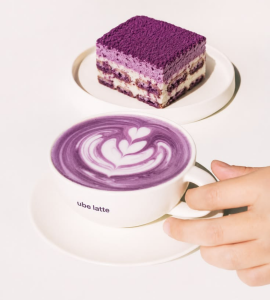
For the last few years, the largest Starbucks Reserve store in Chicago has been offering drinks that are topped with ube-flavored cold foams during the summers. Other popular chains like Costa, Pret, and Black Sheep Coffee also have ube on their menu. In India, the coffee franchise from Greece, Coffee Island which launched multiple stores across the country last year, introduced ube to their drinks. In Kolkata, Scarlet Café has started offering Ube milkshakes, and iced coffees with ube flavors. In Hyderabad, outlets such as Big Star Cafe and Bagel Brigade have been catching up with the trend. Turns out, the color of the drink itself goes a long way in catching the attention of the consumer.
Looking at North America, another arena that might play a hand in the popularity of ube, are the Asian grocery stores — where ube flavored ice creams are a raging hit. Ube is used for flavoring mochi ice creams, and many brands — including Trader Joe’s — offer a version of the sweet but earthy flavored, purple ube ice cream. A popular and earlier version of an Ube dessert served on the streets of Manila, is called sorbetes, which is made by combining purple yams, and the milk sourced from carabaos, a species of water buffaloes indigenous to the Philippines. The other classic dessert is called the ube halaya — which is a creamy yam-based jam. While many ube-flavored edibles are sold as packaged products, it is also sold as a fresh ingredient in local stores run by migrants.
“
Its rich violet pigment lends its colors to a large number of dishes, but its inclusion in dessert recipes of various kinds is what made it start traveling the world.
”
A preliminary round of research suggests that Indians are no strangers to the growth of these tubers. Locally, they go by different names: ratalu, kand, neeli kachalu or konfal, while scientifically they go by dioscorea alata. As many as eight years ago, a man from Thiruvananthapuram managed to harvest a bunch of purple yam that weighed 82 kilograms! The Malayalam name for the vegetable is mulkkizhangu, but it is now rarely cultivated in the state of Kerala, although its surrounding areas have a rich history of cultivating this plant. These yams have been used for cooking savory dishes, and other curries. They are typically used for making chaats, sabzis and also for making paranthas that use kand as a stuffing. However, it seems that its usefulness in desserts has remained uncharted territory.
Ube’s rise to popularity could be compared to the omnipresent nature of matcha based drinks in Indian cafés, but what it also meant for its country of origin, Japan. The rising demand for matcha led to a shortage of the supplies, with stores in Uji, the matcha capital of Japan witnessing massive footfalls, and shelves full of matcha powder tins being swept clean within minutes of shops opening their doors to customers in the morning. Noticing a sustained interest in this green-tea powder, the Indian state of Assam took the initiative of growing matcha in their own backyard, as Japan has been struggling to keep pace with soaring global demand for matcha.
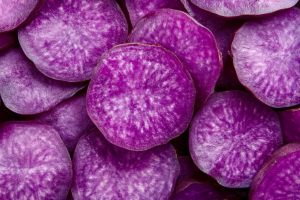
While the demand for ube is on the rise, there seems to be a problem with the supply chains in the Philippines too. In 2025, nearly 1.7 million kilograms of ube products were exported globally by the country, and nearly half of that amount was received by the United States of America alone. This has put a strain on the country’s agricultural landscape, as the amount of purple yams grown in the country has dropped from 15 million kilograms to 14 million, in a span of five years, according to the New York Times.
In recent years, other countries in the region, such as China and Vietnam, have decided to consolidate their efforts to ramp up the growth of purple yams on their soil. Given the fact that Assam has taken the initiative to grow matcha in India itself, what could possibly be stopping farmers in India from tapping into the production of purple yams, especially when many parts of the country provide conditions that are conducive to their growth? To see it take on shapes and forms that have been in the making in other parts of the world? The 21st century has largely projected to be the Asian century, with Asian influences overtaking the world. We have several reasons to believe that this projection is true—as we hop from one colorful global food trend to the next — all to be traced back to the culturally rich and diverse countries of Asia.





Leave a Reply