

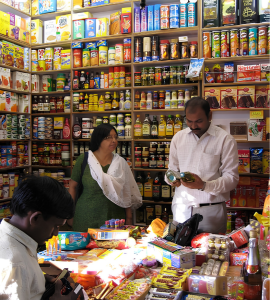
Picture this: you’re standing in a grocery store aisle in New York City, staring at $15 cereal and wondering how the prices soared so high. Or you’re at a local grocery store in Mumbai, where the shopkeeper sells everything from rice to shampoo sachets but only stocks what he can afford to shelve. In both cases, it’s the same question: why does something as basic as food feel so precarious?
That question has found an unlikely answer in the USA. In 2025, the then-New York State Assembly member and now NYC Mayor Zohran Mamdani proposed something that felt both radical and oddly logical at once: what if the city opened its own chain of grocery stores?
The idea is simple. The city would establish publicly-owned grocery stores in areas underserved by private retailers, and particularly in food deserts where residents struggle to access affordable fresh produce. Mamdani has pledged to open five such shops, one in each borough. The first is slated to open in 2027 at The Peninsula, an affordable housing development in the Bronx. Another is planned for 2029 in La Marqueta in East Harlem.
At a rally announcing the Bronx location, Mamdani described the project as evidence that the government can improve people’s daily lives. Supporters saw it as an innovative response to rising food costs and unequal access to groceries. Critics, meanwhile, question whether the city should enter the grocery business at all.
Yet regardless of whether the stores ever succeed, the proposal has already achieved something significant: it has reframed the conversation about food. Instead of asking how consumers can better navigate an increasingly unaffordable system, it asks whether the system itself should work differently.
For decades, the modern supermarket was presented as one of capitalism’s success stories: endless aisles, abundant choice, fresh produce year-round, and competition that supposedly kept prices low. But even if that was ever the full reality, the situation has now changed. Food inflation has turned everyday necessities into financial burdens. Grocery chains have consolidated, closed stores, or retreated from lower-income neighbourhoods. Several communities now live in food deserts, dependent on fast food restaurants or convenience stores for quick access to food.
Much of the world would find the idea of government-run shops familiar. Long before New York began debating municipal supermarkets, governments and communities elsewhere had already trodden this path.
Let us take India as an example. Rationing and ration shops were introduced during colonial rule just a few years before the eclipse of the British empire, then carried onwards to post-Independence India by the Indian National Congress, thanks to the crippling food insecurity colonization had introduced into India.
For decades, rationing provided subsidized grain and other essentials to millions of households. During the pandemic, it became a crucial lifeline, helping families shoulder the stresses of lockdowns, unemployment and supply disruptions. In some ways, Mamdani’s proposal echoes the spirit of India’s rationing system.
Not that the system is perfect. It has consistently been plagued by complaints about poor quality produce, bureaucratic hurdles, and inconsistent supplies. Yet despite its flaws, it stands tall as one of the world’s largest food-security programmes, built on a simple premise: access to food cannot be left entirely to market forces, especially with an economically-precarious citizenry.
Other countries have arrived at similar conclusions through very different models. Cuba’s libreta system guarantees citizens a monthly basket of subsidized essentials through state-run distribution networks. Venezuela’s CLAP programme emerged as an emergency response to economic collapse, delivering food boxes directly to households. In Finland, consumer-owned cooperative supermarkets operate on a different principle altogether, prioritizing member ownership, price stability and community participation over shareholder returns.
Still, the proposal has sparked intense debate. In countries where public services are deeply embedded in everyday life, state involvement in food distribution may seem unremarkable. But the United States has long linked food access to free-market logic. Americans may accept publicly funded schools, libraries, parks and transit systems, yet many remain uneasy about government operating grocery stores.
That discomfort has already surfaced. New York City Council Speaker Julie Menin has questioned how city-owned stores might affect bodegas and neighborhood supermarkets. Small-business groups and independent grocers argue that publicly-funded competitors could distort an industry where profit margins are already low.
Others raise concerns about feasibility. Some critics point to a report by Community Food Advocates suggesting that five stores may be too small a network to meaningfully influence food prices across the city. According to the report, a program capable of significantly affecting affordability would require roughly 20 stores, nearly $400 million in startup costs and hundreds of millions of dollars in annual operating subsidies. Others argue that the city has yet to provide a detailed policy framework explaining how such costs would be justified or sustained.
But perhaps the real significance of the debate lies in what it reveals about a changing relationship between citizens, markets and governments. Across the United States, cities are increasingly experimenting with new approaches to food access. Los Angeles has introduced free grocery shuttles for residents in underserved areas. San Francisco’s Food Empowerment Market offers discounted groceries to low-income households. Chicago has explored the possibility of municipally-owned grocery stores.
For much of the 20th C, Americans largely treated food as a market commodity. Much of the rest of the world treated it as a public responsibility. Mamdani’s proposal sits at the intersection of those two traditions.
From Mumbai’s ration shops to New York’s proposed municipal supermarkets, we are seeing different versions of the same impulse: a recognition that food is too important to be treated as just another product on a shelf. The debate is no longer simply about groceries. It is about who bears responsibility for ensuring that people can afford to eat.





Leave a Reply