

For those who live for the love of books, bookshops end up becoming much more a retail space. The longer the legacy, the more they serve as repositories of memory, conversations, and culture. These are spaces in which generations of readers have stumbled upon new ideas, entered unfamiliar worlds, and found refuge in the companionship of books or people who are regular customers. Across India, a few such bookstores have transformed into cultural landmarks in their own right.
A few have stood firmly in the same spot for decades, witnessing monumental changes such as the country’s independence, or changing reading habits, and the rise of digital commerce. Others have reinvented the traditional bookstore by transforming themselves into community spaces that host literary festivals, author interactions, and public discussions.
From the chilly hills of Darjeeling to the busy streets of Mumbai, these bookstores reflect the literary character of the cities that they are found in. Whether they specialize in rare academic texts, second-hand treasures, or beautifully curated contemporary titles, each offers a distinct experience. Here are five iconic bookshops across India that deserve a place on every reader’s travel itinerary.
Blossoms Book House, Bengaluru
Located on Church Street in Bengaluru, Blossoms Book House is a paradisiacal venue for readers who believe that every book deserves a second chance at life. The first iteration of Blossoms was born in 2002 in a small 200 sq ft space in Brigade Garden, with a humble collection of second-hand books. In a span of two years, it had amassed a collection large enough along with a matching revenue to occupy a space twice the area in Brigade Garden itself. This was the brainchild of Mayi Gowda.
The multi-storeyed bookstore, as it stands today, is famous for its vast collection of new and pre-owned books spanning almost every topic under the sun. Towering shelves packed tightly together create an atmosphere of delightful chaos, encouraging visitors to lose themselves for hours in search of unexpected treasures. One of Blossoms’ defining features is its buyback programme, which allows readers to sell books back to the store after reading them. This approach has enabled the bookstore to build one of India’s largest collections of second-hand books while making reading more affordable for students and avid readers alike.
The bookstore has become such a cultural landmark that Bengaluru-based production house, Last Bench Studio produced a four-part documentary film exploring its significance within Bengaluru’s literary landscape. Their work succeeds in capturing not just the immense scale of the collection but also the emotional relationship many readers share with the store.
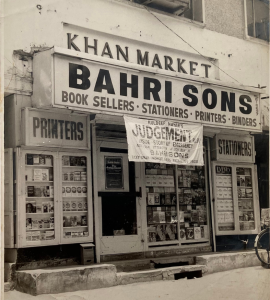
Bahrisons Booksellers, New Delhi
Few independent bookstores have shaped Delhi’s literary culture as profoundly as Bahrisons Booksellers. Founded in 1953 by Balraj Bahri Malhotra in Khan Market, the bookstore quickly established itself as one of the capital’s most sought after destinations for serious readers. Behind the establishment lay a story of resilience and resettlement, as the proprietor of the shop had been forced to relocate from the newly-created state of Pakistan to India during partition. The story of the bookshop can be found in a volume titled ‘Bahrisons: Chronicles of a Bookshop’ written by the oral historian Aanchal Malhotra and her father, Anuj Bahri.
New Delhi’s upscale Khan Market was much smaller and more modest back in the day. Bahrisons, over the decades, built a reputation for thoughtful curation, stocking an extensive range of literature, history, politics, philosophy, biography, and international fiction alongside contemporary Indian writing.
The bookstore has long attracted academics, diplomats, journalists, writers, and students, making it an informal meeting place for the city’s intellectual circles. Recently, the Chandigarh branch of the store became a backdrop for Imtiaz Ali’s partition drama, Main Vaapas Aunga, where Nirvair Grewal (Diljeet Dosanjh) is seen going to Bahrison’s to learn more about the history of his own family. Aashna Malhotra, who’s a third generation bookseller at the shop says that it’s quite significant that Nirvair would choose to go to Bahrisons to learn more about the Partition given the history of the bookshop itself!
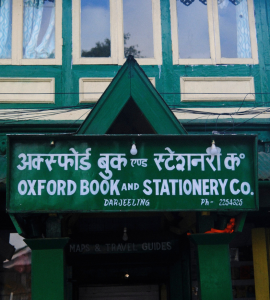
Oxford Bookstore & Stationery Co., Darjeeling
Standing along Darjeeling’s famous Mall Road, Oxford Bookstore & Stationery Co. is among the hill town’s most beloved institutions. The façade of the shop is painted dark green, like the other shops that stand beside it. Above the bookstore, there’s a boutique hotel that goes by the name of Chalet Hotel. Established during the colonial period, the bookstore’s collections include a plethora of works on mountaineering, Buddhism, Himalayan ecology, Nepali literature, and the colonial history of Darjeeling. That makes it an invaluable stop for anyone seeking to understand the region if one has to go beyond the tea gardens and breathtaking views of the hills. It is here that tourists often discover rare local publications that are difficult to find elsewhere in India. The store itself feels like a time capsule, preserving the atmosphere of an earlier era when browsing was an unhurried activity. The shop also sells souvenirs and stationery items for those who are seeking them.
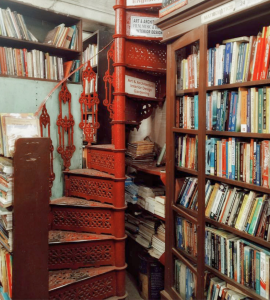
Dasgupta and Co., Kolkata
Established in 1886, Dasgupta & Co. is one of India’s oldest surviving bookstores. It is also hard to choose one bookstore over others in the area, because this shop is located on the legendary College Street, which is home to one of the world’s largest second-hand book markets, and the flagship stores of generations of publishers who have shaped Bengali literary culture. The founder of the shop, Girish Chandra Dasgupta found that luck was on his side, when he managed to secure a shop opposite the Hindu college, paying a rent of Rs 5 per month. The Hindu College changed its name to Presidency University in the years to come, and College Street is generally considered to be a cerebral sweet-spot for it also is the area in which many of the country’s first educational institutions were established.
Historically renowned for academic publishing and educational books, the bookstore has supplied textbooks, scholarly works, dictionaries, and reference materials to countless students attending nearby institutions. In 2023, it was accorded a Grade II Heritage Status by the Kolkata Municipal Corporation, and also turned a part of its premise into a free library.
Kitab Khana, Mumbai
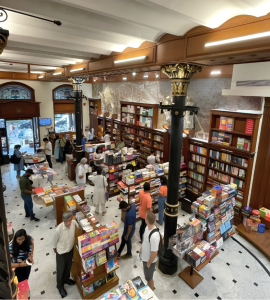
Located on the ground floor of a restored nineteenth-century heritage building named Somaiya Bhavan in Mumbai’s Fort district, Kitab Khana holds space for both literary culture and architectural heritage. Opened in 2010, the interiors of the shop are visually similar to Daunt’s Bookstore in Marylebone, London. The ceilings are high for it accommodates a second level of shelves on a balcony. One finds polished wooden interiors, and an abundance of natural light coming in through the doors in the front.
The collection at Kitab Khana ranges from Indian literature and translated works to art, architecture, photography, children’s books, and academic publishing. One also finds an impressive collection of works written in Marathi and Gujarati. The store’s location is also quite integral to its charm, as it is surrounded by some of Mumbai’s most historic institutions, making it an essential pitstop for anyone exploring the Fort precinct. Right outside the store, one can catch a glimpse of a newly restored Flora Fountain. Visitors could potentially plan a trip to Kitab Khana with nearby landmarks such as the Chhatrapati Shivaji Maharaj Vastu Sangrahalaya or the heritage buildings of Fort.
Beyond selling books, Kitab Khana has established itself as one of Mumbai’s most active literary venues. Its calendar regularly features book launches, author conversations, poetry readings, storytelling sessions, and panel discussions that bring together writers and readers from across the country.




Leave a Reply