

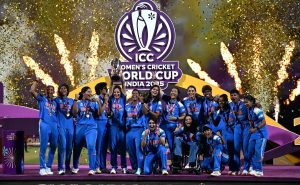
November 2, 2025: The ICC Cricket World Cup final is played between India and South Africa, at the DY Patil Stadium in Navi Mumbai. For the first time ever, a stadium in India is sold out for a women’s cricket match. 45,000 fans attend. A whopping 185 million people watch from home, as 11 women make history on the pitch.
August 30, 2023: The Memorial Stadium in Lincoln, Nebraska see a record-breaking 92,000 people flood the stands for a college volleyball match between the Nebraska Cornhuskers and Omaha Mavericks. The Cornhuskers win that match 3-0.
Two nights, two years apart, but both are signals of a recent uptick in the attention given to women’s sport. Once the stadiums would have been dotted with only a few supporters. Now, it finally feels like the whole world is tuning in. Only this time, the attention feels less incidental, and more intentional.
In the US, the shift seems more gradual. A linchpin was the back-to-back FIFA World Cup wins in 2015 and 2019. An American women’s team winning a global tournament tremendously boosted US morale. It helped that since 2019, channels showing the FIFA World Cup, such as the BBC, ensured that more women’s games were broadcast live. The easier the access, the higher the audience; the growth showed on a global scale, with the FIFA Women’s World Cup breaking even on cost in 2023.
In India, the breadth of interest in women’s sports is somewhat more recent (with exceptional exceptions such as track and field athlete, P T Usha), and primarily focused on cricket. India’s watershed moments have been staggered. The last few decades saw feats of boxer MC Mary Kom, badminton player PV Sindhu, shooter Manu Bhaker, and wrestlers Sakshi Malik, and the Phogat sisters.
But it all came to a collective head with a team achievement in winning the 2025 Cricket World Cup. The level of attention soared when India hosted, and subsequently won, the ICC Women’s Cricket World Cup. This was the third time an Indian women’s squad had reached the finals, but the first time that they converted it into a win.
What might have caused such a wide societal transformation? Why now? With strong female role models becoming more prominent in 2010s USA, in fields such as STEM and politics that were male-dominant, it was only a matter of time before sportswomen actively followed suit. Amongst others, the achievements of Serena and Venus Williams on the tennis courts made people sit up and take notice of women’s sports. Up until then, a mere handful of broadcasters and spectators were paying attention to women’s sport.
Another important driver for this growth is the support of younger sports fans, who have grown up with a deep knowledge of gender and racial equity, and expect to see it engendered across sports arenas. But this too, is only part of the explanation; both male and female Boomers watched more women’s sports events at the 2024 Paris Olympics than their younger counterparts.
Another narrative that has worked? The local hero making it big. Take the case of Caitlyn Clark, whose draft into the WNBA spiked attendances at both home and away games, with the highest recorded numbers since the WNBA first started in the 1990s. Clark was a college star who rose up the ranks, whose early success made her a generational talent to watch. This Caitlyn Clark effect not only shone the spotlight on other rookies, but also increased the attendance across women’s college sports, especially basketball, with talent scouts hoping to spot the next Clark in the making.
Another example? Harmanpreet Kaur, came from the small town of Moga in Punjab, eventually captaining the Indian Women’s Cricket Team to their first ever World Cup victory.
Sportspersons have long been the flagbearers of a country’s patriotism, with every international contest becoming a matter of national pride. For Indian women, there is an extra layer of sentimentalism. In cricket for example, men are painted as the ‘men in blue’, while women are characterized as ‘Bharat ki beti’ or India’s daughters.
Sentimentality is woven into the fabric of how female athletes are presented. Their humble beginnings, their willingness to play a sport despite the sociocultural opposition, given that women are still largely expected to perform softness (as against the brashness of male sportspersons).
Where both USA and India see parallels is in the recency of visual markers of gender equality on the world stage.
For the US, that marker was the first gender-equal lineup for the 2024 Paris Olympic Games. While domestic tournaments had women stepping up and center, more athletes were spotlit on a global stage, cementing the ideals of representation.
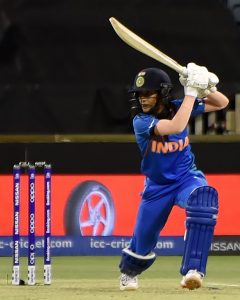
In India, cricket led the way, as it usually does. In 2022, the Board of Control for Cricket in India (BCCI) officially announced equal match fees for male and female players for international matches. And the World Cup win led to that mandate being extended to domestic games. For the first time, Indian women realized that being a sportsperson can be a long-term career option, and not just a hobby. A year later came the launch of the Women’s Premier League (WPL), the female version of the Indian Premier League, the most profitable arm of Indian cricket. This injection of lucre into the game has made a world of difference – for one, cricketers now have the best coaches and mentors globally.
Whether in India or in the US though, this exponential growth feels more like grounded reality than a passing trend. Sponsorship numbers are a great showcase of that, reportedly growing 50% faster than those for men. Sponsor confidence is also growing, with 86% claiming that their sponsorship contracts met or exceeded their ROI expectations.
The Indian players have been seen on talk shows, invited onto podcasts, and are the spokespersons for a number of products. In fact, cricketers make up for 78% of the total brand endorsements for sportswomen in India, with the remaining 22% covering a range of sports, from chess to wrestling. The momentum has translated to their domestic gameplay as well, with the Women’s Premier League seeing an enormous increase in viewership between 2023 and 2025. Cultural and commercial significance have come together for the first time.
And the impact is visible. According to a KPMG report, the commercial value of women’s sports in India is projected to reach $900 million by 2030. While 58% of the audience for women’s sports is still men, the stadium crowd shows more families in attendance, setting the stage for long-term loyalty within the fan bases. In the US, three in 10 adults follow women’s sports ardently.
Alongside this swell of commercial support, an entire ecosystem is slowly growing around women’s sports. For instance, the number of sports bars that exclusively or near-exclusively screen women’s sports has ballooned in the US in 2025, proving that interest can be converted into financially-sustainable spaces.
The bottomline? Seeing is believing. Seeing more women in sports more regularly, engaged in solid gameplay, is believing that they have a future, and that more athletes are waiting in the wings, to take the path that’s being blazed for them. With increased accessibility to follow the sports live, there’s an incentive to sustain that interest. Which means that fans continue to look to broadcasters and organizers to be the drivers of making women’s sports easier to watch and follow. The onus of the continued success of women’s sports is on us as consumers. The players have been bringing their A-game, whether or not the world has been watching.




Leave a Reply