

Mira Nair has said that every film she’s made over the past several decades was shaped by the art of Amrita Sher-Gil. “She taught me how to see,” Nair said when she announced Amri, her long-gestating biographical film about the Hungarian-Indian painter. The film wrapped production in May 2026, shot across Amritsar, Budapest, and Paris. The cast is exciting, with Anjali Sivaraman as Sher-Gil, Jaideep Ahlawat as her father, Emily Watson as her Hungarian mother, Jim Sarbh as the critic Karl Khandalavala (who was one of the few people in Sher-Gil’s lifetime who grasped what she was doing) and Priyanka Chopra-Jonas in a supporting role. The film arrives just as sixty of Sher-Gil’s paintings, on loan from the National Gallery of Modern Art in New Delhi, are completing their first European tour in nearly two decades, currently at the Drents Museum in the Netherlands, before a global circuit beginning in Paris in 2027, continuing to Los Angeles and Doha.
The intention behind all of this is clearly reverence. But reverence is not the same as understanding, and in Sher-Gil’s case the distance between the two is where the most interesting questions live.
We are living through a cultural moment that mistakes access for understanding. If something has been exhibited, auctioned, streamed, and explained, we tend to assume it has also been seen. Sher-Gil’s paintings propose a different standard. They are not difficult in the way that conceptual art is difficult, requiring decoding. They are difficult in a more fundamental sense. They decline to make themselves easy. They do not reward the kind of attention we have gotten very good at giving, the sort that is fast and appreciative but does not really stick. They ask to be sat with. And sitting with them is something the current cultural machinery surrounding her, from the film and the touring retrospective to the auction records and the forthcoming global circuit is not designed, by its nature, to encourage.
This is not an argument against the film or the exhibitions. It is an argument about what they are for, and what they simply cannot do.
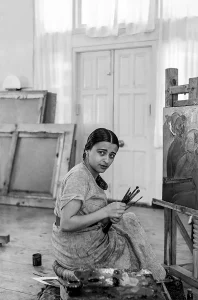
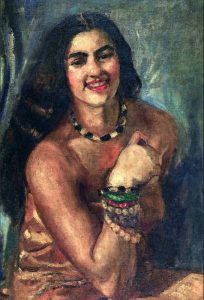
Amrita Sher-Gil was born in Budapest in 1913, to a Sikh aristocrat father and a Hungarian opera singer mother. The family moved to Shimla when she was eight. She began formal art training the same year. By sixteen, she was studying in Paris, first at the Académie de la Grande Chaumière, then at the École des Beaux-Arts. In 1932, she completed Young Girls, the canvas that won her the gold medal and Associate membership at the Grand Salon in 1933, making her the youngest artist, and the first Asian, to receive the honor. She returned to India in late 1934, carrying sixty canvases and what she described as an ‘intense longing’ not for home exactly, but for a subject matter that Europe could not give her. She died in Lahore on December 5, 1941, eight days before a major solo exhibition was to open. She was twenty-eight years old.
This is the outline of a life that has proven irresistible. Tragic early death, Eurasian identity, and an often-discussed personal life. She was Paris-trained, returning to the subcontinent before it was a country. The narrative almost writes itself, and it has been written many times, with great feeling and reasonable accuracy.
But the outline keeps getting mistaken for the point.
Look at Three Girls, painted in 1935, the first major canvas Sher-Gil completed after returning to India. Three young Punjabi women sit close together, bodies turned slightly inward, gazes averted. Yet, you don’t feel they’re shy. There’s a lingering feeling of something heavier, a sealed-off interiority that the composition both reveals and protects. The palette is warm but not consoling, ochres and earth reds, brown skin rendered without exoticization or false softness. The women are not performing their beauty or their suffering. They are simply there, in possession of a stillness the viewer cannot enter.
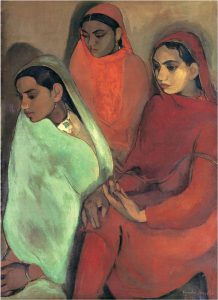
Sher-Gil wrote about this body of work with clarity that has not aged well in every respect, “I realized my real artistic mission, to interpret the life of Indians and particularly the poor Indians pictorially; to paint those silent images of infinite submission and patience.” The language is of its era. But notice what the paintings themselves do, which is something more complicated than the statement suggests. The women in Three Girls are not passive. They are not objects of a reformist gaze. They are, in some fundamental sense, withheld. They are kept in a space the viewer is allowed to look into but not enter. This is a formal choice. Whether it was also a moral one is exactly the question the work keeps raising.
Because Sher-Gil was not painting from the ground. She came from an aristocratic family with landed estates. She was educated in Paris, fluent in multiple European languages, and moved through colonial India with a mobility her subjects did not have. Her own letters describe wanting to capture ‘angular brown bodies, strangely beautiful in their ugliness,’ a phrase that, read honestly, sits uncomfortably close to the ethnographic gaze she is often credited with resisting. Scholars have noted that the same class distance that separated colonial photographers from their Indian subjects also separated Sher-Gil from the women she painted. The comparison is not a verdict. It is a question the work itself keeps open.
Which is perhaps also why the paintings remain interesting.
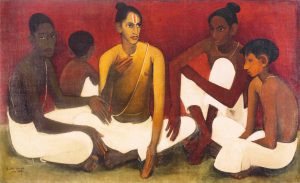
Look at Brahmacharis, completed in 1937 as part of the South Indian trilogy. A group of young male religious students, rendered in the flattened planes and muted ochres that Sher-Gil absorbed from the Ajanta cave murals in Maharashtra, fill a large canvas, nearly five feet tall. Their faces, like those in Three Girls, are turned away or downcast. They do not offer themselves to the viewer. The distance between the painter, a wealthy, European-educated woman looking at mendicant students in a country under colonial rule, and her subjects is not erased by the painting. It is present in the painting, in the careful, almost architectural arrangement of figures who remain, for all the empathy of the brushwork, on the other side of something. The painting neither resolves that distance nor pretends it does not exist. It just holds it.
That is what makes the work worth serious attention. The tension between Sher-Gil’s formal instinct to give her subjects a sealed interiority and her social position as someone looking across a significant class divide is not a footnote to these canvases. It is alive in them. The question is not whether her privilege invalidates what the paintings do. The question is what becomes visible in the work when we stop trying to answer that question and simply keep both facts in view at once.
During her life, Sher-Gil was largely misunderstood and knew it. She was often criticized for depicting a ‘dark side’ of India, praised more condescendingly for her ‘social concern’. She found both responses beside the point. In 1938, she wrote to Khandalavala: “I can only paint in India. Europe belongs to Picasso, Matisse, Braque and the rest. India belongs only to me.”
The statement is typically quoted to illustrate confidence, ambition, refusal to be small. But it can also be read as a claim of attention, as if she is saying, “I am the one who is going to look at this, really look at it, and render what I see without flinching and without flattering. This is my subject and I will not share the terms of its representation.”
This is not an argument for dismissing the work. It is an argument for taking it more seriously than the symbol allows.
Within Indian art circles and among those who study modern Indian painting, Sher-Gil has never been obscure. She was declared a National Treasure by the Government of India, is in the permanent collection of the NGMA, has appeared on postage stamps, and is in every serious textbook of the period. Globally, the Drents Museum noted this year that she remains largely unknown to general audiences outside specialist circles, which is why the current touring exhibition matters.
When thinking of Sher-Gil’s work in a global context, the comparison most often reached for is Frida Kahlo. The parallels are obvious, but they can obscure as much as they reveal, and Sher-Gil spent enough of her life being flattened into a type that adding another layer of comparison does her no particular service.
What Sher-Gil is, right now, is in transition. Her work, her memory, and even her legacy is being moved through the film and the exhibitions and the auction attention. It is being moved from the category of ‘important Indian modernist’ into something closer to global icon. This is where the current moment becomes genuinely interesting and genuinely risky.
Iconization gives audiences permission to feel they have encountered an artist without having to reckon with the work. The stamps, the textbooks, and the auction records confirm that Sher-Gil matters. They do not tell us how to sit inside Three Girls until the stillness of those three women begins to feel like a question directed at us. They do not prepare us for the discomfort of Brahmacharis, for what it means to look at a painting that is itself about the act of looking across a distance that cannot be closed. Turning her into an icon smooths over exactly the tensions that make the paintings worth returning to.
Which brings us back to Mira Nair, and to what Amri will need to be in order to honor its subject. A film about a painter is, almost definitionally, a film about a life. The medium insists on narrative, on scene, and on forward motion. It cannot do what the art does, it cannot be still in that way, cannot withhold in that way. What it can do, if it is serious, is make the audience hungry for the paintings. It can use Sher-Gil’s story to create the conditions under which the canvases become necessary rather than decorative.
It can refuse the consolation of the tragic arc and insist instead on the strangeness of the work, on the fact that a twenty-two-year-old’s painting of three Punjabi women contains a formal argument about looking, about privacy, about who gets to be depicted and on whose terms, that has not been settled yet. These are paintings that neither erase nor resolve the distance between painter and subject. They construct a sealed interiority for women who had very little power over how they were seen, while also raising questions about who gets to do that constructing, questions that remain unresolved eighty years later. Hopefully, the film sees that.
Nair is a filmmaker of real intelligence and long commitment to this subject. But the question Amri will need to answer is not whether it is accurate, or beautiful, or moving. No doubt it will be. The question is whether it makes you want to stand in front of the paintings, or whether it replaces them.
In a 1935 canvas not quite three feet tall, three women sit together and say nothing to us. They do not look at us. They were painted by a woman who had more in common with the people who would eventually hang them in museums than with the women depicted in them. And they are still among the most searching images made in twentieth-century Indian art, not because that tension was resolved, but because it was not.
Eighty years of biography, scholarship, exhibitions, and auction records have not settled what these paintings are doing. That is not a failure of attention.
That is the work.





Leave a Reply