

Laid out in a neat grid, they resemble miniature art: delicate green bamboo, crimson characters, blue circles, and compass-like winds carved into smooth rectangles of ivory, bone, or plastic. You’ve probably seen them before — scattered across your grandmother’s dining table or trending now on TikTok as a satisfying ASMR clack.
Mahjong isn’t new. Its history is long and layered. Believed to have originated in the mid-1800s in China, the game was once the preserve of Qing officials and scholars before it spread across social classes and borders. In 1920s America, it surged in popularity thanks to an export boom and was a status symbol among white upper-middle-class women, complete with their own ‘exotic’ tile sets and rulebooks – that love for Mahjong continues to this day. Meanwhile, in Hong Kong, Taiwan, and Japan (and elsewhere), the game evolved into its own regional variants and became a staple of family life.
Today, Mahjong is back — loudly, proudly, and globally. In New York, Asian-American communities are reclaiming it as part of their own cultural inheritances. In London, hidden Mahjong clubs have emerged in basement speakeasies. In Hong Kong, competitive Mahjong tournaments are being live-streamed with fashionably dressed players and full sponsorships.
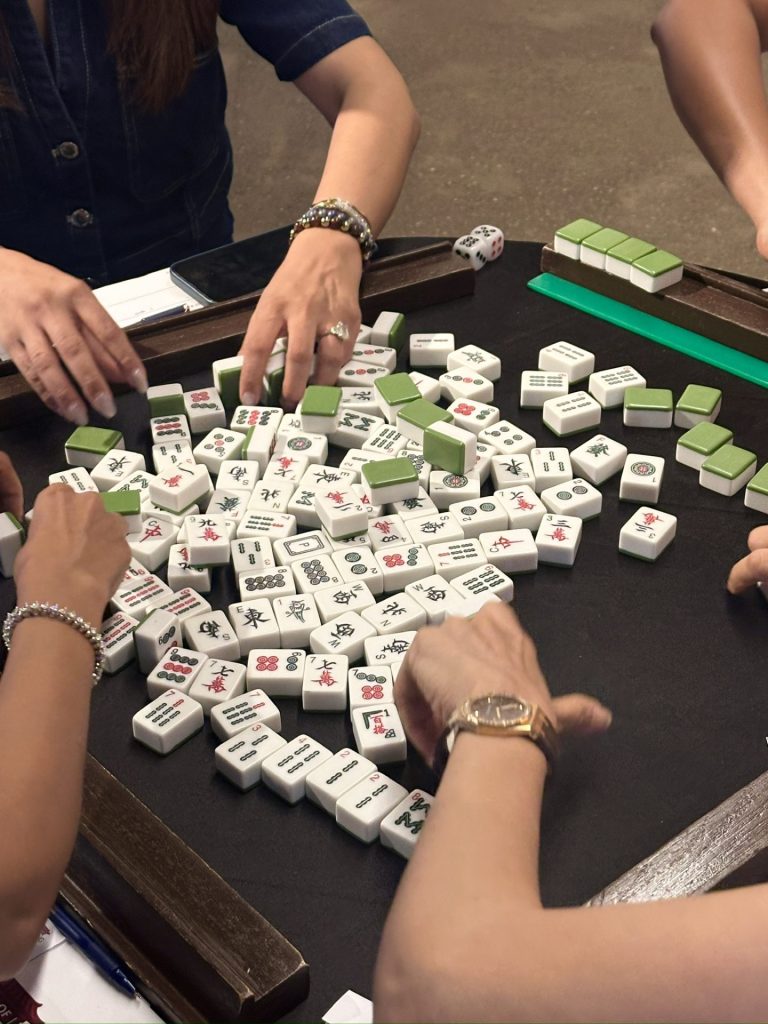
Unsurprisingly, India is having its very own Mahjong moment too.
In Mumbai, a group of young professionals started The Mahjong Network via WhatsApp. Within months, it had grown into a full-blown movement, with rotating hosts, mentorship sessions, and tournament-style gatherings. Aditi Dugar, restaurateur at Masque, Masque Lab, TwentySeven Bake House, and Paradox has Instagrammed her love of the game. Stars of the Netflix show The Fabulous Lives of Bollywood Wives, Maheep Kapoor and Bhavana Panday are similarly obsessed. In Delhi, casual brunch cafés now offer Mahjong-themed mornings. In Bengaluru, a Parsi restaurant offers daily Mahjong classes; in Mumbai, an (unrelated) Parsi cafe offers the same thing. On Urbanaut, a ticketing platform, a plethora of Mahjong events rub shoulders with jazz performances and guided museum tours. Schools and colleges are hosting tequila and Mahjong alumni events. Indian jewellery brands such as Nishkara are even crafting jewelry and bag charms inspired by Mahjong tiles. Across India, brunches, birthdays and tea parties are being designed around Mahjong tables.
There is nothing new about Mahjong in India though. The Times of India of the 1920s is dotted with mentions of Mahjong-playing ladies, an elite British craze sparked by the colonial ties between China and India. Lacquered scarves with dragon designs and imported bone-and-bamboo Mahjong sets were all the rage with the ladies who lunch stepping to their colonial club of choice for their weekly game fix. Colonial-era Chinese restaurants, opened by immigrants from China, likely also operated as Mahjong clubs, possibly helping to pull new fans to the game.
Even after Independence, the game never really disappeared. It sat quietly in Parsi homes, where aunties would gather around the card table in the afternoon, and in Indian military circles, passed between postings as a refined time-pass.
It’s no wonder then that India, a largely family and community-driven country, has taken to the game so thoroughly. Everyone from nostalgic Gen X-ers who remember watching their parents play, mid-career women looking for a new social scene, and Gen Zs are embracing Mahjong as an exercise of both mind and memory.
Sangeeta Kewalramani, Mahjong teacher and founder of Mumbai’s House of Mahjong echoes this. “Socially, it brings people together across generations, I’ve even taught grandparents and grandkids together,” she explains. “I think why it has a renewed appeal is because of its versatility. For example you can host a Mahjong lunch party with the girls and also compete formally at a tournament. You have older women who’ve been playing rummy or bridge for years and are now loving the novelty of Mahjong. But more and more I see women in their 20s and 30s getting hooked.”
In some ways, the appeal of this Chinese game in India mirrors the global moment. It taps into the longing for connection and community in offline spaces, and a quiet rebellion against endless productivity.
Part of its comeback lies in the aesthetics: the tactile satisfaction of the tiles, the visual charm of the sets, even perhaps the gifting culture that is intrinsic to the nature of the game. “It’s no longer just about the tiles; it’s about the lifestyle, the hosting, and the gifting traditions that surround the game – giveaways and prizes are an integral part of the whole culture. Mahjong is its very own subculture now,” explains a representative from Nishkara.
Another reason? Everyone agrees that in a world defined by hyper-speed and endless screen time, Mahjong offers a kind of analog elegance. It demands attention, invites conversation, and unfolds in real time — four people, one table, no scrolling.
But there’s also something deeper at play. The pandemic left many of us starved for community and craving rituals that feel grounding. Mahjong delivers both. It’s strategic, communal, and meditative, a rare combination in modern life.
But this is where we differ from the rest of the world. Mahjong players in India largely belong to a specific social class with the privilege to access gated and membership-only spaces such as the Willingdon Club in Mumbai. Mahjong sets, although easily available, are expensive, and access to Mahjong classes is often paid.
We’re living in an age not of invention, but of re-invention. From vinyl to zines, from Indian pickles to Mahjong tiles, there’s a wider cultural pull toward revisiting what once was: toward reclaiming forms of slowness, tactility, and togetherness that got lost in the churn of modernity.
Mahjong isn’t just back. It never left. We’re the ones circling back, clicking tiles like rosary beads, finding comfort in repetition, connection in tradition, and clarity in the clatter.




Leave a Reply