It starts with a toss but ends with a cultural takeover. The Indian Premier League, now in its seventeenth year, has become more than just a sporting phenomenon. Over time, it’s India’s most potent soft power tool. What began as a domestic T20 tournament has evolved into a slick, high-gloss spectacle that shapes how the world sees India: fast, chaotic, competitive, and endlessly entertaining.
At a time when national identity is increasingly built through pop culture and media, the IPL operates as a shorthand for modern India. It’s not just the cricket that draws global attention — it’s the Bollywood-backed team ownerships, international player rosters, drone-shot stadium cinematics, and theme music that sounds like it belongs in an action film trailer. For millions abroad, this is India at its most visible — a nation where entertainment and ambition collide in dazzling colour.
The numbers reflect that reach. The IPL is one of the most-watched sporting leagues in the world, with streaming deals stretching across continents. For international brands — from Saudi tourism boards to global soft drink giants — IPL sponsorships are a way to tap into India’s massive consumer base while aligning with the league’s aspirational sheen.
“
If Hollywood was America’s soft power in the 20th century, the IPL may be India’s in the 21st. It packages sport, celebrity, nationalism, and commerce into a single, irresistible export.
”
But the IPL’s soft power isn’t just external. It also reflects India’s self-image. In the league’s aesthetic, we see a country willing to negotiate tradition and hypermodernity — cricket whites have been replaced with neon kits, devotional chants have been repurposed as crowd anthems, and local dialects have been woven into high-production promos. The IPL champions hustle culture, regional pride, and pan-Indian unity — all on a three-hour broadcast.
That said, this cultural diplomacy comes with contradictions. The tournament’s embrace of spectacle can overshadow deeper conversations around labour rights, gender parity in sport, and access to resources. And while Indian players are front and centre, the tournament is still often run with a corporate logic that flattens regional nuance into easily marketable archetypes.
An Indian flag waving in the crowd at the ICC Men’s T20 World Cup | Image Credit: Raunaq Sachdev on Pexels
Still, if Hollywood was America’s soft power in the 20th century, the IPL may be India’s in the 21st. It packages sport, celebrity, nationalism, and commerce into a single, irresistible export. And whether you’re watching from Chennai or Chicago, one thing’s clear — this isn’t just about cricket anymore. It’s about image. And India knows exactly how to play the game.
On a weekday morning in New York, the subway car settles into its usual choreography. Headphones in. Eyes lowered. Everyone practises a small, private neutrality to get through the day. Then someone glances up and frowns. A poster, bold, smug, a little too pleased with itself, has broken the spell. Faces follow the gaze, a ripple of annoyance travels down the carriage, and for a moment strangers are united by a single, shared reaction.
The ad has succeeded. Not because people liked it, but because they couldn’t ignore it.
Ragebait used to belong to political campaigns or the murkier corners of the internet. Now it’s creeping into beauty ads, grooming brands, tech startups, sparkling-water companies, places that once sold pleasure or convenience. And that shift isn’t accidental. It’s a clue to the emotional climate of American public life, and to the new tactics brands are using to cut through a landscape thick with noise.
The rise of irritation as strategy
Provocation has become a design choice. Marketers may not call it ragebait, but the vocabulary is unmistakable: “disrupt the scroll,” “spark conversation,” “stop people in their tracks.” It’s the language of rupture, not persuasion.
This approach works because irritation is more legible than charm. Charm takes effort; irritation is instant. Digital platforms long ago taught brands that strong emotions travel fastest, and anger, even mild anger, generates reactions. Reactions keep content circulating.
Provocation has become a design choice | Image Credit: Anthony Hortin on Unsplash
Circulation becomes visibility. And visibility is the currency that every brand is scrambling for.
What’s new is how this digital logic is spilling into the physical world. The subway has become a testing ground for emotional disruption. You’re captive. You’re overstimulated. Your guard is down. A provocative poster doesn’t feel playful. It feels like an intrusion. And that’s precisely why advertisers place it there.
How public space absorbs online atmosphere
Walk through any major American city and you can sense the shift. Once, public advertising aimed to entertain or inform. Now it often aims to interrupt. The mood mimics the internet — quick, reactive, slightly abrasive. Public space begins to feel less like a commons and more like a comment section.
The effect is subtle but cumulative. Irritation becomes ambient. The day begins with a small jolt of friction rather than ease. Not enough to push anyone over the edge, but enough to raise the emotional temperature by a degree or two.
“
In a landscape where calm is scarce, irritation becomes oddly efficient. A shortcut to visibility. A cheap emotional spike. Brands aren’t creating the exhaustion; they’re capitalising on it.
”
This isn’t about sensitivity. It’s about the atmosphere. When brands treat everyday life as raw material for agitation, the commute becomes a site of emotional extraction. The poster isn’t merely selling a product. It’s shaping the emotional texture of the morning.
The cost to brand identity
The strategy delivers attention, but attention is not loyalty. This is the quiet paradox of ragebait: a brand can win the moment and lose the meaning.
If a company irritates you into remembering them, they become associated with irritation — not trust, not aspiration, not desire. Even if people don’t consciously reject the product, they mentally downgrade the brand. The emotional temperature sticks to the name.
The long-term danger is erosion. Warmth disappears. Coherence dissolves. Consumers may recall the punchline but not the product. And gimmicks rarely scale. What provokes today becomes wallpaper tomorrow, and suddenly the brand has trained its audience to expect stunts rather than substance.
Provocation is incredibly easy to copy and nearly impossible to own. When every brand starts raising its voice, no one stands out. The volume goes up, but the meaning drains out.
A culture stretched thin
It’s tempting to blame algorithms or generational habits, but the deeper cause is cultural fatigue. Americans are overwhelmed by the sheer velocity of stimuli — alerts, feeds, notifications, headlines, ads stitched onto every inch of public and private space.
In a landscape where calm is scarce, irritation becomes oddly efficient. A shortcut to visibility. A cheap emotional spike. Brands aren’t creating the exhaustion; they’re capitalising on it. But desperation is not a strategy.
Campaigns are being built on gentleness instead of aggression | Image Credit: Olena Kamenetska on Unsplash
What comes after the provocation
Every emotional cycle has a counter-cycle, and small signs of a cultural correction are emerging. People seek quieter retail spaces, restaurants with no screens, hotels that emphasise stillness, even “silent flights.” The desire is not only for escape but for clarity. Calm becomes a commodity.
Some brands are already leaning into this shift. Campaigns built on gentleness instead of aggression. Long-form storytelling instead of short-term shock. A return to consistency rather than spectacle.
The cultural pendulum is moving toward relief — brands that lower the temperature rather than raise it. Not purity, not nostalgia, but something subtler: the pleasure of not being yelled at by your own commute.
What this moment reveals
Ragebait advertising isn’t a trend so much as a symptom. It reveals something about the current American mood: overstimulated, emotionally thin-skinned from too much noise, and increasingly attuned to disruption as the default instead of the exception.
When public ads adopt the tone of online conflict, the boundaries between physical and digital life blur. We start to inhabit the same emotional posture everywhere — reactive, watchful, slightly on edge.
Subways have always been cultural barometers. They show you the city’s preoccupations long before the city can name them. Today they tell us something subtle but important: irritation has become ambient. Not explosive, not dramatic, just a faint, steady buzz.
And if that buzz becomes the norm, it’s worth asking who benefits, who adapts, and what emotional costs we’ve quietly agreed to pay.
Open any major platform and a certain pattern appears. A stranger studies quietly on TikTok Live, a creator walks through a supermarket with viewers trailing behind, meditation apps offer modes that resemble shared presence, and AI companions send morning greetings. Productivity tools now include virtual coworkers. These features look like entertainment or efficiency hacks, yet they are built to give people the sense that someone is nearby.
A decade ago, loneliness felt like an interior mood. Now it shapes product decisions across the tech industry. Companies have realised that users return more reliably when something feels companionable. The numbers reflect this shift. Low-interaction livestreams on TikTok have grown steadily over the past two years, AI companion apps have pulled in tens of millions of users around the world, and long, quiet study videos on YouTube continue to draw consistent viewing. The engagement holds even when very little is happening.
The reasons stretch beyond technology. Remote work reduced daily contact, and many shared spaces either changed or disappeared. Cafés raised prices, libraries shortened hours, and neighbourhood spots became harder to maintain. A global survey in 2023 by Meta and Gallup reported that around one in four adults experiences frequent loneliness. It tracks with what people describe in their own lives. As familiar rhythms faded, they began looking for softer forms of connection that could slip into unpredictable days.
Someone’s presence in the background, even through a screen, can soften the day | Image Credit: Libby Penner on Unsplash
AI accelerated the trend. Companion apps offer a feeling of steadiness without the weight of social performance. Conversations take place at a pace people can manage, which often makes them easier than real ones. The appeal here is quiet. Many users are not searching for romance or fantasy. They want acknowledgement that fits into the edges of a scattered routine.
Livestreams and shared-task videos serve a different purpose. Someone’s presence, even through a screen, can create a backdrop that softens the day. Walking streams, cooking sessions, and silent study rooms are simple formats, yet they mimic the comfort of being around others who are also going about their lives. These spaces carry no pressure, which explains their endurance.
“
Many people are not seeking grand emotional narratives or deep conversation. They want a softer kind of company that can sit beside work, chores, or study, and the world does not offer that easily anymore.
”
The behaviour is most visible among younger users, yet it crosses age groups. Many people feel stretched by erratic schedules, high expectations, and social environments that sometimes feel too demanding. A low-demand connection can feel reliable in a way traditional social life often does not. A livestream does not ask you to keep up. A digital companion stays even when you step away.
Companies respond to what they see. Some now measure engagement in terms of presence rather than taps or clicks. A few surface creators who hold attention simply by showing up regularly. The idea is straightforward. People trust spaces that feel steady, and steadiness keeps them returning.
There are concerns about how these habits develop. Platforms gain when users stay inside their ecosystems, so these environments can expand quietly. Hours drift by. A stream that starts as a background company sometimes takes up a larger share of the day than expected. Comfort and habit can merge without much notice.
Observed among young users, the behaviour crosses age groups | Image Credit: Amanda Vick on Unsplash
Even with the risks, it is clear that these tools fill a gap. Many people are not seeking grand emotional narratives or deep conversation. They want a softer kind of company that can sit beside work, chores, or study, and the world does not offer that easily anymore. Technology stepped into the space left behind by changes in work, housing, mobility, and community life.
The loneliness market is less a verdict on people and more a reflection of the moment. It shows how individuals are rearranging their emotional routines when older forms of casual connection no longer appear without effort. Digital companionship, even when light, offers a sense of continuity that is hard to find elsewhere. The behaviour will shift as the world changes, yet the need that drives it feels durable. People want to move through their day with some feeling of closeness, even when that closeness takes a different shape from what they expected.
A decade ago, global entertainment followed a familiar pattern. A small group of countries produced most of the shows that travelled, and most of those shows were in English. Translation existed, but it was secondary. Subtitles were a courtesy and dubbing was an afterthought. Cultural influence moved outward from a narrow centre, and everyone else adapted to it. This is why shows like Friends and Full House became household names across the world in the 1990s and early 2000s, building devoted subcultures far from the places they were made.
That arrangement held as long as distribution stayed limited and production budgets stayed manageable. By the mid-2010s, both conditions started to collapse. In January 2016, Netflix expanded into more than 130 new countries in a single move, abruptly widening the potential reach of any show it carried. At the same time, the cost of producing flagship domestic originals rose sharply. Translation stepped into that pressure point, and the economics of global storytelling shifted around it.
Platforms learned quickly that international titles offered a different kind of return. A series like Money Heist made this visible. It began as a modestly performing Spanish show and was cancelled by its original broadcaster in 2017. Once acquired, translated, and pushed across markets by Netflix, it found large audiences in Europe, Latin America, and eventually Asia and the Middle East. What mattered wasn’t that it became a hit everywhere at once. It was that language stopped limiting where a story could go.
From a platform’s perspective, the logic was simple. Domestic originals were expensive and risky. International titles, once translated well, travelled cheaply and kept viewers engaged longer. Subtitles and dubbing stopped being support functions and became central to growth strategy. Netflix executives later confirmed this shift in scale, noting that in 2021 alone the company subtitled roughly seven million minutes of content and dubbed more than five million minutes globally. Translation budgets rose, dubbing pipelines expanded, and release schedules began to assume global circulation from day one.
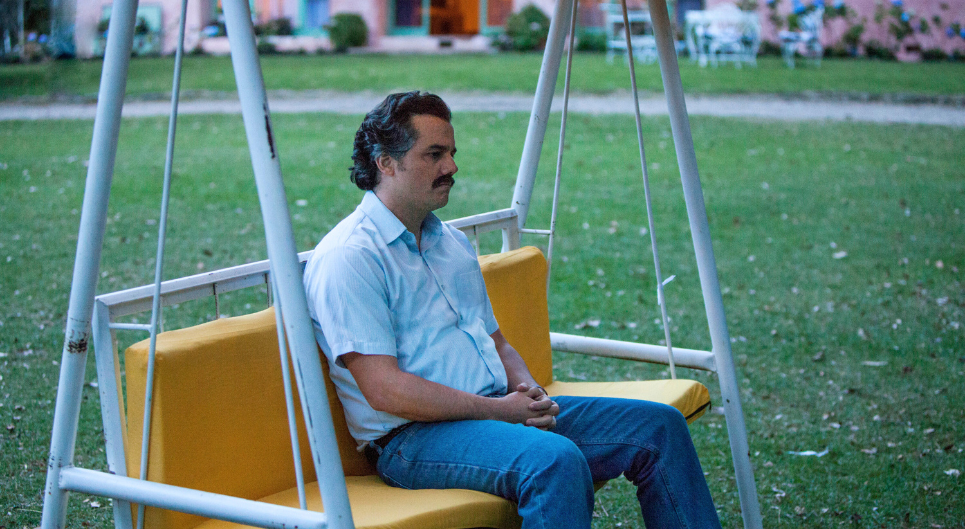
A still from Narcos | Image Credit: IMDb
That shift changed how creators worked. As translation became reliable, the incentive to mimic Anglo-American storytelling weakened. Writers and directors no longer needed to flatten their work to feel “exportable.” A Korean legal drama like Extraordinary Attorney Woo leaned heavily into local workplace hierarchies, social rhythms, and cultural cues and still became one of Netflix’s most-watched non-English series globally in 2022. Nollywood followed a similar pattern. Nigerian films did not need shared history or linguistic familiarity to build viewers abroad once subtitles and dubbing lowered the barrier to entry.
Distinctiveness became an asset rather than a risk. Translation allowed stories to carry their own cultural density without being rewritten for an imagined global norm.
Audiences adapted just as quickly. Once platforms began releasing high-quality subtitled and dubbed versions simultaneously, viewers started exploring work from regions they had rarely encountered before. This shift became unmistakable between 2019 and 2021. Parasite crossed $250 million at the global box office after winning the Palme d’Or and the Academy Award, while Squid Game reached more than 1.65 billion hours viewed in its first 28 days on Netflix, becoming the platform’s most-watched series at the time. What began as curiosity turned into habit.
Viewers learned how to watch across languages. They learned to follow emotion, pacing, and genre conventions without full cultural familiarity. Demand followed, and with it, higher expectations for translation quality.
“
Influence now travels through subtitlers, dubbing artists, and release schedules rather than diplomats. It arrives quietly, embedded in character choices, humour, and ordinary life.
”
Platforms responded by investing in dedicated dubbing hubs in Madrid, Seoul, Mumbai, and Los Angeles. Translation became less about literal accuracy and more about tone. Humour, timing, and emotional cadence mattered because they kept people watching. A poorly dubbed show now risked losing audiences who had learned what good translation sounded like.
These dynamics altered the creative map. Spanish thrillers began influencing crime writing beyond Spain. Korean dramas reshaped expectations around emotional arcs and character development. Anime’s visual language informed animation choices far outside Japan. Once translated, these works carried not just plots but social cues, everyday behaviour, and ways of relating that had previously struggled to travel.
This unsettled older assumptions about cultural power. English-language entertainment still commands large audiences, but it no longer defines global taste on its own. Viewers routinely choose shows in languages they do not speak, drawn to atmosphere, character, and emotional structure rather than familiarity. Recognition has shifted away from linguistic proximity toward resonance.
Translation is not neutral and it is certainly not perfect. Context is sometimes smoothed over and meaning is often shifted. Decisions about what to explain and what to leave implicit shape how cultures are perceived. These debates matter and remain unresolved. Even so, platforms continue to expand translation budgets because the returns are clear. Netflix’s own engagement reports show non-English-language titles now account for a substantial share of total viewing hours across regions, particularly outside North America. International titles retain subscribers, and their value compounds over time.
A still from Crash Landing on You | Image Credit: IMDb
What emerges is a form of soft power that operates without official choreography. South Korea’s surge in global cultural visibility after Squid Game did not come from a state-led export campaign, but from audiences absorbing language, social hierarchies, food, games, and emotional codes through a translated series they chose to watch. Influence now travels through subtitlers, dubbing artists, and release schedules rather than diplomats. It arrives quietly, embedded in character choices, humour, and ordinary life.
Translation reshaped global storytelling because it reshaped the incentives underneath it. Platforms needed scale, creators needed freedom, and audiences wanted variety that did not feel engineered. When those needs aligned, translation became infrastructure rather than accessory.
The result is a global media environment where stories circulate with fewer gatekeepers and fewer assumptions about whose voice travels best. Soft power now grows less from dominance than from availability. It grows because translation widened access and because viewers learned, willingly, to listen across languages.
Or, as Bong Joon-ho said when his subtitled film stood on a global stage in 2020, “Once you overcome the one-inch-tall barrier of subtitles, you will be introduced to so many more amazing films.”
The industry, it seems, spent a decade turning that insight into infrastructure.
Every day in Mumbai starts with a familiar beat: the hum of rickshaws, the ring of local trains, and making their way through it all, a steady procession of men in white. In cotton shirts and Nehru caps, they navigate crowds with lunchboxes balanced on bicycles or slung over shoulders. These are the dabbawalas — a service that began in 1890 to bring home-cooked meals to office workers. More than deliverymen, they are guardians of trust: carrying a family’s food, keys, or sometimes even cash across a sprawling city, and returning it safely.
For more than a century, dabbawalas have perfected a system that modern apps and algorithms continue to study: moving 200,000 meals every day across Mumbai, without a single GPS ping, and with an error rate so low it has earned a Six Sigma certification — near perfection in a city where even Google Maps often falters. Harvard has studied it; global figures from Prince Charles to Richard Branson have praised it.
But this isn’t a story about statistics. It’s about how Mumbai — in the thick of modernity, chaos, and congestion — still makes room for human care.
The Soul in the Steel Box
Mumbai is a city of commuters. Every morning, millions cram into local trains, leaving home at 6 a.m. to reach offices by 9. For most, carrying a tiffin is a logistical impossibility. One dabbawala collects your lunch at 8:30 a.m., bikes it to a train station, passes it to a colleague riding into the city, and finally hands it to the last-mile courier who delivers it to your desk. By afternoon, the empty box is back home, often before you even leave the office.
“
In today's fast-paced world, the dabbawalas demonstrate that slower can be smarter. And in their persistence, in their quiet mastery of turmoil, they resemble Mumbai itself: durable, resourceful, and vibrant.
”
There’s no tech, just a brilliant system of colour-coded markings: a squiggle for Churchgate Station, a number for a specific office tower in Nariman Point. The code is memorised by heart, often by men with little formal schooling. They are mostly from Maharashtra’s Varkari community, working as equal stakeholders in a co-operative. They take home modest earnings — ₹9,000 to ₹12,000 (roughly $100–$130 USD) per month — globally admired, yet financially vulnerable. Yet the system hums with remarkable consistency, day after day.
Trust in Motion
The dabbawalas’ fame belies the intimacy of their work. Office workers hand them spare keys, forgotten wallets, and even cash with quiet confidence. Many have survived monsoon floods, negotiating swollen streets to deliver on time. They embody precision amid the city’s controlled chaos: Six Sigma meets overcrowded trains, unmarked lanes, and a city that rarely stops moving.
A dabbawala making deliveries in Mumbai | Image Credit: Abhishek Mishra on Pexels
When the World Paused
The COVID-19 lockdown tested this century-old system. Trains halted, offices closed, and the number of daily deliveries fell from 200,000 to a few hundred. While some dabbawalas went back to their communities, others switched to delivering groceries or medications. Some tried digital payments and orders based on WhatsApp. By 2022, the “Digital Dabbawala” had emerged, extending to new last-mile delivery models while maintaining its foundation in human contact and trust. It was a shift embraced cautiously: the work remained personal, the relationships remained central.
More Than a Logistics Miracle
Globally, they are studied for efficiency. In Mumbai, they are woven into the city’s rhythms. The approach is based on local knowledge, intuition, and interpersonal interactions. It is also low-carbon, with bicycles, trains, and a commitment replacing engines and paper.
In today’s fast-paced world, the dabbawalas demonstrate that slower can be smarter. And in their persistence, in their quiet mastery of turmoil, they resemble Mumbai itself: durable, resourceful, and vibrant.
So the next time you see a man in white pedaling past, dabbas clinking like wind chimes, remember that you are experiencing the city’s heartbeat.
Warli figures appear in museum gift shops in Europe, on walls at international design fairs, and in branding campaigns meant to signal “authenticity” to a global audience. Madhubani motifs surface in fashion collaborations abroad, stripped of text and context, translated into pattern. Pattachitra turns up in curated exhibitions on “traditional art,” far from the communities that practise it.
Indian folk art has always travelled. What’s different now is the scale, the polish, and the prestige of the spaces it moves through. The recent resurgence has brought visibility, funding, and institutional attention. But the artists who created these forms are far less mobile.
What’s unfolding is often described as a revival. In practice, it looks more like a redistribution of cultural value where visibility increases and control diminishes. Folk art enters international circuits as a premium aesthetic, while the people who have sustained it over generations remain largely absent from the spaces that now define its worth.
This imbalance becomes most visible outside India.
From 2026 to 2028, a major collaboration between the Indian Council for Cultural Relations (ICCR) and the Museum of Sacred Art (MOSA) in Belgium will bring Indian folk and tribal art to Europe through at least five exhibitions a year across seven countries, including Germany, France, Italy, and Hungary. Drawn from MOSA’s collection of over 1,500 works, the initiative is framed as a celebration of “authentic” traditions. It reflects a growing appetite among European institutions for Indian folk art, positioned as cultural heritage with global relevance.
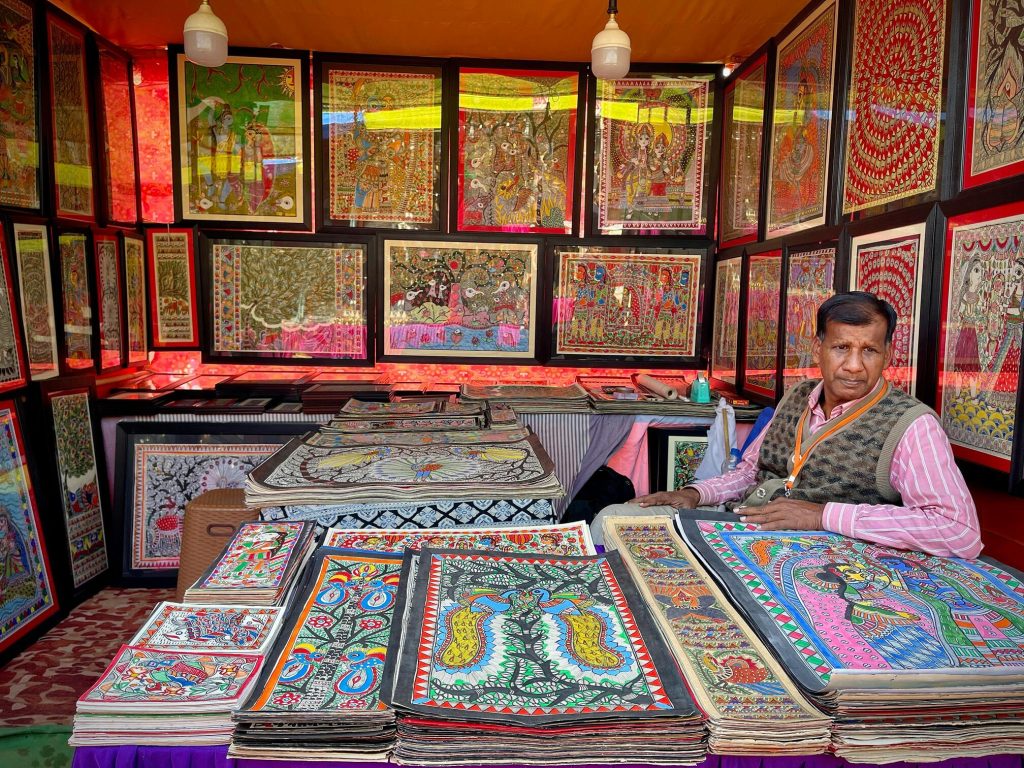
An art stall display with Madhubani paintings | Image Credit: Nishant Aneja on Pexels
Similar moments are unfolding elsewhere. In London, the Runjeet Singh Gallery is exhibiting a collection of Mithila paintings acquired directly from artists in the 1970s as part of Asian Art in London. Online, international folk art exhibitions organised by foundations working with Madhubani and tribal artists have begun reaching global audiences. Warli artists such as Mayur and Tushar Vayeda have been featured in exhibitions across Europe, Japan, and Australia.
The work is travelling widely. The terms under which it travels are less clear.
In global exhibitions and design showcases, Indian folk traditions are often framed through curatorial language that emphasises heritage, symbolism, and timelessness. The art is presented as collective and ancient rather than authored and contemporary. That framing makes the work legible to international audiences, but it also erases the conditions under which artists might assert rights, negotiate credit, or influence how their work is reproduced.
Warli art offers a clear example. Developed by the Warli Adivasi community in Maharashtra, its visual language of stick figures, rituals, and everyday life has become a global shorthand for “indigenous India.” Designers and institutions often collaborate with Indian studios or illustrators to reinterpret the style for international markets. The original artists are rarely part of those transactions.
When artists are included, it is often through NGOs or intermediaries who control access, pricing, and timelines. While the work moves, the credit often does not.
“
Folk art is no longer confined to tourist markets or state-sponsored exhibitions. It is being absorbed into the global premium economy, where cultural difference functions as distinction.
”
The same pattern repeats with Madhubani. Once painted on walls and floors in Mithila using natural pigments, the form is now reproduced across textiles, stationery, and décor for export markets. Attribution is frequently reduced to “inspired by,” a phrase that dissolves responsibility. Inspiration carries no obligation to compensate, credit, or consult.
Artists are not unaware of this imbalance. “It’s not that people don’t want to work with us,” one Mithila painter told The Moment. “They just want us cheap. And quiet.”
This is not a uniquely Indian story. Indigenous Australian dot paintings circulate widely through international galleries and museum shops, even as Aboriginal artists continue to contest how their work is licensed and reproduced. West African textile traditions like adire are globally popular as “tie-dye,” their origins flattened into trend. In the United States, Native American motifs have long been absorbed into fashion and homeware under the banner of “Southwestern” design, often without collaboration or consent.
Across contexts, the pattern is familiar, communal art forms move easily through global markets, while the communities that sustain them remain peripheral to the value created.
What makes the current moment distinct is the status of the platforms involved. Folk art is no longer confined to tourist markets or state-sponsored exhibitions. It is being absorbed into the global premium economy, where cultural difference functions as distinction. Museum stores, fashion houses, and international festivals benefit from the aura of tradition without fully engaging with questions of authorship, labour, or rights.
An example of a Pichwai painting | Image Credit: oskar holm on Unsplash
There are exceptions. Some organisations insist on naming artists, negotiating fair compensation, and sustaining long-term relationships rather than one-off commissions. Groups like Dastkar and artist-led collectives have pushed back against extractive models, while newer platforms are experimenting with licensing, profit-sharing, and direct representation. But these remain marginal within a system that continues to reward speed, scalability, and aesthetic flexibility over accountability.
The problem is not that Indian folk art is being seen globally. Visibility is not the enemy. The problem is that the structures governing its circulation were never designed to include artists as agents.
What we are calling a revival, then, is uneven by design. The forms travel, the value accrues, but the artists remain asked to perform continuity without power. Until that imbalance is taken seriously, Indian folk art will continue to be admired abroad while its makers remain peripheral to the success of their own work.
Folk art is moving faster than the systems meant to protect the people who make it. That gap, more than the revival itself, is perhaps the story of this moment.
Ask a mainstream AI chatbot for directions in Quechua, or try to joke with it in colloquial Marathi, and something feels off. The words may come back technically correct, but the meaning doesn’t quite land. The response sounds like someone who learned the language formally and missed how it’s actually used.
That gap isn’t accidental. It reflects where today’s most widely used AI systems come from.
Large language models are overwhelmingly trained on English-language data, much of it drawn from formal writing, Western media, and standardised registers. When other languages appear, they tend to show up in their most polished forms: textbook Hindi, European Spanish, or standard French. Everyday speech, regional slang, oral traditions, and cultural reference points are far less visible.
For people outside those defaults, using AI often means translating yourself first.
That’s beginning to change, largely through regional efforts to rebuild the interface itself.
Across Latin America, a coalition of universities and researchers is working on LatamGPT, a regionally developed language model trained on Latin American data and contexts. The goal is not scale, but representation, and to build systems that understand how language is actually spoken across the region.
That matters in a place where Spanish varies sharply by country and class, and where millions speak Indigenous languages such as Guarani in Paraguay, Nahuatl in Mexico, or Mapudungun among Mapuche communities in Chile and Argentina. These languages carry grammatical structures, metaphors, and ways of reasoning that don’t map cleanly onto English.
A model trained on lived languages can understand context | Image Credit: Solen Feyissa on Unsplash
The challenge goes beyond vocabulary.
In 2023, ChatGPT was asked to translate the Mexican idiom “me cayó el veinte.” The literal output, “the twenty fell on me,” missed the point entirely. What the phrase actually means is closer to “I finally got it” or “the penny dropped,” a reference to old payphones that only worked once a 20-cent coin clicked into place.
A model trained on dictionaries can translate the words. A model trained on lived languages understands the context.
That distinction explains why regional models are gaining urgency.
India faces a parallel problem at a different scale. With 22 official languages and thousands of dialects, linguistic exclusion is built into digital systems by default. The government-backed Bhashini programme aims to create open language datasets that allow translation and speech tools to function across Indian languages. Alongside it, companies like Sarvam AI are building Indic-language models trained primarily on Indian data, rather than adapting English-first systems after the fact.
“
When machines begin to understand how people actually speak, they don’t just talk differently. They also listen differently.
”
These efforts mirror earlier shifts in digital adoption. WhatsApp’s success in India wasn’t just about cost. It was about accommodation. Voice notes, regional scripts, and flexible keyboards allowed people to communicate without switching registers. Users didn’t have to learn the platform. Instead, the platform learned them for the users.
Building AI that works this way requires different data and different ethics.
Much of the world’s linguistic richness isn’t archived neatly online. It exists in oral histories, local television, community radio, street signs, and WhatsApp messages. Turning that into training data raises questions of consent and ownership.
Projects like Masakhane in Africa and Karya in India approach this collaboratively, paying contributors and keeping datasets open and community-owned. The work is slower and messier than scraping the web. It is also more accountable.
What’s emerging is not just a technical correction, but a shift in power.
As AI moves into healthcare, education, and public services, language stops being a cosmetic feature. It becomes the interface through which people are recognised or ignored. When systems understand only formal, standardised speech, they privilege certain users over others.
When machines begin to understand how people actually speak, they don’t just talk differently. They also listen differently.
Step outside in most cities today and you’ll feel it, a kind of heat that clings to buildings, radiates from pavements, and turns your own home into an oven by noon. Urban summer is no longer just inconvenient, many would say it is unbearable. In many places, it’s becoming a structural problem, one that architecture and infrastructure were never designed to handle.
As temperatures rise, cities have been looking for solutions. Air conditioning helps, but only if you can afford it, power it, and keep the grid from collapsing. So planners and governments are being forced to ask a quieter question, what if the problem isn’t that we lack technology, but that we forgot how to build for heat in the first place?
That question has led many of them back to the roof.
A view of buildings in Yazd, Iran | Image Credit: Dad hotel on Unsplash
In New York City, more than a million square feet of rooftops have been coated with reflective paint in recent years. The idea is simple. Lighter surfaces absorb less heat, which keeps buildings cooler and reduces the need for energy-intensive air conditioning. For residents without reliable cooling, that difference can be the line between discomfort and danger.
But what’s most striking is how old this idea is.
Long before “cool roofs” entered climate policy documents, communities living with extreme heat had already figured out how to manage it. In parts of Rajasthan, lime-coated roofs reflected sunlight and kept homes habitable through brutal summers. Across the Mediterranean, whitewashed buildings served the same function. These choices were practical responses to climate that later came to be recognised as stylistic ones.
For decades, that kind of design knowledge was sidelined. Modern construction favoured speed, uniform materials, and darker surfaces that tended to trap heat. Cooling became something machines were expected to solve.
Now, as those machines strain under rising temperatures, the older logic is resurfacing.
In Tamil Nadu, state-led cool roof programmes have moved beyond small pilots. Hundreds of government schools have been retrofitted with heat-reflective coatings, not as an experiment, but as policy. In earlier pilots in Chennai and Perumbakkam, indoor temperatures dropped by as much as 3 to 8 degrees Celsius. Classrooms became bearable again, without additional electricity demand.
“
Studies now show that widespread use of reflective materials can lower ambient urban temperatures by up to two degrees Celsius, reduce cooling loads, and lessen health risks during heatwaves. What was once treated as informal knowledge is being validated in technical terms.
”
The significance of this isn’t just technical. It marks a shift in how solutions are being valued. Instead of chasing expensive, high-tech fixes, governments are beginning to recognise that low-cost, passive interventions can make a measurable difference at scale.
This pattern is repeating elsewhere. Not everywhere, and not all at once, but enough to notice. In Tokyo, the resurfacing of uchimizu, sprinkling water on streets during peak heat, reflects a similar impulse to cool cities without new infrastructure. In Mexico City, community-led lime washing programmes reduce heat absorption in dense neighbourhoods. In parts of the American Southwest, urban design guidelines are starting to acknowledge principles long embedded in Indigenous desert architecture including shade, reflectivity, and airflow matter.
These approaches share a common trait. They work with climate rather than against it.
The same logic runs through older architectural forms across hot regions. Mud-brick construction in North Africa insulates against extreme temperatures. Mashrabiya screens in Cairo filter sunlight while allowing ventilation. Stilted homes in parts of Southeast Asia lift living spaces above heat-trapping ground. None of these were designed with climate models in mind. They emerged from lived experience.
Cool roofs are also a feature of architecture in Santorini, Greece | Image Credit: iSAW Company on Unsplash
Only recently has modern research begun to catch up. Studies now show that widespread use of reflective materials can lower ambient urban temperatures by up to two degrees Celsius, reduce cooling loads, and lessen health risks during heatwaves. What was once treated as informal knowledge is being validated in technical terms.
There is an uncomfortable irony here. Many of these methods come from regions that were historically dismissed as “backward” or “underdeveloped.” Their building practices were ignored in favour of globalised design norms that assumed energy would always be cheap and plentiful.
As that assumption collapses, cities are being forced to look again.
In Ahmedabad, experimental cool roof projects in informal settlements have painted tin roofs with reflective coatings. The results are modest but meaningful, indoor temperatures fall, residents sleep better, and electricity use drops. No futuristic materials. No massive infrastructure overhaul.
Just paint, applied with intent.
These are not new ideas. They are responses shaped by necessity, refined over generations, and set aside too quickly. The solutions have been here all along. What’s changing is how we are looking at them.
On a weekday morning in New York, a man pulls a paperback from his tote bag and props it against his knee. In a subway car full of phones, the gesture feels almost declarative. Across the aisle, someone glances over, not out of curiosity, but recognition.
Scenes like this are becoming more noticeable. In London, on the Overground, in Seoul, in study cafés that fill by noon, and even in Bengaluru, in library-cafés where people come as much to sit with a book as to escape the heat. Reading in public isn’t new. What’s new is how visible it feels.
We now have library-cafes in Bengaluru where people read, and escape the heat | Image Credit: Vika Glitter on Pexels
Part of that visibility comes from contrast. Nearly everything else we consume now arrives pre-filtered. The shows we watch, the music we hear, the news we encounter, even the jokes that find us are shaped by recommendation systems designed to anticipate our preferences. The book, oddly enough, still resists that logic. It doesn’t auto-play. It doesn’t refresh. It doesn’t quietly optimise itself to keep you engaged.
That resistance has started to matter. Despite years of predictions about the death of print, physical books remain dominant globally. Print still accounts for roughly 60 percent of book sales worldwide, and much more in parts of Asia and Latin America. In the United States, print made up close to three-quarters of publishing revenue as recently as 2022. Among younger readers, the preference is striking. A 2021 Pew survey found that nearly 70 percent of Americans aged 18 to 29 preferred print to digital formats.
Ebooks haven’t disappeared, but they haven’t replaced print either. Digital reading has grown steadily, especially in genres like romance, where speed and volume matter. What’s emerging instead is a split. Screens for convenience and paper for presence. The choice feels less about format and more about how people want their attention handled.
“
Many younger readers move fluidly between print, audiobooks, fan fiction, and online communities. The book offers texture where the screen offers flow.
”
That distinction becomes clearer in public. In Tokyo, “reading rooms” and silent cafés operate almost like gyms for concentration. In Seoul, book cafés offer multi-hour seating precisely because people want permission to stay still. In New York, the subway has always had readers, but the sight of a paperback now stands out against endless scrolling. Reading in public has become a way of opting out, briefly, from the ambient churn.
Part of the appeal is physical. A book takes up space. It occupies both hands. It sets a pace you can’t speed up without effort. In a life where work, leisure, and socialising all collapse onto the same glowing rectangle, the book reintroduces a boundary, albeit a modest one.
Yet, that boundary is increasingly rare. Work messages arrive on the same screen as entertainment. News alerts interrupt conversations. Even leisure is measured, tracked, and optimised. The book doesn’t participate in that economy. It doesn’t ask who you are or adjust itself based on past behaviour. In a culture obsessed with personalisation, the book remains curiously indifferent.
Of course, books are not untouched by algorithms. Covers are tested, titles are optimised, and BookTok can turn a novel into a bestseller overnight. But the act of reading, especially reading in public, still resists total mediation. Once the book is open, the feed stops.
That’s why books have become visual objects again with bold covers, coloured edges, and spines designed to be seen. Social media has taught people to read the world as image, and books have adapted. But the signal they send isn’t just aesthetic. A book in public now reads as a commitment to focus, or at least to the desire for it.
Books offer a rare encounter with something that doesn’t choose you back | Image Credit: Element5 Digital on Pexels
Is this nostalgia, or is it compensation? Historically, reading has always moved in cycles. Periods of technological acceleration tend to produce counter-movements toward slower media. In the recent past, we have seen vinyl return, film photography resurface, and handwriting classes in places like Japan fill up every spring. Books fit into that pattern, but they aren’t retro in the same way. They don’t evoke a specific decade. They simply sit outside the logic of constant update.
That’s why the revival isn’t about bookishness. Many younger readers move fluidly between print, audiobooks, fan fiction, and online communities. The book offers texture where the screen offers flow.
From familiarity to narrative stability, and even relief from constant interruption, older readers return for different reasons. The overlap of these motivations helps explain why independent bookstores are opening again, with more than 200 new shops launched in the US over the past five years.
In London, too, Waterstones has redesigned stores to encourage slower browsing. In Mexico City, weekend book fairs spill onto sidewalks. In Indian cities, library-café hybrids double as refuge from the heat. These spaces don’t promise optimisation. They promise time.
It would be easy to frame this as a romantic backlash. But something more pragmatic is happening. In a world where nearly everything is curated in advance, the book offers a rare encounter with something that doesn’t choose you back. And for now, that seems to be enough.
Open a phone in India and it is easy to miss how little effort is involved. Dinner appears in Swiggy before hunger has fully registered. Groceries arrive from Zepto in under ten minutes, timed neatly between meetings. CRED nudges you with a reward that feels oddly well placed. Nothing breaks, nothing asks too many questions, and the system works.
What disappears in that smoothness is how much learning sits underneath it. Over the last decade, India’s app economy has become exceptionally good at recognising behavioural patterns, not just what users do, but when they do it, how often, and in what sequence. The most successful platforms no longer compete primarily on features or price. They compete on prediction.
This shift did not begin with manipulation. It began with scale. Between 2016 and 2020, India underwent one of the fastest digital expansions in the world. After Reliance Jio entered the telecom market in 2016 with ultra-cheap data plans, mobile internet usage surged across income groups. Today, four out of five Indian households have a smartphone, and India ranks among the world’s largest consumers of mobile data by volume. According to India’s Ministry of Information & Broadcasting, smartphone penetration crossed 80 percent of households by 2023, while average monthly mobile data usage per user exceeded 20 GB, among the highest globally. Hundreds of millions of users came online in a compressed window of time, often mobile-first and app-first.
That scale changed the economics of apps almost overnight. Food delivery, quick commerce, and fintech became winner-take-most markets. By 2022, India’s food delivery market was already dominated by two platforms controlling the vast majority of orders, while leading fintech apps reported that repeat users generated a disproportionate share of revenue. Margins were thin, competition was intense, and customer acquisition costs rose quickly. Retention mattered more than novelty. Engagement mattered more than differentiation. Behaviour became the most reliable signal platforms had.
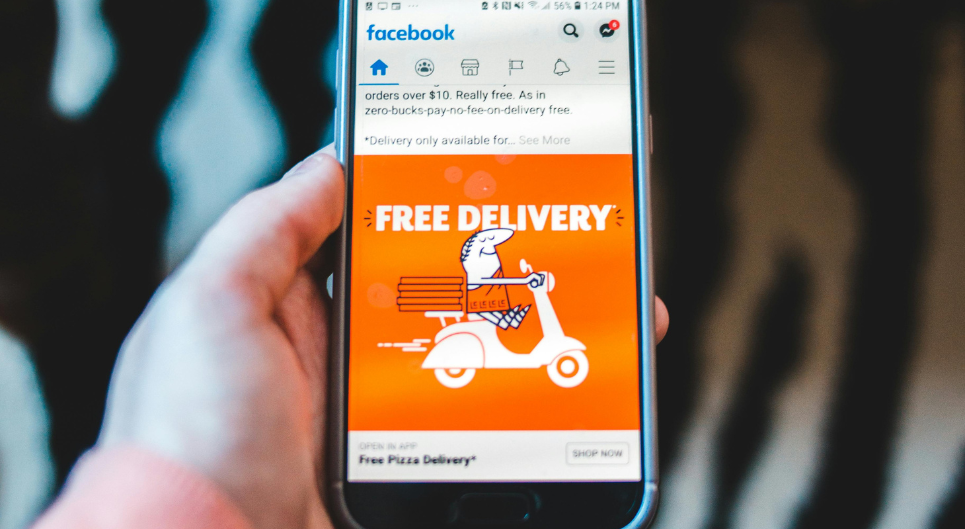
Food Delivery became one of the winner-takes-most markets | Image Credit: Erik Mclean on Pexels
So apps began to observe closely. Not in the cinematic sense of surveillance, but in the infrastructural sense of logging patterns. When people open an app, how long they linger, which offers they ignore, which ones they redeem late at night after a long day. Late-evening discount nudges on food delivery apps, for instance, are often timed to coincide with historically higher order completion rates, especially among repeat users. Over time, these traces form behavioural profiles that are less about identity and more about rhythm. Hunger has a schedule, spending has a mood, and attention has a curve.
The country is overwhelmingly an Android market, which means lower-cost devices, faster adoption, and looser default permission settings. Android accounts for over 95 percent of smartphones in active use in India, a sharp contrast with the United States, where iOS and Android usage is more evenly split. Digital literacy varies widely, and privacy controls are often abstract compared to the immediate payoff of convenience. In this environment, behavioural data is easier to capture than explicit intent, and far easier to monetise. Industry studies consistently show that personalised, behaviour-timed notifications convert at significantly higher rates than generic promotions, making prediction more valuable than stated preference.
The result is a different relationship between user and platform. The app does not need to ask what you want. It waits, infers, and nudges. Rewards systems, flash offers, and personalised notifications are calibrated around timing rather than persuasion. The aim is not to change behaviour, but to meet it at its most predictable moment.
This is why many Indian apps feel intuitive. They are not responding to conscious choice. They are responding to repetition.
“
Cheap data, dense competition, and a massive, heterogeneous user base make behavioural optimisation unusually valuable. The app economy does not need to persuade users to behave differently. It simply learns how they already do.
”
There is also a cultural dimension to this dynamic. In a country shaped by inequality and aspiration, everyday behaviour becomes a resource. Fintech apps learn when users feel optimistic enough to spend. Delivery platforms learn when exhaustion overrides frugality. Patterns drawn disproportionately from urban and semi-urban users are packaged into predictions and fed back as ease.
None of this is illegal. Much of it is disclosed, technically, through consent screens and privacy policies. But consent here is ambient rather than deliberate. The exchange is rarely stated plainly. In return for speed, convenience, and small moments of pleasure, users offer up patterns of daily life.
What makes this system powerful is not that it hides, but that it feels normal. This is not a uniquely Indian story. American platforms pioneered many of these techniques. But India is where the model sharpens. Cheap data, dense competition, and a massive, heterogeneous user base make behavioural optimisation unusually valuable. The app economy does not need to persuade users to behave differently. It simply learns how they already do. Over time, this changes what products are built for. Success is measured less by usefulness and more by stickiness. The most valuable users are not the most satisfied ones, but the most predictable ones. Behaviour becomes capital.
Seen this way, India’s app boom is not just a story of innovation or convenience. It is a story about how everyday life is being translated into signals, and how those signals now sit at the centre of consumer capitalism. The system works because it feels frictionless. But that frictionlessness has a cost. It makes the trade invisible. And that may be the most consequential shift of all.