

A decade ago, global entertainment followed a familiar pattern. A small group of countries produced most of the shows that travelled, and most of those shows were in English. Translation existed, but it was secondary. Subtitles were a courtesy and dubbing was an afterthought. Cultural influence moved outward from a narrow centre, and everyone else adapted to it. This is why shows like Friends and Full House became household names across the world in the 1990s and early 2000s, building devoted subcultures far from the places they were made.
That arrangement held as long as distribution stayed limited and production budgets stayed manageable. By the mid-2010s, both conditions started to collapse. In January 2016, Netflix expanded into more than 130 new countries in a single move, abruptly widening the potential reach of any show it carried. At the same time, the cost of producing flagship domestic originals rose sharply. Translation stepped into that pressure point, and the economics of global storytelling shifted around it.
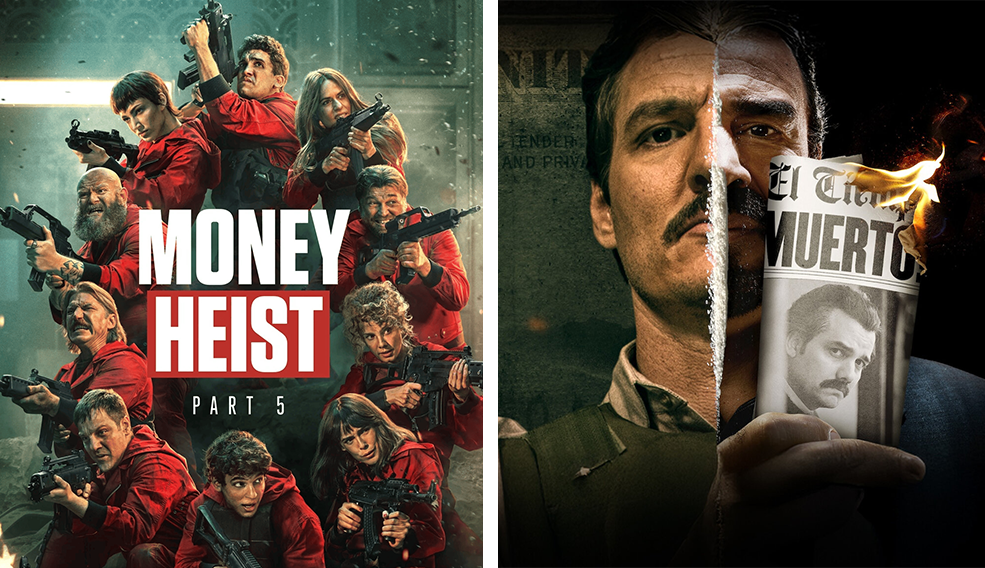
Platforms learned quickly that international titles offered a different kind of return. A series like Money Heist made this visible. It began as a modestly performing Spanish show and was cancelled by its original broadcaster in 2017. Once acquired, translated, and pushed across markets by Netflix, it found large audiences in Europe, Latin America, and eventually Asia and the Middle East. What mattered wasn’t that it became a hit everywhere at once. It was that language stopped limiting where a story could go.
From a platform’s perspective, the logic was simple. Domestic originals were expensive and risky. International titles, once translated well, travelled cheaply and kept viewers engaged longer. Subtitles and dubbing stopped being support functions and became central to growth strategy. Netflix executives later confirmed this shift in scale, noting that in 2021 alone the company subtitled roughly seven million minutes of content and dubbed more than five million minutes globally. Translation budgets rose, dubbing pipelines expanded, and release schedules began to assume global circulation from day one.
That shift changed how creators worked. As translation became reliable, the incentive to mimic Anglo-American storytelling weakened. Writers and directors no longer needed to flatten their work to feel “exportable.” A Korean legal drama like Extraordinary Attorney Woo leaned heavily into local workplace hierarchies, social rhythms, and cultural cues and still became one of Netflix’s most-watched non-English series globally in 2022. Nollywood followed a similar pattern. Nigerian films did not need shared history or linguistic familiarity to build viewers abroad once subtitles and dubbing lowered the barrier to entry.
Distinctiveness became an asset rather than a risk. Translation allowed stories to carry their own cultural density without being rewritten for an imagined global norm.
Audiences adapted just as quickly. Once platforms began releasing high-quality subtitled and dubbed versions simultaneously, viewers started exploring work from regions they had rarely encountered before. This shift became unmistakable between 2019 and 2021. Parasite crossed $250 million at the global box office after winning the Palme d’Or and the Academy Award, while Squid Game reached more than 1.65 billion hours viewed in its first 28 days on Netflix, becoming the platform’s most-watched series at the time. What began as curiosity turned into habit.
Viewers learned how to watch across languages. They learned to follow emotion, pacing, and genre conventions without full cultural familiarity. Demand followed, and with it, higher expectations for translation quality.
Platforms responded by investing in dedicated dubbing hubs in Madrid, Seoul, Mumbai, and Los Angeles. Translation became less about literal accuracy and more about tone. Humour, timing, and emotional cadence mattered because they kept people watching. A poorly dubbed show now risked losing audiences who had learned what good translation sounded like.
These dynamics altered the creative map. Spanish thrillers began influencing crime writing beyond Spain. Korean dramas reshaped expectations around emotional arcs and character development. Anime’s visual language informed animation choices far outside Japan. Once translated, these works carried not just plots but social cues, everyday behaviour, and ways of relating that had previously struggled to travel.
This unsettled older assumptions about cultural power. English-language entertainment still commands large audiences, but it no longer defines global taste on its own. Viewers routinely choose shows in languages they do not speak, drawn to atmosphere, character, and emotional structure rather than familiarity. Recognition has shifted away from linguistic proximity toward resonance.
Translation is not neutral and it is certainly not perfect. Context is sometimes smoothed over and meaning is often shifted. Decisions about what to explain and what to leave implicit shape how cultures are perceived. These debates matter and remain unresolved. Even so, platforms continue to expand translation budgets because the returns are clear. Netflix’s own engagement reports show non-English-language titles now account for a substantial share of total viewing hours across regions, particularly outside North America. International titles retain subscribers, and their value compounds over time.

What emerges is a form of soft power that operates without official choreography. South Korea’s surge in global cultural visibility after Squid Game did not come from a state-led export campaign, but from audiences absorbing language, social hierarchies, food, games, and emotional codes through a translated series they chose to watch. Influence now travels through subtitlers, dubbing artists, and release schedules rather than diplomats. It arrives quietly, embedded in character choices, humour, and ordinary life.
Translation reshaped global storytelling because it reshaped the incentives underneath it. Platforms needed scale, creators needed freedom, and audiences wanted variety that did not feel engineered. When those needs aligned, translation became infrastructure rather than accessory.
The result is a global media environment where stories circulate with fewer gatekeepers and fewer assumptions about whose voice travels best. Soft power now grows less from dominance than from availability. It grows because translation widened access and because viewers learned, willingly, to listen across languages.
Or, as Bong Joon-ho said when his subtitled film stood on a global stage in 2020, “Once you overcome the one-inch-tall barrier of subtitles, you will be introduced to so many more amazing films.”
The industry, it seems, spent a decade turning that insight into infrastructure.


Leave a Reply