

Core Memory, Colaba
1992, outside the Taj Mahal Palace Hotel in Colaba. I wore an oversized Fresh Prince of Bel-Air T-shirt, Nirvana blasting through a ruby-red Walkman. At the curb, a vada pav stall hissed and smoked.
My mother, knowing my stomach too well, said don’t; my father’s nod said otherwise. I bit in anyway: chilli, potato, butter, newspaper ink bleeding into my fingertips. We walked the frontage of the Taj while they watched me take the city in.
Bombay, because that’s the city of my earliest memories, was intoxicating even then, a place where five-star hotels and pavement stalls shared the same stretch of sea-facing road, where a kid like me could taste both in a single bite.
That night, paying for my bravado in chilli and butter, I knew this was a core memory. Not a judgment on my mother’s caution, a reminder that Bombay rewards small rebellions, the kind that stay with you long after the moment has passed.
That was my first lesson in Bombay: you could step between worlds here, and no one asked you to choose.
When the World Walked In
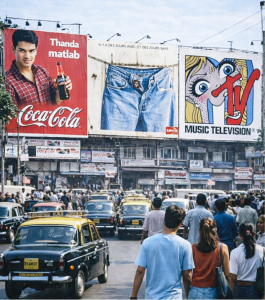
In 1991, India’s economic reforms swung the doors open, and the city became the stage where the new world walked in. I was still in school then, old enough to notice that the city’s soundtrack was changing, that the hum of my childhood was giving way to something sharper, more outward-looking, and unmistakably global.
Satellite TV antennas began appearing across terraces, and by 1992, MTV India had arrived, beaming global pop culture into homes that had, until recently, been tuned to grainy state broadcasts. Advertising shifted almost overnight. Pepsi and Coca-Cola were suddenly everywhere, and international brands like Levi’s began appearing in markets like Colaba Causeway.
MTV played grunge, hip-hop, and Bollywood remixes into the same living rooms. It felt new, slightly chaotic, and impossible to ignore.
Music videos changed how people dressed. Foreign soaps introduced new accents and ways of speaking. Shops began stocking brands that felt, at the time, unmistakably global. But the city didn’t copy. It adapted. What arrived foreign didn’t stay that way for long.
Liberalization wasn’t an abstract policy. You could see it in everyday life.
Bombay began to resemble a new India: cable wires looping across terraces, film posters layered over political slogans, a city mid-transition but entirely sure of its direction.
The world was arriving, but on Bombay’s terms.
Once you’ve watched the city take in the world like that, you start to notice how often people here are changing direction, in what they wear, what they watch, and what they begin to want for themselves.
The City on Screen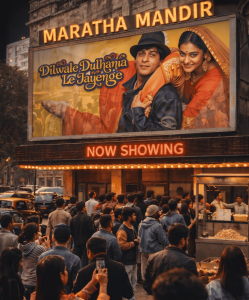
Cinema has always shaped how Mumbai sees itself. Long before I understood policy or economics, I understood something about the city through its films. Growing up, it came to me through what I watched and heard, songs, scenes, fragments that travelled far beyond the screen.
In Mumbai, what appears in film doesn’t stay contained for long. It slips quickly into popular culture, into the music people play, into everyday references, and into the way a film lingers in the city long after it leaves theatres.
What people watched didn’t stay on screen for long. It showed up in how people dressed, spoke, and carried themselves.
In Bombay, films sit close to everyday life. They influence taste, language, and ambition in ways that are easy to spot if you’re paying attention.
New films arrive every week, part of the 1,600 to 2,000 films India produces each year, more than any other country. The industry is valued at nearly ₹200 billion, or $2.4 billion, and sells more than 2.5 billion cinema tickets annually, far surpassing Hollywood. But its influence goes beyond box office numbers.
From Leicester Square to Jackson Heights, the Indian diaspora has carried Bombay’s cinema into living rooms and local theatres across the world. A Mumbai film screens in Toronto, a wedding sequence is remixed in Nairobi, a premiere draws queues in Dubai. Over time, these stories travel back, shaped by the audiences who watched them.
Take Dilwale Dulhania Le Jayenge. Still playing at Maratha Mandir decades later, it became more than a blockbuster. It became a habit. Generations kept returning, a sign that in a city defined by change, the theatre could offer something familiar.
You could see the influence in small ways. A song picked up quickly. A style repeated across neighborhoods. A line from a film turning up in everyday conversation.
Mumbai and its cinema have grown alongside each other. One reflects the city as it is. The other quietly shapes what it becomes.
Imagination for Sale
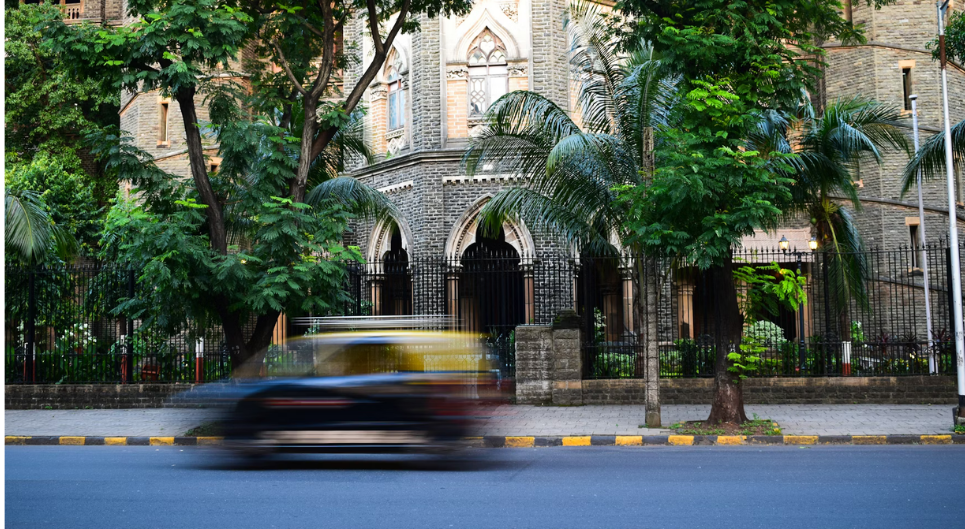
By the 1980s and 1990s, South Bombay’s agencies were working with global clients while speaking directly to Indian audiences. Campaigns moved easily between Hindi, Marathi, and Hinglish, and began shaping what people noticed, wanted, and recognized.
Television entered almost every living room, bringing soap operas, music videos, and commercials into daily routine. What people watched at night showed up the next day in conversation, in clothing, and in what shops chose to stock. Indian films and television also travelled abroad, reaching Indian communities overseas and extending Bombay’s cultural reach.
Advertising didn’t create ambition here. It gave it a new language, one people could see and respond to.
The city’s energy came from its people: Koli fisherfolk, Gujarati traders, Parsi entrepreneurs, Marathi merchants and mill workers, and waves of South Indian immigrants. Over time, business and culture grew together until it was hard to separate one from the other.
The Many Lives of Bombay
Neighborhoods carry their own signals. In a members’ club in a northern suburb, film directors, screenwriters, and lyricists sit around in thick black Karan Johar–style glasses, part fashion, part shorthand for the world they belong to. In the same place, by day, a young woman works the front desk, managing members and conversations. By night, she heads to dance rehearsals, preparing for her stage debut in December.
Across town in Kala Ghoda, Yazdani Bakery fills up each morning with bun maska and chai. The tables are worn, the pace is unhurried, and the same routines play out day after day. Some parts of the city change quickly. Others stay exactly as they are.
Bombay Dreaming
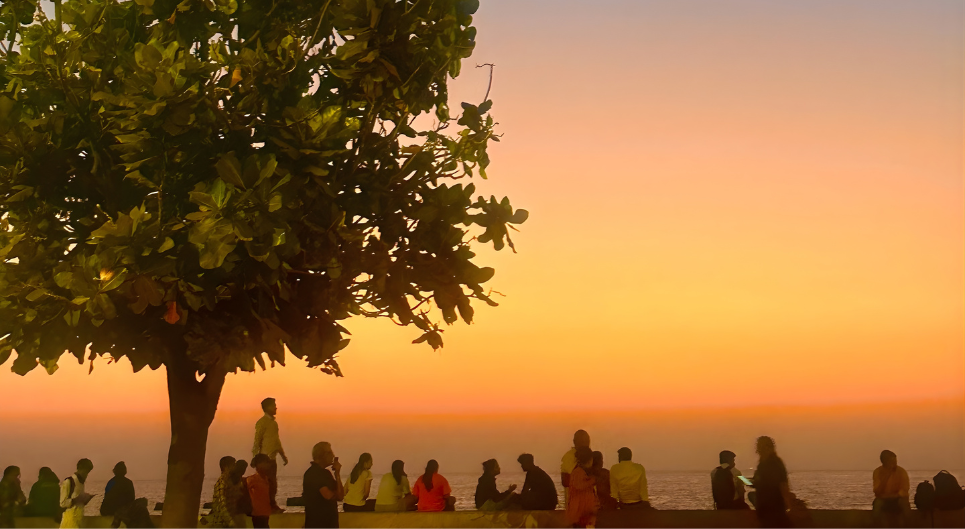
What draws people to Bombay is the feeling that you can begin again, even if you don’t fully know how.
My flatmate trained as a behavioural economist in London, working with data sets and regression models. A few months ago, she was in Kashmir, between Dal Lake and Gulmarg, filming her first feature. That decision opened up a new way of living for her, and along the way, it set an entire chain of work in motion, from lyricists and composers to choreographers, managers, and full crews.
And she isn’t alone. A former banker opens a restaurant. A copywriter starts a fashion label. A family-business heir picks up a camera and stays with it. People here allow themselves to try something else, and it rarely needs explaining.
Cinema has always captured this about the city. Wake Up Sid got it right in its monsoons, its late nights, and the feeling of figuring things out as you go. It showed a version of Bombay that feels familiar if you’ve spent enough time here.
The Coastal Road has begun to redraw parts of the city, changing how it moves and connects. Like everything before it, the city absorbs the change and keeps moving.
Some things make sense only much later. You spend years understanding what you first felt instinctively. For me, that feeling began in Bombay, with that first bite. I’ve come back to the city because something in me was always drawn here, something I recognized long before I could explain it. Being here now, it feels less like a return and more like picking up a thread I never really left.
Epilogue
For Ipsitaa, Vishal, and Sayali, for their persistence, and for reminding us what this city makes possible.


Leave a Reply