

There was a time when kings, queens, and members of the aristocracy emptied their coffers to sustain some of the greatest art in the world: from Isabella d’Este as one of the foremost female patrons of the Italian Renaissance, to Catherine the Great’s benefaction supporting artists such as Fyodor Rokotov and Dmitry Levitzky.
In the last few centuries, the identity of patrons – and the art they support – has changed quite a bit; but the intent remains the same. Today, corporations are at the front of the line, moving past traditional marketing and sponsorship goals to funnel money into contemporary art and artists. Their motivation has shifted from simple brand identity and commodification to building culture from behind the scenes, with the people behind the scenes.
In the world of social media, for instance, Substack is following a unique sponsorship model. The revenue from flagship partner companies like Uber, T-Mobile, and Balenciaga will directly support select influential creators on Substack. The motive is to make connecting with budding talent “easier and better than ever before.” Dan Robbins, head of brand sponsorships at Substack, says, “An ad is sort of grabbing you by the collar, and a sponsorship is kind of like the wind at your back.”
This is what patronage in the times of brand culture can look like. Design-led tech company Nothing launched its Club Nothing Fund, which offers $10,000 to four music collectives in support of their next “rebellious” and “innovative” event. While this can be viewed as a two-way deal – with Nothing being tagged in social media posts and having the Club Nothing ® logo stitched on merchandise – such investment has the ability to encourage and shape culture at the creator level. Charlie Smith, chief brand officer at Nothing, says: “The way I see it, modern-day brands can be patrons of the arts and help support artists, musicians and filmmakers. That’s when the creative community can see that you want to engage in a dialogue and not just take from them.”
The question, then, is: in a world where competing with AI creations has become the new norm, will artists be compelled to rely only on monetary goodwill to create the art the world needs so badly?
The most recently talked about partnership between the industrial and the creative world is that of Laika Entertainment and their new film, Wildwood. In 2005, Nike co-founder Phil Knight acquired the financially troubled Will Vinton Studios and rebranded it as Laika. His son Travis, then an animator at the studio, became its CEO in 2009. Laika released its first feature film, a stop-motion animation film titled Coraline in the same year, which grossed approximately $188.2 million worldwide, and has taken a seat in the cult film hall of fame.
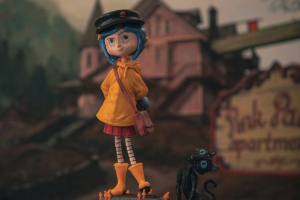
Now, Laika has released Wildwood, a film that has been 16 years in the making, and has received stellar reviews. The New York Times says: “In a world of A.I., reboots and repeats, it feels quietly remarkable to encounter a film whose every frame – every stitch of clothing, every feather, every leaf – is so painstakingly rendered by human hands…the enchantment of Wildwood is the ambition and expertise demonstrated in every frame.” Even Rotten Tomatoes, known for its stingy reviews, has offered the film a 100% on its Tomatometer. The painstaking and laborious work of stop-motion animation speaks volumes for the passion that this film and its creators have for the art. Director Travis Knight speaks to this emotion: “At the time when entire worlds can be built with the click of a mouse, and videos generated from a prompt, choosing to make a stop-motion film feels like a quiet act of rebellion.”
As these conversations take place, it is important to ask: how much of this dedication is possible only because of the support of Phil Knight behind the studio? Phil and Penny Knight are among the most prominent philanthropists in America, having directed millions of dollars toward a wide range of causes through their foundation. While Laika doesn’t follow the traditional playbook of corporate patronage ventures, the presence of a business bigwig such as Knight in its C-suite undoubtedly finances its ability to keep on competing in an industry that seems to only reward box-office hits, not creative passion.
Hollywood’s relationship with animation is one of love and hate. With Disney and DreamWorks Animation as household names, animation has found its undeniable seat at the table; and yet, in the last 50 years, only seven animated films have finished their year as the No.1 domestic release. Amidst the plethora of live-action remake after remake, somewhere along the line, animation faded into the woodwork as nothing more than a genre created for children. Pixar’s chief creative officer takes on part of the blame, “You look at 90% of the [Hollywood industry’s] movies, and they’re funny, goofy, a little bit like babysitter material. We could step up our game [as an industry].” But does ‘for children’ mean any less effort? As Guillermo del Toro put it: “Animation is not a genre; it is a medium.”
In May 2024, Pixar cut 14% of its computer animation studio staff. Sony Pictures Entertainment laid off hundreds of employees across its film and TV studio, with CEO Ravi Ahuja citing evolving industry requirements as a key reason in his statement, “To support our growth, we are aligning our organization with where the business is going — not where it has been. That requires changes to how we are structured and where we invest.” Sony consequently shut down its VFX firm, Pixomondo, amongst other restructuring decisions.
It is here that we can revisit the question we asked in the introduction of this article: is patronage the way forward for projects that are built on passion rather than profitability? Our knee-jerk reaction is to say yes. Former Disney animator Tom Bancroft, who worked on superhits such as The Lion King and Aladdin, speaks about how AI can shift the world of animation, “It’s hard to think of a positive scenario where artists help train an AI and then aren’t needed anymore…AI is not going away. Artists need to get involved in shaping how it’s used.” Spiridellis Bros. Studio is developing Space Unicorn, an ‘AI-forward’ animated film estimated to finish the film in only two years using only 40 animators — a fraction of the 1000+ creatives that worked on Wildwood. The opinions on the matter of AI in animation are varying; yet recognition of its presence and persistence remains throughout.
There are fewer and fewer flowers growing out of the cracks in the pavement. Flow, the 2025 Oscar winner for best animated feature, was made on a budget of $3.7 million on Blender, and grossed over $66 million in profits worldwide. It seems to be an outlier rather than a norm slowly taking shape. Despite Wildwood’s clear artistic mastery and perceived Oscar buzz, its domestic box office numbers for the weekend reached only around $11.6 million – a dismal number contrasted against its $100 million budget.
The creative impulse survives. But with AI reshaping industries and layoffs gutting creative teams, we risk a future where art reaches the masses only if a patron decides to fund it.




Leave a Reply