

It is a truth universally acknowledged that every Indian town must have a literature festival. Not Jaipur though. Everyone knows the Jaipur Literature Festival, that absolutely carnivalesque spectacle melding books with a soupcon of music, dance, food and handicrafts.
I mean Dehradun, Bhopal, Dibrugarh, Kozhikode, Nainital, Puducherry, Mangaluru. (Name a town; there’s a festival. Maybe even two.) So ubiquitous has the Indian lit fest become that travel sites now publish listicles on which lit fests to fly across the country for; it is impossible not to acquiesce to the suggestion that this is now a fairly lucrative part of the literary industry.
But in all the plaintive edits written about the commercialisation of the literature festival, something gets left out. The idea that even the most obscure lit fest might actually be doing some good!
The regional bookfest might be the only networking chance that a marginalised writer might get in an otherwise insular industry; one that prioritises a very particular kind of reader: Anglophile, well-educated, perfectly-dressed, articulate.
The actual reading ecology in the country stretches far wider and more disparately. Marathi pulp thrillers. Bengali detective serials. Malayalam magazines whose readers dwarf many English publications. Hindi self-help, devotional texts, graphic novels, and even Substacks. These readers are enormous in number and almost absent from the cultural narrative.
A small-town festival is one of the places where they can be part of the larger literary conversation. A Marathi-language crime novelist can be the headliner at a Pune festival, while the Odisha lit fest might underline the works of local-language historians. They aren’t part of one larger panel hoisted into the festival simply for tokenism. And they aren’t the sideshow. They are the main event, as they should be.
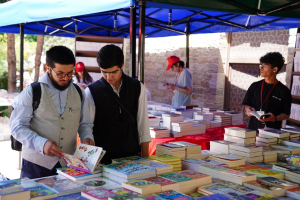
And of course, the advantages abound for the readers. For one, they can discover names beyond William Dalrymple or Amitav Ghosh, names that might resonate even more deeply since they come from a shared language and cultural space. A literature festival is, after all, an event built to bring together writers and readers, and at festivals like JLF, the chasm between the two yawns dangerously wide. Besides, a literature festival at readers’ doorsteps is a literature festival they are far more likely to attend.
That is not to say that a festival set outside of the metros is necessarily small in stature. The Shillong Literary Festival, for instance, has headliners such as Booker Prize winners Kiran Desai and Damon Galgut, some of the biggest names of our time.
Does a festival in Dehradun fix the world? No. It may feel faintly frivolous to hold one when the world seems to be on fire. But a room of curious people, listening to each other, is a small argument that we can still imagine things together.
The debate about whether India reads will continue, because it is really a debate about what kind of cultural self-image we want. That is worth having. It would just go better if it began by taking seriously what Indians actually read, and where they are willing to turn up to talk about it.
The Jaipur ideal has a place. It is just one part of a much larger picture.



Leave a Reply