

Long before MF Husain became a world-renowned artist, he hand painted Bollywood billboards, store banners and signs in what was then-Bombay. The influence of these street assignments are visible in his paintings too. The bold colors and brush strokes, black outlines and alphabets can be seen in most of his work, including his painting of Mahabharata, Ramayana or British Raj history. He often integrated handwritten scripts, Devanagari characters and Urdu calligraphy directly into the imagery.
These hand-written signboards with different fonts could be seen across Mumbai’s facades. There were businesses across many neighborhoods that were dedicated only to creating such signs. They were the OG font designers and painters rolled into one. “They would create fonts depending on the brand, its positioning and something that would look nice and coherent with the signs next to it,” says type designer Tanya George. These artists created open-to-sky font galleries at every market.
Over time, with the advent of quicker digital printing, these businesses dwindled. The art perished and so did the artists. Markets lost their creativity and soul. Everything looked flat and uninteresting.
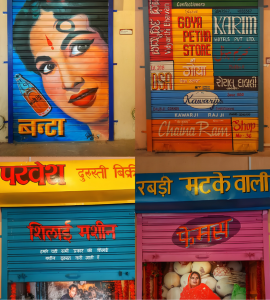
The turn came in the early-to-mid 1990s, when digital printing — cheap, durable vinyl banners run off a machine — arrived in Indian cities. What once took a painter days of mixing enamel, sketching guidelines and filling in letterforms by hand could now be printed in hours, at a fraction of the cost. For sign-painters, this wasn’t a gradual fade so much as a rout.
In Delhi, veteran sign painter Kafeel Ansari (the artist who created the official artwork for Fred again..‘s debut India tour) has described how the arrival of modern signage brought on something close to an existential crisis for artists like him, who feared the trade itself wouldn’t survive the shift. Many didn’t survive it: painters retrained as flex operators, moved into other trades, or simply stopped getting work as shopkeepers found it cheaper and faster to order a printed banner than commission a hand-painted one.
But as analog is becoming cool again, some brands are opting for hand-painted signboards. The Bombay Sweet Shop in Byculla is one such. The big advantage is that the lettering in the Devnagiri script isn’t compromised. George explains: “Many city signages rely on older digital fonts that fail to support modern technical advancements.” They can’t properly render the connecting shirorekha or correctly place the matras.” Hand-painted is the best for that. It takes longer, but gets the job done,” adds George. Plus, just like any art or design, handmade typography has so much more character, depth, soul and joy to it. It’s also a great way to support and become patrons of an art or an artist.
Ahead of his highly anticipated debut tour in India recently, London-based music composer Fred again, commissioned Kafeel Ahmed Ansari, a 70-year-old master sign painter based near Jama Masjid in Old Delhi, to create the official tour artwork.
There are also brands that have preserved their painted signboards through decades. Bandra’s men’s tailor S.S Dias & Co., established in 1930, has been taking care of its wooden, hand-created signboard for several years now. The stretch alongside Colaba market still has some of these hand-painted gems.
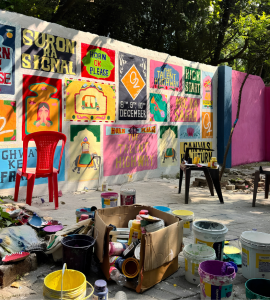
Mumbai’s story isn’t unique — it’s part of a pattern playing out on hand-painted streets worldwide, each hit by the same arithmetic of cheaper, faster printing. In Pakistan, the ornately painted trucks that once served as rolling billboards are seeing less work, as political campaigns increasingly favor mass-produced posters over the hand-painted trucks that used to carry their messages. In Mexico City, hand-painted rótulos — shop signage built on guarded techniques passed master-to-apprentice through generations, blending muralism, typography, calligraphy and color theory — have faced an even more sudden threat: local authorities in one borough recently ordered thousands of these signs whitewashed over in the name of civic uniformity, sparking public backlash from artists and residents alike.
The details differ — a Delhi calligrapher, a Rawalpindi truck yard, a Colaba tailor’s shopfront, but the shape of the loss is the same everywhere: a slower, costlier, more unique, more enticing human form of art being edged out by whatever prints fastest.
The hope is that more brands and people will subscribe to designed, hand-made typography, giving Mumbai a reason to walk and watch, and its artists good livelihoods. Because that, in the end, is what makes Mumbai’s small counter-trend worth watching — not as nostalgia, but as a bet that a city’s streets read better when someone’s hand was actually on them.


Leave a Reply