

When a decade-old video of New York Mayor Zohran Mamdani resurfaced recently, the internet had a field day. The clip, from a 2016 South African radio interview promoting his filmmaker mother Mira Nair’s Queen of Katwe, showed Mamdani speaking about his childhood in Uganda in a noticeably different accent from the one New Yorkers know today.
People on both sides of the political spectrum had plenty to say. Some lobbed accusations of a fake accent at him and accused him of appropriating an African identity. Others pointed out a far more rational possibility: Mamdani was speaking about Uganda, on a South African radio station, about a Ugandan film — which makes complete sense as someone who was born in Uganda, and whose father is a prominent Ugandan academic.
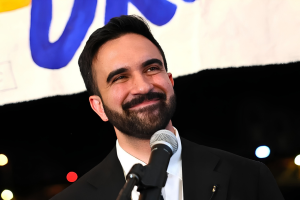
The debate says less about Mamdani’s voice than it does about our discomfort with people who refuse to have just the one.
When people in the West talk about code-switching, they usually think of it as a linguistic practice i.e., shifting from one language or dialect to another, depending on where in the world you are and who you are talking to. But for those in the diaspora, the term has come to encompass something broader — the language, yes, but also the mannerisms, vocabulary, volume, rhythm, and the version of yourself you allow into a particular room.
We all do it to some degree. You learn which version of your name is easiest for someone else to pronounce. You may soften your Malayali accent on the telephone. The person speaking English at work may be the same person who speaks Gujarati to their parents, and a Parsi dialect of the language with their cousins. Sometimes the switch is consciously chosen, sometimes it’s automatic.
That’s what makes the Mamdani clip so revelatory. Those lambasting him for appropriating a Ugandan accent are missing the point. Mamdani is a child of various cultures and nationalities, all of which he embraces wholeheartedly. Born in Uganda, of Indian origin, and living in New York from the age of seven, Mamdani’s life has been shaped by various languages and cultures. During his mayoral campaign, he used Arabic, Bangla, Hindi-Urdu, Luganda, Spanish, and English to speak directly to New York’s immigrant communities.
People of color have long been familiar with this double (or triple) identity, often being forced to see themselves simultaneously through one’s own eyes and through the eyes of a society intent on pigeonholing them in some way. But equally, class is another powerful reason people code-switch. A working-class person meeting their partner’s wealthy family may hear themselves speaking differently — more careful with diction, newly conscious of how they hold themselves.
The shift can feel performative; equally, it can feel like making a choice between various identities. Somewhere along the way, diaspora communities may begin to wonder whether such code-switching has cost something, a negation of one part of themselves whilst privileging another. Some may see it as evidence of inauthenticity — as though a single, original self sits buried beneath all those adaptations.
But cultural identity is never fixed. It changes through migration, marriage, work, class, and time. Research into code-switching increasingly recognizes this complexity.
And this is the way we must understand Mamdani’s many voices. He isn’t moving between a ‘real’ Ugandan self and a ‘real’ New York self — rather, he’s moving through the various worlds that made him. Code-switching is often framed as something people are forced to do, a survival mechanism born from the pressure to assimilate. Sometimes it is. But it can also become a skill, and eventually a choice. The ability to read a room in seconds, to hold various identities without needing to resolve them, is its own form of intelligence. One that communities of color have long ago achieved.


Leave a Reply