

For nearly a quarter century after India won independence, the country’s deposed royalty lived in a kind of suspended grandeur. Independence stripped them not only of their titles (nominal though that was), it stripped them of their sovereignty too. As a sort of compensation for joining the newly independent Indian republic, these former rulers of princely states received an annual tax-free government stipend known as the privy purse. It held the erstwhile royalty a sliver away from outright poverty, affording them some semblance of their earlier pomp.
But that too came to an abrupt end in 1971, when Prime Minister Indira Gandhi’s government abolished the privy purse through a constitutional amendment. As the historian Dr. Rakesh Ankit’s research shows, the decision could hardly have come as a surprise; the battle to wrest the privy purse away was actually the culmination of a protracted, bitter four-year political and bureaucratic battle.
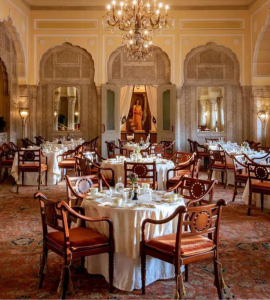
Families adapted to democracy the best way they could: selling heirlooms, selling their properties. And several did the unthinkable; they opened their doors to the Indian hospitality industry.
In fact, the Rambagh Palace in Jaipur, once a royal guesthouse for Maharaja Sawai Man Singh II, had already begun operating as a hotel in 1957, and the Lake Palace in Udaipur followed suit in 1963. But 1971 proved to be the turning point for India’s hospitality industry. That was the year in which Maharana Bhagwat Singh of Udaipur signed an agreement handing over management of his Lake Palace to Taj Hotels — a deal that presaged a broader shift in how India’s royal architecture would be monetized.
The Taj group of hotels was quick to recognize that while they could easily build sky-soaring towers of luxury, centuries-old history could not be replicated. They, along with other hotel groups such as the Oberoi, would go on to acquire many such royal residences.
Equally pivotal for the industry was the work of Aman Nath and Francis Wacziarg of Neemrana hotels; they bought and restored the ancient, crumbling 15th C Neemrana Fort which had once belonged to descendants of the Rajput king Prithviraj Chauhan III. Nath and Wacziarg spent five years restoring it before opening a 12-room hotel in 1991 (it has since swelled to nearly five times its original size). The Neemrana group would go on to gain a name for revitalizing ruined architectural marvels across the country.
And while Rajasthan has the earliest and highest number of palace and fort hotels, the model has evolved to include multiple others. In Maharashtra for example, a palace built between 1755 and 1803 by Khem Sawant III of Sawantwadi sat partly dormant for nearly 30 years before Yuvraj Lakham Sawant Bhonsle and Yuvrani Shraddha Sawant Bhonsle, both trained at the Culinary Institute of America, converted its Taisaheb Wada wing — originally built for the kingdom’s five queens — into a six-suite hotel in 2023. The property, built around the region’s Ganjifa card art and Malvani cuisine, is often described as India’s first chef-owned palace hotel.
India’s heritage hotel market is now estimated at roughly $487 million, and is projected to surpass $1 billion by 2034, according to industry forecasts.
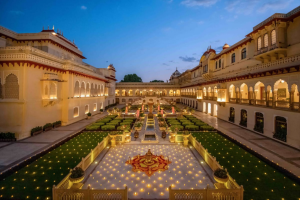
Depending on who you ask, this shift is a democratizing force, knuckling power and privilege away from royalty; appropriate in a democratic India. Others say that while India’s feudal hierarchy was erased on paper, it didn’t necessarily erase the habits of deference that sustained it. Palaces began selling a controlled, temporary version of that same experience back to the public — a few nights of being treated like royalty, for a price.
Today, the palace hotel is no longer simply a relic of India’s royal past repurposed for the present. It has become part of the country’s luxury identity, allowing travellers to inhabit, however briefly, the architecture and rituals of a world that officially disappeared more than half a century ago. The irony is hard to miss. The republic that once sought to dismantle the privileges of India’s princes has, in a different form, helped turn their former residences into some of the country’s most coveted destinations.





Leave a Reply