

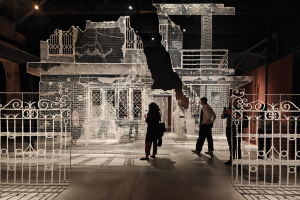
Walking around artist Sumakshi Singh’s life-size, embroidered fabric architecture is like being inside a surreal dream. It’s hard to take your eyes off the white, translucent spiral staircase, the intricate patterns on the walls, the double gate, the windows. I notice other viewers walking around, eyes wide with wonder, peering up and down to closely examine the panels, and resisting the urge to touch the fragile work.
But once you walk out of the work, you see the bigger picture, the cohesive structure of a house. There is something haunting about this work, a replica of Singh’s grandparents’ Delhi home that was built soon after the India-Pakistan Partition. It’s where Singh held some of her most cherished memories, but it was taken down a couple of years ago.
At the 2026 Venice Biennale, the India Pavilion’s theme – Geographies of Distance: Remembering Home – address the concept of a physical home and question what happens when that home no longer exists, you’re far away from it, or even when that physical home is no longer your real emotional home, explains curator Amin Jaffer.
Jaffer’s prompts for the Venice Biennale project were his lived experience as part of the South Asian diaspora, and a rapidly developing and changing India. He was born in Rwanda, Africa, and has lived in Britain, Canada, the USA, Portugal, Italy, the Bahamas and India. His work has taken him around the globe, from Japan, China and Russia to the Gulf, Africa and the Americas. “The preoccupation with home is a reflection of my own circumstances, as someone of Gujarati origin, born in a former Belgian colony, raised with multiple Indian and European languages and value systems,” he says.
Geographies of Distance: Remembering Home is also a response to the demographic, economic and technological boom in India, and the increased movement of Indians. “We are more mobile than ever before, within the country and across the world,” says Jaffer. “This turned my thoughts to notions of home and especially a home that is far away, either ggeographically or because the physical space has changed,” he adds.
Is a Home a Physical Space?
Established Indian artists Zarina Hashmi, Krishen Khanna and Satish Gujral have mourned the loss of their homes, family and friends during the 1947 Partition. The desire to return, to feel a sense of belonging in a place left behind, has long been evident in their art.
But for a younger generation of artists who have lived and worked in different countries, the idea of home is not bound to a physical space, perhaps because that physical space is constantly changing. Indian cities are dotted with redevelopment projects. Old structures are rebuilt as sky-rises. Difficult-to-maintain, sprawling bungalows are being erased for a mall or even a parking lot while the family moves to an apartment. The physical space is lost but the emotional space stays. Carry that with you wherever you go, and that, perhaps, becomes your home.
Singh, who has worked and lived in eleven countries, felt the most ‘belonged’ in her grandparents’ Delhi home. It’s where her family gathered, where festivals and important events were celebrated. But when that home was being demolished, she recreated it at the Biennale, with a delicate embroidered panel. The delicacy of the work gestures to the impermanence of a brick-and-mortar building. But the memory of it stays, and that, for Singh becomes her emotional home.
Living across borders and straddling multiple cultures has inspired works of other international artists too. South Korea’s Do Ho Suh creates life-sized replicas of the homes he has lived in across Seoul, New York and London, with translucent fabrics, exploring how memory, personal identity and space intertwine to shape one’s residence. Nigerian artist Akunyili Crosby, based in the United States, creates paintings that feature interiors and domestic scenes of a transnational home and the complexities of inhabiting two different cultures simultaneously.
The Climate Crisis
But even those who continue living in the same place they were born and raised in are questioning the idea of home. For Skarma Sonam Tashi, one of the five artists showing at the Indian Pavilion, home is closely related to his homeland Ladakh’s traditional architecture. His work, a block of traditional Ladakhi homes made with papier-mâché and clay from his homelands, becomes a commentary on how brick and mortar houses are replacing these structures. “It mourns the loss of traditional home-making skills and artistry to climate change,” says Tashi. The region, a traditionally dry one, has seen a recent swell of rainfall thanks to the climate crisis. The old houses were not built to protect from rain. That’s one of the reasons people are building brick-and-mortar buildings. “But those aren’t any good for our ecology either,” he laments.
A Home Lost to Violence
Palestinian-UK artist Mona Hatoum creates household furniture using items such as electric wires and mesh steel, treating the house not as a safe space, but as a site of political confinement and displacement.
Ghana’s Ibrahim Mahama places objects from his nation’s colonial past, such as train seats, defunct aeroplanes, locomotive engines and hospital beds in global art institutions, such as Kunsthalle Wien, Vienna, White Cube, London, and University of Michigan Museum of Art. By doing so, he prompts a discussion about how history has shaped what we call home. But it begs the question – can an exploitative past make a home?
In India, for instance, the concept of furniture as permanent space holders such as the dining table or a bed was introduced by the British. Our traditional style of dwelling facilitated movement. A charpoi could be carried to a terrace on a pleasant day or to the aangan for guests. But these furniture pieces would become an integral part of our houses. Our houses’ geographies were dictated by these items, and we forgot how our old houses were always minimal. In that sense, what we have inherited is a borrowed idea of a home. So, does that make it ours?





Leave a Reply