

Open your front camera. Pick a filter. You still look like yourself, just smoother, sharper, lighter. You didn’t ask for an upgrade, but the algorithm gave you one anyway.
Face filters seem harmless, right up until you examine what they’re doing, and who they’re built for. Behind each digital ‘enhancement’ is a machine learning model trained on data that largely skews to a Western model. When these models are applied to South Asian faces, they automatically lighten skin, narrow noses and straighten jaws.
Platforms such as Instagram and Snapchat rely on facial recognition tools developed primarily in the West. In one study from MIT Media Lab, facial analysis algorithms had an error rate of just 0.8% for light-skinned men, but up to 34.7% for dark-skinned women. That’s not just about identification. It also signals who the system sees clearly and who it reshapes.
The effect isn’t always obvious. Many Instagram filters don’t announce themselves because they’re baked into the default camera settings. A light blur here, some auto-slimming there; you post the selfie because the camera automatically makes you look good.
Globally, over 1.5 billion people use augmented reality filters every day. In India, with its 200+ million Instagram users, the numbers aren’t broken out — but scroll for five minutes and you’ll see it. A filter-fed aesthetic is slowly becoming the norm. Eventually, unfiltered faces start to feel almost unnatural.
India already had a complicated relationship with beauty. Caste, class, and colourism have long defined desirability. What filters do is scale those ideas. Preferences become presets. Bias becomes baseline.
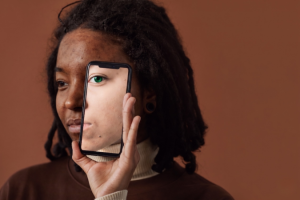
You could argue this isn’t new. After all, fairness creams and nose jobs have been telling us what to fix for decades. But tech makes it frictionless. You don’t have to choose change anymore. The camera does it for you.
When Snapchat launched its ‘beauty’ lens in 2020, users across Asia pointed out how it lightened skin and Europeanized features. Tiktok installed on South Korean and Japanese phones automatically whitened users’ skin, gave them smaller faces and plumped up their lips. Some have pointed out that their Japanese TikTok, when used with a Japanese SIM, wouldn’t let them record anything without a beauty filter. The app’s “Bold Glamour” filter uses AI so precise it doesn’t glitch when you move your face or dance around the room. It works so well that it doesn’t feel like a filter any more, it feels like a suggestion.
India’s creator economy is responding. Filter makers are designing AR effects that lean into regional features, brown skin tones, and desi humour. But platform discovery still rewards what’s already working. And what’s working is what fits global defaults.
If beauty is becoming a tech product, we have to ask: who’s writing the code? Who trained the model? How many Indian faces were in the dataset?
The face in the mirror is yours. The one on the screen might be the platform’s version of you. The real question is, will we keep editing ourselves until we match it?





Leave a Reply