

There is a problem with everything being available. After a while, nothing feels necessary. Theatre has always resisted that logic. It asks for a particular kind of attention that no other medium quite produces. It is not the passivity of a streaming platform, and it is not the distracted watching of a phone in hand. It is the knowledge that what is happening in front of you is happening only once, that the actor on stage is aware of you as you are aware of them, and that the experience will not be available for replay.
For decades, this quality was treated as theatre’s limitation. It is increasingly looking like its advantage.
Streaming platforms have trained us to treat culture as inventory, something to be browsed, sampled, abandoned, and returned to later, or never. The algorithm optimizes for the next thing, which means it undermines the experience of being fully inside the current one. You cannot pause a play, you cannot watch it at 1.5 speed, and you cannot look at your phone without missing something that will not recur. Constraints that once seemed inconvenient have begun to feel, for many people, like relief.

This is goes beyond being nostalgia for analog experience and often turns into a desire for an encounter that makes a genuine claim on your presence, one that treats your attention as something worth having rather than something to be captured and monetized. Theatre does this by necessity. Liveness is not an added feature of the form. It is the form.
The appetite for that kind of experience is showing up well beyond the stage. Live Nation reported 151 million attendees across its events in 2024. Book festivals, running clubs, supper clubs, and Saturday morning food markets are flourishing in the same cultural moment. They offer something a screen cannot replicate, the experience of being physically present with other people inside something unfolding in real time.
A stadium concert may tolerate divided attention. A theatre, at least most theatre worth attending, does not.
In India, the signs of this shift are visible in ways that would have been harder to predict a decade ago. Prithvi Theatre in Mumbai has long been one of the country’s most reliable cultural barometers, staging more than 640 performances each year while sustaining average attendance of around 80 percent. Its audiences have always been loyal. What feels newer is the sense that people who never thought of themselves as theatregoers are beginning to find their way into these spaces.
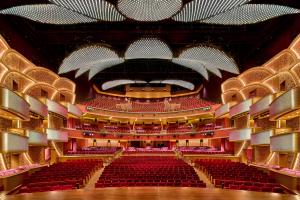
The Nita Mukesh Ambani Cultural Centre, which opened in Mumbai in 2023, welcomed more than one million visitors in its first year, hosted over 700 performances, and staged India’s first Broadway musical. Whatever one makes of private cultural patronage at that scale, the centre has signaled that live performance remains worth investing in and capable of attracting audiences well beyond traditional theatre circles.
Smaller venues across Mumbai, Delhi, and Bengaluru appear to be experiencing a similar shift in interest, even if comprehensive attendance data remains difficult to come by. The people arriving are not always seasoned theatre enthusiasts. Many are looking first for an evening out, the social ritual of leaving home and sharing an experience with strangers, and discovering that theatre offers something their regular media diet does not. As Ishita, a Mumbai-based writer, recently put it, “If I wanted to half-watch something, I would watch it on Netflix. But I want to go out and get away from a screen. So I watch a play instead. We’re watching one nearly every week now.”
The remark contains more than it first appears to. It is not merely a preference between two art forms. It is a description of what going out has come to mean. Choosing, together, to be in a room and pay attention to something has become an experience in itself. The togetherness matters. The commitment matters. So does the knowledge that this particular evening, with this audience and these performers, will never happen in exactly the same way again.
Whether this develops into a lasting shift remains uncertain. Infrastructure takes time, and audiences have to become habits. The informal circuit that sustained Indian theatre through leaner decades is not automatically equipped to scale, and scaling without losing what made those spaces distinctive is a genuine challenge. There is also the question of whether new funding encourages experimentation or rewards safer forms of cultural programming.
Those are important questions. But they are the questions of a living art form rather than one in retreat.
The interesting thing about liveness is that it cannot be optimized. You can improve the production, the acoustics, and the sightlines. You cannot eliminate the possibility that something unexpected will happen, whether it is a missed cue, an inspired improvisation, or a moment of connection that exists only for the people in the room that night.
That unpredictability is not a flaw to be engineered away. For audiences who spend much of their lives inside systems designed for convenience, personalization, and endless replay, it may be the very thing worth leaving the house for.




Leave a Reply