

Scene 1: Aunty wobbles slowly down a staircase, her leg encased in a thick bandage, wires protruding from her nose. Her foot misses a step, but her son steadies her.
Scene 2: Aunty is in a gym, wearing a loose salwar kameez and fuchsia pink sneakers. She looks fragile, dwarfed by the thick support belt she has girdled round her waist. Suddenly she bends down, et voila! Aunty has just deadlifted 80 kgs (approximately 175 pounds) with ease.
This isn’t the latest Avengers film. This is a reel from the Instagram account maaormannu, managed by the trainer Manish Singh Shakya (via @becomingmannu), featuring his 57-year-old mother Javitri Shakya. What makes Ms Shakya’s journey even more extraordinary is that she has battled cancer, and is missing a chunk of flesh from her leg.
Scene 1: The camera, all a-blur, focuses on an aunty in a pea-green salwar kameez. Her hair is streaked with white, and she is breathing heavily. Around her, young men with ropy muscled arms, stand around and chat with each other.
Scene 2: Aunty stretches to get rid of the kinks in her back, then bends down. She has just trapbar deadlifted 110 kgs (pounds) with perfect form.
These aren’t scenes from the Justice League film. This is a reel from the Instagram account Weightliftermummy, featuring 71-year old Roshni Devi Sangwan, who has been featured everywhere from the South China Morning Post to the BBC. As in Ms Shakya’s case, Ms Sangwan is trained by her son, Ajay Sangwan.
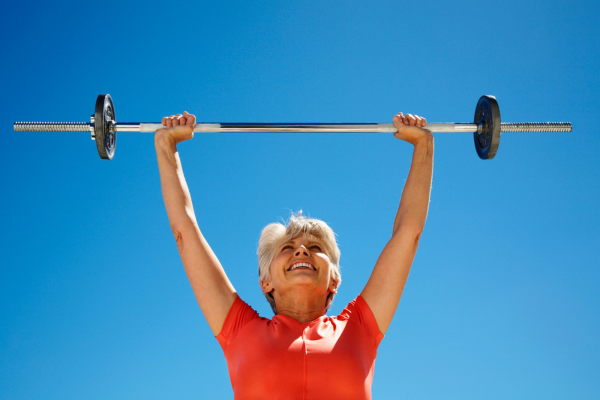
Across India, a slew of older Indian women are picking up heavy pieces of metal in the gym, and skewering stereotypes in the process. Urged on by worried children, many of whom are fitness trainers themselves, these ladies are reversing osteoporosis, calming their cholesterol, and reducing their diabetes. The biggest flex, it turns out, is no longer just your Hyrox trophy. It’s your mother hip thrusting 100 kgs.
In a testosterone-steeped country, this is more than just a trend. It gestures to a much larger societal shift.
But first, let us examine some numbers. India’s commercial fitness sector is valued at ₹16,200 crore — roughly US$1.94 billion — with some 46,500 facilities and 12.3 million members. By 2030, that figure is expected to nearly double, to ₹37,700 crore, with 23.3 million Indians possessing a gym membership.
And yet, according to a 2024 report by the Ministry of Statistics and Program Implementation, only 3.9 percent of Indian women under 29 exercise daily. For men in the same age bracket, the figure is 14.8 percent. For every woman exercising in India, nearly four men are doing the same. And it goes without saying that the participation rate drops even further still as women age into motherhood and grandmotherhood.
Consider what the average Indian woman’s day looks like. She wakes early to cook and pack lunchboxes, to shunt children off to school and husband off to work. A full day of office work later, she returns home to the third shift of the day; cooking, doing the dishes, supervising homework, the endless administration of her household. Studies on time use in India consistently show that women spend three to ten times more hours on unpaid domestic work than men do.
Then there is the question of space. Fitness — running, cycling, strength training at the gym — is largely predicated on striding into public spaces. But such spaces are oft seen as the arenas of men; women instead, are buttressed into their homes by the restrictive language of respectability. Is it entirely respectable, patriarchy asks, for a woman to go into a male-dominated space such as a gymnasium, and lift heavy pieces of metal, perhaps with a male trainer? And when it comes to older women, that fear swells, folded into the larger worry of injuries to aging bones and joints.
Gendered constraints aside, there is also the peculiar problem of plenty. Middle-income families are now glutted with a vast choice of carbohydrate and fat-rich food in restaurants and stores. Traditional Indian food skews towards starch anyway, and without the balance of fitness, older Indian women are amongst the highest at-risk demographic for bone and heart disease.
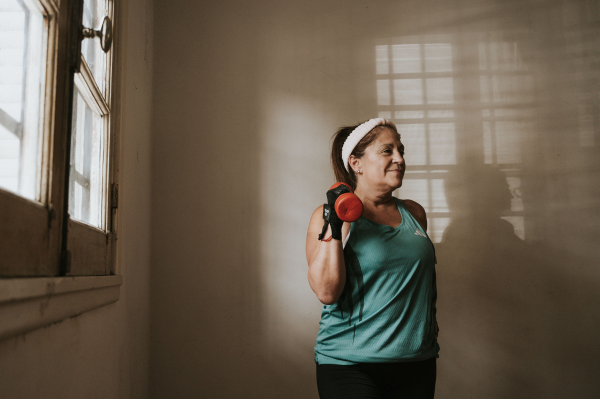
Luckily change is coming, slowly but surely.
In cities like Bengaluru, Chennai, Mumbai, and Hyderabad, a new crop of women-only fitness spaces has begun to emerge. Pink Fitness, India’s largest all-women fitness chain, is staffed entirely by women: trainers, dietitians, physiotherapists, even housekeepers. Commercial gymnasiums sometimes offer women-only zones.
And simultaneously, India’s ‘Silver Economy’ is starting to spike a massive infusion of wealth into age-related fitness services. There are a handful of indications already. For one, even a cursory glance at most newly-developed senior living spaces will reveal that they are endowed with superbly-equipped gyms. Secondly, fitness trainers such as Bhavna Harchandrai, certified in senior citizen fitness, are now hosting training sessions for anyone above 60. An overwhelming majority of students are women. An ecosystem is slowly bricking itself around the aunty.
Social media is reflecting this change too. A new wave of fitfluencers with names like @young67fit, @fitwithdadi and @barbellaunty are acting as megaphones for a different gym demographic — older, self-assured baddies, entirely comfortable squatting in salwar kameez.
This revolution is mirrored around the world. In the United States, women like Joan MacDonald — who began lifting at 70, thanks to her fitness-trainer daughter — and Virginia Maccoll — a three-time Ninja Warrior competitor in her seventies — have built vast online (and offline) followings. Catherine Kuehn broke multiple world powerlifting records in her nineties. Meanwhile, in Taiwan, a ‘super-aged’ society with more than 20% of its population aging into their 60s, more and more senior women are finding their way into gyms, proving that their strongest years are ahead of them.
And so something is stirring. And in the churn of social media and aspirational culture, the image of what an older woman’s body can do is being renegotiated in real time. The sons and daughters of women who never exercised are now fitness trainers, and they are urging their mothers to the gym. Perhaps this is the way that change comes then: not through institutions first, but through families. Not through public policy, initially, but slowly, slowly, through the persuasions of a concerned child.





Leave a Reply