

2026 was the year that changed everything.
Jamir Nazir’s The Serpent in the Grove was one of the winners of the 2026 Commonwealth Short Story Prize. So were short stories by John Edward DeMicoli and Sharon Aruparayil. Soon after, Harnidh Kaur’s The Girls Are Not Fine began to make its way into Indian bookshops. And around the same time, Olga Tokarczuk, the Nobel Laureate, gave a (somewhat polarising) speech in Poland.
What threads these seemingly disparate events together? All these writers have faced an online outcry for using AI. Or so the Internet would have us believe.
There is nothing new about the fears of machine-written texts. But up until now, these fears lurked behind relatively minor niggles about Chatbot-scribed student essays, inflated Amazon reviews and the odd article or two (apparently even the New York Times is not immune).

But now? The incidents of 2026 have showed us that technology has scythed through the writerly bastions that were once believed to be heavily walled against it. Apparently, nowhere is safe anymore. Any writer, good or bad, publicly putting their work up online is now at risk of being accused of using AI; as creative writers, the subtext goes, we are meant to be better than that.
Across social media, posts now pop up like flags — ‘Ways to Spot AI’, ‘How to Tell if AI Has Written This Article’. Carousel after carousel and tweet after tweet point to the use of the em dash, the repeated use of the word ‘delve’ or apparently ‘gamechanger’, the obsession with the use of three (adjectives, phrases), the asking and the answering of a question, the use of the X and Y variables (“it’s not just x, it’s y”), the tedious, bloviating explanations of the most basic ideas.
The assumption is that most writing is now steeped in AI. A ravening mob of commentators now prowl the comments sections, lying in wait with pitchforks, only to leap out at the teensiest hint of it. And instead of engaging with the actual content, the writing is dismissed as slop.
The issue has climbed to such a fever pitch that the Author’s Guild was elbowed into releasing a statement for publishing professionals stating that uploading or inputting a copyrighted work or an author’s personal information into AI systems without permission may constitute a violation of the author’s copyright or right of privacy, and it puts the author’s intellectual property and personal information at risk.
This is not to dismiss legitimate concerns over AI.
The world is in an unprecedented environmental crisis, further stoked by data centers gorging precious ground water and spiking temperatures. (The latest salvo in the ongoing battle against these centers has now been fired by Erin Brockovich herself, who is mapping the footprint of data centers across the USA).
There are also very real fears that AI might dim users’ critical thinking and creativity; we may argue that these are the very traits that make us human.
But standing against technology-assisted writing does not equal supporting the AI author witch hunts.
Many of the accusations made are supposedly baseless. Aruparayil for instance, has strenuously denied using any kind of AI for her stories. Tokarczuk has since clarified her loose comments on using AI as well, stating that none of her texts, including the novel that will appear in Polish this fall, have been written with the help of artificial intelligence – except for using it as a tool for faster preliminary research. After all, AI detection models such as Pangram can be wrong too — how then can one choose them as the final arbiter of a piece of writing?
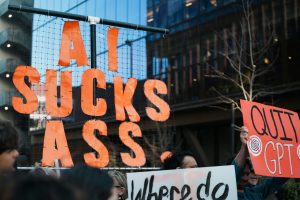
Besides where do we, as readers, draw the line? An entire text slapped out by Claude AI is clearly unacceptable. But what about dropping in a phrase or two? Or using Claude to search for that one particular, appropriate word instead of fossicking through the Cambridge English Dictionary? Or using it as the bedrock of your research, upon which you can later build your piece?
Nowadays, some writers are too paralyzed to write a single word publicly. Others are simply pissed off. “No one is more annoyed by the AI revolution than people who can actually write a sentence,” tweeted Laura Matsue. “Basically, having any ability to write now is suspect — you will get accused of being AI at some point. It feels like you are being accused of being a witch, of holding a type of rare magic that only the machines are now allowed to have.” Which begs the question – are some of these critiques born of the scarcity mindset, or dare we say, writerly envy?
Matsue got a volley of responses in support, and her message was reposted 1,111 times at the time of writing this piece. Several commenters pointed out the deep irony of the fact that the GenAI style being called out was in fact bricked upon centuries of human writing. AI uses em dashes because humans use em dashes, and always have.
All of which is to say that writers will keep writing, people will keep critiquing. You might think the best writers use AI. You might think the worst ones do. But it is important to remember too that all bad writing is not AI. Sometimes, bad writing is just bad writing. And vice versa, of course.




Leave a Reply