

Your aunt sends you a devotional Reel every morning, your father has strong opinions about which YouTube finance channel to trust, and your grandfather joins Zoom calls without being asked (but he just refuses to mute himself). For years, these felt like stories from the edges of internet life. Increasingly, they are internet life.
We talk about the internet as though it belongs to the young. Every few months there is a new generation to decode, a new platform to panic about, a new slang term requiring a glossary. Brands chase Gen Z and startups chase Gen Alpha. Entire industries are built around predicting what younger users will do next.
Meanwhile, some of the most consistent growth in India’s internet user base is happening among people over fifty.
The numbers tell a partial story. India crossed 950 million active internet users in 2025, according to the Internet and Mobile Association of India, with rural adoption growing at roughly twice the pace of urban areas. Age-disaggregated data is harder to come by, but the direction seems to be clear. The share of internet users aged 35 and above has been rising steadily since 2019, and demographic projections suggest that trend will continue as India’s population ages and smartphone access deepens in smaller cities and towns. The next wave of first-time internet users in India will not look like the last one. What is less discussed is what happens to a platform’s culture when so many new people arrive on it. A demographic that is older, often more patient, and frequently more purposeful about why they are there.

In India, a new kind of everyday ritual is taking root. Mornings begin with bhajans on YouTube. Then come WhatsApp family groups, a regional-language news video, or maybe a stock market explainer from a creator who uses analogies that are relatable. A Facebook birthday message for an old colleague, followed by a quick check of a government portal that someone figured out how to navigate and then screenshot for everyone else. The routine is structured, habitual, and deeply social. It is also as sticky, in its own way, as any Gen Z screen schedule.
But the motivations are different. For many older users, the internet is not primarily a place for self-expression or personal branding or keeping up with the cultural conversation. It is a tool for maintaining relationships, staying connected to family, managing practical life, and participating in communities that matter to them.
This shows up in how they behave once they are online. Older WhatsApp users, as anyone in a family group can confirm, do not just forward; they annotate. A news article usually arrives with commentary, a health tip comes with a personal observation, and good-morning messages, with their small festivals of flowers and folded hands and heart emojis, are not just broadcast content. These have quickly become a daily form of contact. Communication stays relational rather than algorithmic, and in an era when younger users often describe social media as exhausting and isolating, that is not nothing.
The effect is subtle but significant. Spaces that platforms often imagine as channels for content become, in practice, places for conversation. It’s not uncommon to see a comment section turn into a reunion or a devotional livestream become a community gathering.
Part of what is driving older Indians online is a structural shift that does not get talked about enough in digital culture conversations. The family has changed shape and technology has moved in to fill some of the gap.
Joint households have given way, across much of urban and semi-urban India, to smaller nuclear arrangements. Adult children have moved to other cities, or other countries. The Indian diaspora is large and still growing. There are over 32 million people of Indian origin living outside India, among the largest overseas communities in the world. For many of them, daily contact with parents and grandparents happens through a screen.
This creates an understated yet practical imperative. Parents and grandparents who want to stay close to children abroad need to be online. Video calls, WhatsApp updates, shared Reels, and Facebook posts that let you feel like you witnessed something have become how families stay emotionally present across distance.
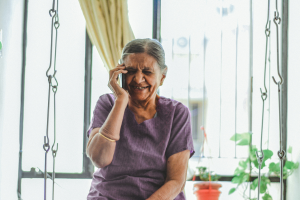
Research on the lived experience of older Indians left behind by emigrating children describes something that rings true. Digital communication genuinely mitigates loneliness, but it also reveals its own limits. A five-minute call can hide a difficult day. Warmth can come through, context often cannot. Still, the alternative, sporadic phone calls across time zones, is worse. And so older adults learn the platforms, figure out video calling, join the family group, and gradually become more comfortable in digital spaces than anyone expected.
For NRI families, this is not a small thing. The grandmother who can now send a voice note and receive a photo from a birthday party on the other side of the world within minutes of it being taken is not marginal to the internet. The internet came to her.
As more older Indians come online, a small but growing ecosystem has emerged around them. Companies like Seniority, Emoha, and Goodfellows are building services specifically for this demographic, from ergonomic products and elder companionship to curated digital experiences for seniors. Healthcare platforms are also increasingly offering simplified digital flows.
Content creators are also a part of this shift. Retired teachers run YouTube channels explaining Sanskrit texts, with production values modest enough to feel trustworthy. Grandmothers share recipes with audiences spread across multiple countries. Regional-language creators discuss gardening, spirituality, personal finance, and everyday health for viewers who rarely see themselves reflected anywhere else online. Utkarsh, a Delhi-based banker told us, “I gifted my father a podcast mic for his retirement. He wants to start an educational channel to talk about finance for older people. He worked for the government for decades and wants to share his knowledge. He even has 5k followers!”
These are not niche curiosities. Devotional content on YouTube has grown into one of the platform’s most reliably streamed categories in India. The audience for that content is not primarily young.
But there’s another side to the story as older Indians log in more. None of this is uncomplicated. They are also more vulnerable to misinformation, digital scams, and phishing attempts. They are more likely to be scammed than younger users. On top of that, platforms were not designed with their threat models in mind. Multiple studies across different countries find that older adults are also more likely to share misinformation online, often not from carelessness but from a different sense of what sharing means.
This has produced a recognizable intergenerational dynamic in a lot of Indian households. The adult child explaining privacy settings, gently questioning that viral health claim, showing a parent how to spot a suspicious link, while that same parent is sending online registration links for government schemes they figured out how to navigate, or passing along stock tips, or knowing exactly which government portal has the right form for a particular bureaucratic task. Everyone teaches and everyone gets taught. Everyone is also at least slightly exasperated.
Most Indian platforms still behave as though their user is young and digitally fluent in the way that demographic usually is. User interfaces assume a certain comfort with gesture and navigation that many older first-time users do not have. Marketing and product decisions continue to treat new users as synonymous with young users. Voice search, larger text options, simpler checkout flows, these are still exceptions rather than defaults.

The numbers suggest this will have to change. How people pay looks different in this demographic. They use less UPI, more cash on delivery, more comfort with phone-based rather than app-based transactions. How they search looks different, they tend to use more voice commands, more full questions phrased in regional languages, and less comfort with truncated keyword logic. How they decide what to trust looks different too. Platform reputation and community validation matter more than influencer endorsement.
Some companies have noticed and begun adapting. Quick commerce and delivery platforms have begun targeting older demographics with campaigns that acknowledge, rather than ignore, the learning curve. Uber’s guest-ride feature allows users to book rides for someone else. Blinkit has experimented with collaborative shopping tools that recognize that purchases are often made collectively rather than individually. These may seem like small product decisions, but they reflect a larger reality. Still, it is early and the gap between where the user base is going and where product design currently sits is wide.
India’s internet is older than it was five years ago, and it will be older still in five more. That does not mean the memes disappear or the youth platforms empty out. It means the internet becomes more genuinely intergenerational, more varied in its purposes, its languages, its habits, and its assumptions about what being online is even for.
So that aunt sending the devotional reel every morning is not a straggler arriving late to someone else’s party. She is part of one of the most significant shifts happening in Indian digital life right now, and the rest of the internet is still catching up to what that means.





Leave a Reply