

India’s museums hold no shortage of curiosities — from a bomb placed inside a book, planted in an attempt to assassinate a British official, to a mechanical toy that strikes the gong inside a clock. These are more than just interesting objects; they are enduring testaments to the brilliant minds of artists, sculptors, architects, and, of course, curators. These institutions, after all, are both repositories of history as well as spaces for communities to gather and engage with their own, often complicated histories. Plans are afoot for a swathe of new museums at the ancient archaeological sites of Lothal, Chittorgarh, Udaigiri, Adhichinallur, Jhansi, and Dholavira, to showcase (amongst other things) the country’s Buddhist heritage.
Many believe that the idea of a museum is inherently a colonial construct; the concept of the museum was brought to India by British authorities, who set up the country’s first museum in Calcutta in 1814. Today, many of these institutions have sought to reverse the impact of colonialism by telling the stories of post-independence India, although some of their origin stories lie in the making of colonial narratives.
India, of course, has a plethora of museums. Figuring out which ones you absolutely shouldn’t miss, however, is no easy task. Here’s a list of five iconic museums in India that you should consider visiting if you find yourself in any of these cities.
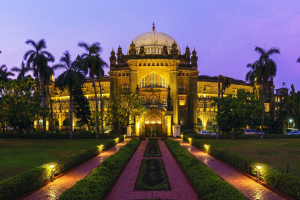
1. Chhatrapati Shivaji Maharaj Vastu Sangrahalaya (CSMVS), Mumbai
The Chhatrapati Shivaji Maharaj Vastu Sangrahalaya (CSMVS) in Mumbai stands as one of the country’s most distinguished centers for art and history. The museum was established in the early 20th century to commemorate a royal visit from England and was originally named the Prince of Wales Museum of Western India. It was later renamed to honor the 17th-century Maratha monarch, Shivaji Maharaj. Designed by Scottish architect George Wittet and completed in 1915, the building is a prime example of Indo-Saracenic architecture, seamlessly combining traditional Indian elements like Mughal arches, Maratha jharokhas, and a central dome inspired by Bijapur’s Gol Gumbaz with Western structural proportions. There are arms and armor from the Mughal era, miniature paintings, a collection of pottery from East Asia, and even a section dedicated to Natural History, making its collection quite expansive. Located in South Mumbai’s vibrant Fort district, CSMVS sits in close proximity to major art landmarks such as the National Gallery of Modern Art (NGMA) and the Jehangir Art Gallery. After you are done, feel free to head to Colaba Causeway to buy some trinkets!
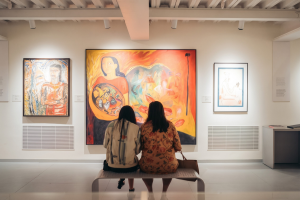
2. Museum of Art & Photography (MAP), Bengaluru
The Museum of Art & Photography (MAP) in Bengaluru represents a distinctly contemporary approach to museum design in India. It breaks from the conventional model of physical expansion, as MAP launched as a digital platform before opening its physical facility, building an engaged audience through virtual exhibitions, online archives, and educational programs prior to the building’s completion. This strategy shares similarities with institutions like the Delhi Art Gallery (DAG), which broadened access to Indian art through meticulous archiving and public engagement. Located in India’s technology capital, MAP combines fine art, photography, textiles, and design under one roof, using its modern space to make art a regular part of civic life. The institution has acquired more than 20,000 artworks. If you happen to fly out of Bengaluru’s Terminal 2 airport and have some time on your hands before boarding your flight, you could also spend some time at the digital museum, which offers visitors the chance to view a wide selection of artworks and photographs on a giant screen. It also comes with the option of emailing those works to your inbox, along with details such as the name of the artist and the year the work was completed.
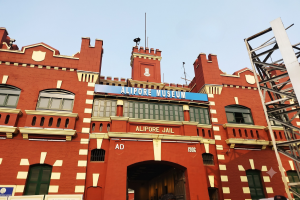
3. Alipore Jail Museum, Kolkata
Kolkata is home to the oldest museum in the country, the Indian Museum, established in 1814. However, newer spaces have also emerged, offering a plethora of interesting objects and materials. Originally operating as the Alipore Central Jail, this preserved red-brick site played a prominent role in India’s struggle for independence, having held key freedom fighters including Netaji Subhash Chandra Bose, Jawaharlal Nehru, and Sri Aurobindo. The complex maintains an atmosphere of historical reflection, preserving significant areas such as execution yards, gallows, and individual cells. The museum differs from other museum spaces in Kolkata because much of it extends beyond the confines of four walls. Loudspeakers blasted patriotic songs that made one feel like they were living in a time when the masses were being roused to adopt a sympathetic attitude toward the struggle for independence from colonial rule. The audio guides also enhance the visitor experience. Today, the space has been reimagined as a public cultural venue that regularly hosts literary festivals, talks, and gatherings, bringing scholars and visitors together in a location formerly defined by colonial control.
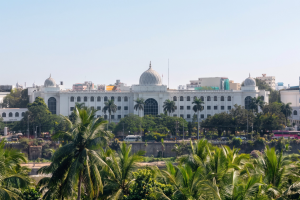
4. Salar Jung Museum, Hyderabad
Located on the banks of the Musi River in Dar ul-Shifa, Hyderabad, the Salar Jung Museum houses one of the world’s largest individual art collections, assembled largely by Nawab Mir Yousuf Ali Khan, also known as Salar Jung III. Among its expansive range of artifacts, two specific exhibits are renowned for drawing crowds. The first is a 19th-century British musical clock featuring a mechanical automaton figure that emerges from a small door to strike a gong every hour on the hour. It’s quite the spectacle, with visitors huddling around to watch. The second is The Veiled Rebecca, an 1863 marble masterpiece carved by Italian sculptor Giovanni Maria Benzoni from a single block of stone, creating the illusion of a translucent fabric veil draped over the figure’s face and form. There is, of course, more to be seen, including photographs of the royal family, exquisite pieces of furniture, and the recreated Nizam’s Darbar Hall, whose ceiling is hung with beautiful crystal chandeliers. This serves as a reminder of the cultural contributions made to Indian art and culture by royal families, although, as institutions, their relevance has dwindled over time.
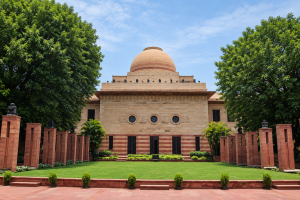
5. National Gallery of Modern Art, New Delhi
When in the national capital, there are a plethora of museums to choose from, but we highly recommend paying a visit to the National Gallery of Modern Art. Sawlaram Haldankar, Nandalal Bose, M.F. Husain, Abanindranath Tagore, and Amrita Sher-Gil are just a handful of the legendary artists whose works you can encounter here. Together, they reveal the fascinating shifts in Indian artistic thought across time. Currently, its main building, Jaipur House, is undergoing renovation, and most of the artworks of interest have been transferred to the New Wing. A visit here offers a fascinating glimpse into the different eras of Indian art, as well as the changing ideas and influences that shaped its artists. Some works date to the colonial period, where the influence of European academic traditions and styles of painting is clearly visible. Alongside these, however, are works that challenged the artistic status quo, looking beyond colonial conventions and drawing inspiration from distinctly Indian traditions, ideas, and forms. Others looked eastward, most notably toward Japan. Abanindranath Tagore was famously inspired by the works of Yokoyama Taikan and Okakuro Kazuko. The gallery is also set within a beautiful garden, making it a particularly pleasant place to spend an afternoon. The campus itself is striking, with its buildings constructed in the warm red and yellow sandstone so characteristic of New Delhi’s historic architecture.





Leave a Reply