

The history of the spectacle dates back to the 13th century, and back then nobody could have imagined that within the frames of these trusty spectacles, one could make space for a camera and a microphone. The legend of the Peeping Tom who spied on Lady Godiva seems to have found a technological afterlife in this era, except he wouldn’t have to be looking from a distance. With the invention of smartglasses, people realized that they can also be empowered to capture, process and preserve everyone and everything that enters the wearer’s field of vision.
In 1980, Steve Mann, a researcher from Toronto, Canada, created what Guinness World Records recognises as the first wearable eyeglass camera. Mann’s original apparatus combined a camera with an optical display capable of placing computer-generated graphics before his eyes. The prototype of the processing equipment depended on a computer carried in a backpack. Over the years, Mann refined this ‘digital eye glass’ into increasingly sophisticated versions. The device could record the wearer’s perspective, process the resulting images and return visual information via a miniature screen placed before the eyes.
The transition from being a conspicuous machine to an accessory that looks seemingly harmless, with no extra parts attached, is precisely what makes contemporary smart glasses so interesting, technologically and socially. If a person holds up a phone to take a photograph, he is performing a recognizable gesture — one that announces itself. Smart glasses, by contrast, fold that gesture into the ordinary act of looking.
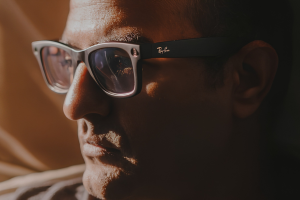
Photography once raised similar questions, before it settled into an acceptable way of ‘recycling reality’ and was regarded as a branch of high art. It was not perceived as a necessity in the way it is today. Today, it might count as one because we need cameras to verify that we are real human beings behind the screen. We need to show our faces for a seamless check-in experience at Indian airports (read: DigiYatra), or to secure verified accounts on dating apps. At times when our phone cameras are not scanning our irises, we might need them to scan important documents. Access to a camera is now commonplace, but the next step in technological evolution might be hinting towards the way we look — and, increasingly, towards the way looking itself gets folded into memory, verification and everyday transaction.
Smartglasses, with their power of recording, can blur the distinction between the act of looking and that of recording. What we see can now become data, an image or a piece of information without requiring us to reach for another device. This introduces a new relationship between the wearer, the environment and the people around them — a relationship shaped less by any single bad actor than by the fact that intention, in this new arrangement, is no longer legible from the outside. A glance and a recording now look identical.
This question of visibility and consent recently played out in Delhi, where Shubnam, a transfeminine graphic artist attending a trans rights protest, was covertly filmed using Meta AI Ray-Ban smartglasses by a content creator. Within hours, the footage was turned into fodder for the social media algorithms, as it was turned into transphobic memes that went viral across social platforms. Shubnam later described Meta’s wearable tech as ‘pervert glasses,’ pointing out that the device raises questions not only about individual privacy but about the social ethos of shared public spaces.
When Indian influencers like Rida Tharana promoted these glasses online, they faced community backlash for endorsing a technology that some felt raised concerns around public safety. Even defenses citing Meta’s built-in blinking LED recording light prompted debate; a tiny indicator light may not always provide meaningful awareness to an unsuspecting bystander, especially when it can be easily overlooked.
It is said that a small recording light comes on once the glasses are being used to record what one’s eyes see, but that signal doesn’t always register with bystanders who aren’t looking for it. What this really points to is a more basic shift: smart glasses are capable of converting ordinary spaces into sites where the line between watching and recording is no longer visible to the people sharing that space. A conversation at a café, a business appointment, a date or even someone’s journey on public transport can be documented without an obvious camera ever appearing. This becomes more pointed in places where people reasonably expect discretion: hospitals, schools, courtrooms, changing rooms, workplaces and private homes. Even when recording is technically lawful, it is worth asking whether it fits the norms of the space it happens in. In the United Kingdom, smartglasses are forbidden in the courts of law. Cinemas in India such as PVR have also put them on their list of prohibited items lest they be used for the purpose of recording the films.
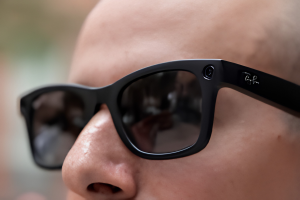
At the same time, the ability to continuously document the world around us is precisely what makes smart glasses such an important technological development. Unlike the smartphone, which requires us to stop, hold and point, smartglasses can operate as an ambient layer of technology. The camera follows the wearer’s natural line of sight, while microphones, processors and increasingly sophisticated AI systems can interpret what is happening around them. The technology is moving photography and computing from something we deliberately operate towards something that can accompany us as we move through the world — less an instrument we pick up than a layer we wear, so that seeing and recording start to happen in the same motion.
A wholesale rejection of the technology, however, would miss what this same shift makes possible. The same camera that can intrude can also function as an assistive eye. As a collection of letters published by The Guardian emphasized, the controversy surrounding smart glasses risks overshadowing the potentially life-changing value the technology can hold for disabled people. Many have described how it can help users read signs, communicate, navigate their surroundings and perform everyday tasks with greater independence. One wearer with muscular dystrophy highlighted the importance of hands-free access, while visually impaired users pointed to an inconsistency in condemning wearable cameras while treating smartphones and CCTV as routine.
For a blind or low-vision person, smart glasses can provide descriptions of a room, read printed texts in front of them, identify objects, recognise currency or help locate an item that has been misplaced. They can also connect the wearer to a sighted volunteer who receives a live camera feed and offers spoken assistance. Because the camera follows the user’s natural line of sight, the experience can be more immediate and less cumbersome than repeatedly positioning a phone. Here, the same ambient quality that raises questions elsewhere becomes the whole point: the technology lets someone move through the world with less friction, not more scrutiny.
Another question worth sitting with, though, concerns the sale of this product in India and the support available to customers after purchase. In markets like ours, where Meta and Ray-Ban aggressively encourage the sale of wearable technology, official policies state that there are no dedicated local service centers to repair damaged glasses, leaving users with tech that is effectively disposable once it breaks.
The camera is no longer necessarily something we hold in our hands. It can become part of the way we move, see, communicate and interact with the world.
The answer, then, is neither a celebration of the technology nor a call to set it aside. What smart glasses need is a framework that keeps pace with what they’ve changed: thoughtful limits in sensitive locations, clear boundaries around biometric identification, workable remedies when footage is published without consent, and real consequences where recording tips into abuse. Accessibility exemptions must also be designed with disabled users at the table, or rather designed with them, not just for them.
The larger technological shift, however, is already underway. From Steve Mann’s backpack-sized apparatus to a pair of glasses that can record, process and interpret the world around us, wearable technology is steadily making computing less visible and more integrated into everyday life. The smartphone changed the way we photograph the world. Smart glasses may change the way we see it.





Leave a Reply