

Not long ago, the sitar sat in a corner — heard mostly at family gatherings, spiritual retreats, or the rare recital on YouTube. It was revered, yes, but it was also remote. The kind of sound young people respected from afar while queuing up their next favourite lo-fi beat drop. But a change is underway.
Across our Instagram reels feeds, Spotify playlists, and late-night jam sessions, Indian classical music — especially instrumental traditions like the sitar and sarod — is quietly slipping back into the mainstream. Only this time, it’s wearing sneakers and vintage tees, carried by a generation that’s less interested in preserving the past than in remixing it.
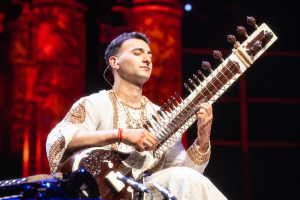
At the center of this shift is a cohort of artists like Rishab Sharma, whose sitar-led reinterpretations of Bollywood songs and Western melodies have found surprising traction online. But Sharma is not alone. From Coke Studio India’s reimagined ragas to Gen Z creators blending classical raags with hip-hop, there’s a quiet cultural return happening — not to tradition as it was, but to tradition as it could be.
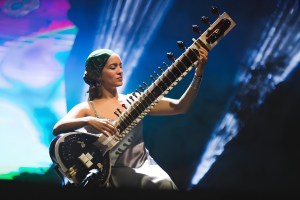
Anoushka Shankar, the most Grammy-nominated Indian woman globally, has spent her life trying to free the sitar from purist expectations, while the instrument has, in turn, carried the rhythm of her own eventful life with a quiet, determined vulnerability.
Her latest collaboration, for example, is with Gorillaz, whose ninth album, The Mountain, features her alongside Asha Bhosle, Amaan and Ayaan Ali Bangash, and Asha Puthli. None of this detracts from the purity of the sitar.
A Generation Looking Back to Look Forward
Gen Z — often flattened into a monolith of short attention spans and TikTok/Instagram trends — is, paradoxically, turning to older, slower forms of expression. There’s a fascination with the analogue, the handmade, and the authentic. In a world that feels algorithmically curated and culturally compressed, Indian classical music offers something elusive: depth.
But this isn’t your grandmother’s Bhairavi.
Rather than treating classical forms as untouchable or sacred, many young listeners are pulling them into new contexts — combining sitars with synths, using tabla loops in electronic tracks, or creating Instagram reels that break down raags in casual, demystified language. They’re not gatekeeping tradition; they’re decoding it.
And crucially, they’re asking: what does this music mean to me?
For Swayam Siddha Priyadarshi, a fashion-forward Bhubaneswar-born sitarist, it means blending stringent classical training with a modern stage and social media presence — which often includes his floofy cat, Poki. He’s toured India, performing to sold-out crowds while also collaborating with brands like Gucci and Crocs. Strumming his sitar strings to a Harry Potter or Friends cover is as seamless as performing to a Raag Lalit.
And for Sharma, who in 2022 became the first sitar soloist to play at the White House, his music draws from old traditions like Raga Chikitsa, or ‘Raga therapy’, an ancient practice using music to heal physical and mental ailments. Plunged into depression after his grandfather’s death, he turned to the sitar as part of his own healing — going live on Instagram and Clubhouse to play and talk through loss, imagining his grandfather still listening in. These sessions grew into a shared virtual room for grief, which he named Sitar For Mental Health (SFMH), using the instrument as his voice for the conversation.
Decolonizing the Aesthetic
For years, the global image of the sitar was largely shaped by a Western gaze — from Ravi Shankar at Woodstock to its psychedelic associations with The Beatles. While these moments undeniably expanded its reach, they also froze it in a frame. The sitar came to be seen as exotic, mystical, and otherworldly.
But today’s revival feels different.
Today it is not about exporting Indianness to a curious West, but a way to reclaim it, remix it, and root it in contemporary selfhood. When Sharma plays a Lata Mangeshkar melody on the sitar, or when a young musician sets Raag Yaman against a trap beat, they’re collapsing boundaries — not between East and West, but between what’s considered ‘high’ art and what’s emotionally resonant.
This isn’t fusion for fusion’s sake. It’s a form of cultural authorship.
One reason classical music has historically struggled with young audiences is access — not just in terms of affordability, but cultural proximity. It’s been framed as elite, rigorous, and heavily coded. You needed to know the rules to enjoy it — or at least pretend to.
Younger generations are uninterested in playing by those rules.
Instead, they’re finding entry points that feel personal: short videos that explain taals in meme-speak, jam sessions that foreground joy over purity, and creators who talk openly about learning raags on the internet rather than through lineage. There’s still respect for tradition — but not at the cost of accessibility.
It’s this shift — from performance to participation — that’s keeping the form fresh.
What we’re seeing now is less a comeback than a recontextualization. A generation raised on hyperpop and streaming fatigue is choosing to slow down. To listen. To reorient their ears — and their identities — around something deeper than the beat drop.
And in that act of listening, they’re also reinventing. Maybe that’s what makes this moment so compelling: it’s not about cultural preservation as duty, but as pleasure. A rediscovery of the sitar not because it’s ‘ours’, but because it sounds damn good after a long day of noise.
From Reverence to Relevance
Indian classical music has always been about nuance, improvisation, mood. It knows how to sit with discomfort, how to build toward ecstasy. In many ways, it’s the perfect soundscape for a generation navigating chaos, climate dread, and existential swirl.
And so, the question is no longer whether young Indians will care about classical music. They already do.
The real question is whether the institutions — the gharanas, the academies, the cultural bodies — will meet them where they are. Or whether, like Sharma and so many others, they’ll have to carve a new raag out of old strings.





Leave a Reply