

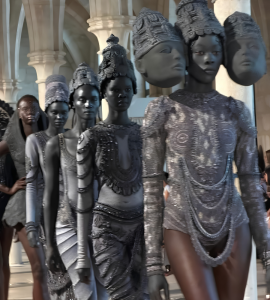
At Paris Couture Week in 2026, fashion designer Rahul Mishra used silk, dabka, zardosi, crystals and bugle beads to create fabrics that appeared like stone. With his collection Devi: The Eternal Muse, he brought ancient Indian temple sculptures to the ramp in Milan and created a memorable global fashion moment. He changed the way the world looks at Indian fashion.
International labels have often used Indian embroidery, block printing and other textiles and crafts as embellishment. But Mishra’s trompe-l’œil couture made Indian craftsmanship and artisanship showstoppers of his collection of sharp, edgy, sculptural dresses and corseted pieces.
Indian fashion has forever been part of larger fashion collections of international designers. These designers have rarely, if ever, attributed their inspirations to the country of origin. Ajrakh block prints, Zardosi and Aari embroidery, the Kashmiri Kalka known in the West as paisley, have been extensively used on the global stage but seldom attributed to the country of their origin.
That’s changed: the internet and social media scrutinize and recognize everything now. If it’s Indian in origin, it’s immediately called out, and the brand is forced to give its makers the recognition. Prada had to acknowledge that its sandals that cost over US $900, are the original creation of Kolhapuri craftsmen or that Madras checks have been created in India forever (the hint is in the name!).
Such moments have been putting Indian fashion on the global map. The world now knows that India has always been a fashion-forward country. So it watches with curiosity when our designers amp these traditional arts to a whole new level.
And in all fairness to them, they have always done that. All big Indian labels, including Tarun Tahiliani to Sabyasachi Mukherji and Rahul Mishra have employed chikankari, aari, gotapatti and other Indian traditional crafts and textiles in their collections.
The game changer has been the corporate collaboration and backing of independent designers. Tahiliani presented a show in Milan way back in 2003. “We were inundated with orders from around the world, which we just couldn’t fulfil as we had not worked out that aspect of the business yet,” he says. But with Reliance, the Birlas and the Mahindras now in the mix, supporting the logistics, Indian fashion designers finally have the money and the know-how to scale up, and to open stores in London, New York, Dubai, Sydney and other international cities.
Equally importantly, designers are being able to experiment. Even though wedding couture still leads Indian fashion’s overseas market, it’s no longer recognized as just that. Gaurav Gupta, Vaishali S, Kanika Goyal, Amit Aggarwal are creating some cutting-edge designs that are flying off the racks alongside Gucci, Versace and Hermes.
Mukherjee recently announced a historic collaboration with The Metropolitan Museum of Art. The long-term project will have the designer reinterpreting the museum’s 5,000-year-old archive of global art into contemporary luxury pieces. The inaugural chapter, a high jewellery collection inspired by the art of the Byzantine Empire is set to debut during New York Fashion Week on September 15.
There was a time when international celebrities flaunted Indian designs on red carpets. That was the validation the home-grown fashion aspired for, even if they, sometimes, paid the celebrities to wear their clothes. Cut to today, one of the best museums in the world has called upon an Indian talent to work with it. India is being recognized as a design powerhouse, its creators are getting their due on the global stage. This is just the beginning. As the world embraces maximalism, India, its forever champion is likely to ace the style game, of course with sophisticated, new and innovative design.


Leave a Reply