

There’s something about a plate of momos that just feels like home — even if you didn’t grow up eating them. Fat little parcels of warmth and comfort, ladled steaming hot onto paper plates, dipped into a pool of chile sauce or chutney: in Indian cities, they’ve become a kind of emotional staple. Cheap and filling, momos are sold on bustling street corners, in high-end cafés, and at 2 am outside college hostels for empty-bellied students.
Momos arrived in India with a cloud of Tibetans who fled the Chinese annexation of their homeland. But Indians took them to heart; they are Delhi’s most ubiquitous street snack, pot-bellied with tandoori masala or sweetened with a stomach of chocolate.
But here’s the thing: you’ll find a similar joy halfway across the world.
China has, expectedly, a universe of dumplings: Shanghainese shiaomai, soupy xiaolongbao, shuijiao (boiled dumplings) and guotie, pan-fried till their skins are crisped and gilded.
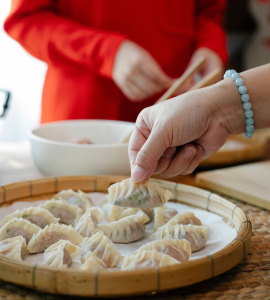
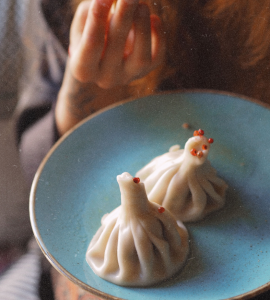
But the dumpling cannot be restricted to any particular geography. In Polish kitchens, it’s the pierogi. In Turkish households, it’s the tiny, hand-folded manti. In Korean feasts, it’s the plump mandu. In Nigeria, there’s moin-moin — a steamed bean cake, savory and wrapped. In Nepal, it’s the jhol momo, swimming in a spiced sesame broth. In Korea, the mandu might be stuffed with tofu and kimchi. In Italy, ravioli could hold ricotta and spinach. Georgian khinkali is a knob of dough pinched and twisted and stuffed with meat or vegetables.
Closer to home, in Southern India, there’s kozhukattai, often stuffed with jaggery and coconut. Bengal has dudh puli, a festive rice dumpling soaked in kheer. The northeast celebrates momos in dozens of variations, and in Gujarat, muthias are hand-shaped and tempered with mustard seeds.
Every culture, every corner, seems to have stumbled upon the same soul-soothing idea — dough cradling a filling, warm from the inside out. These fillings reflect geography, available ingredients, and cultural touchstones. After all, what makes dumplings so universal is what they hold — a snapshot of place and people.
Call it what you will, the dumpling is less a recipe and more a shared instinct — an edible expression of care, survival, and joy. Legend tells us that Chinese boiled dumplings, jiaozi, were born 1,000 years ago to muscle through a harsh winter. Steaming hot parcels of dough, their bellies fattened by lamb, ginger and garlic, were fed by a Chinese physician named Zhang Zhongjing to people suffering from frostbite.
The reason dumplings exist everywhere, even in sultry summers and torrid monsoons, probably had practical origins. Take a small amount of meat or vegetables, wrap it in dough, and suddenly you have a meal that stretches further, stays warm longer, and can be boiled, steamed, or fried depending on your resources. That’s why they’ve long been linked to moments of migration, hardship, and adaptation. But over time, they became symbols of family, celebration, and love.
What’s fascinating is how these forms rarely clash. Instead, they create a kind of culinary constellation. Nobody argues whether the momo or pierogi came first — because they’re not copies, they’re cousins.
In the past decade, social media has given dumplings a fresh global stage. TikTok and Instagram are filled with videos of people folding momos with their grandmothers, or experimenting with gyoza shapes. Dumpling pop-ups in Brooklyn serve Tibetan, Japanese, and Nigerian versions side by side. In Darjeeling, you can now find curated momo trails for tourists eager to try every variety.
There’s also something democratizing about dumplings online — they don’t require elite training or Michelin-starred kitchens. They invite hands-on making, often in groups, around kitchen tables. In that sense, they’re perfect for a generation craving tactile rituals in a digital world.
So the next time you bite into a momo — or pierogi, or mandu — know that you’re tapping into a global language of care, one fold at a time.





Leave a Reply