

Every evening, the NCPA springs to life.
Fairy lights twined around the trees in its lawns, glint and glitter in the twilit gloom. A gentle wind from the nearby seashore ripples the leaves.
A flurry of impeccably-attired ladies and gentlemen gather at the gates of its grand Jamshed Bhabha theatre, waiting to enter its vast marbled halls. Inside, there is warmth. The place rings with stories and music and laughter. Patrons with earthier concerns thicken the food counter, eager for the famous cold coffee and chutney sandwiches.
But this is all a prelude; everybody is waiting for the bell to announce the entry of the Symphony Orchestra of India, and time is finely diced into minutes until the curtains open.
There is always a gleam, a glister, about a night at the NCPA.
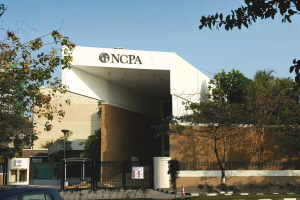
But Mumbai’s NCPA isn’t merely the grand Jamshed Bhabha. It is after all, a belt of theaters wedged between the expensive Oberoi hotel, and a redoubt of tetrapods that open out into the Arabian sea. Each venue is distinct — the bowl of the Sunken Garden scooped out of the ground; the Experimental Theatre with its entirely reconfigurable interiors; the vast Tata amphitheater and its revolving stage; the aptly-named Little Theatre; the renowned music library, and so on.
Although the NCPA boasts of a plurality of cultures – audiences often throng its halls for a Marathi play or a Hindustani classical concert – it has come to be known as a bastion of Western classical music. Its Parsi chairman, Khushroo Suntook, almost papal in his responsibility towards classical music, instituted the Symphony Orchestra of India (India’s first and only professional symphony orchestra) in 2006. He brought in British-Parsi conductor Zane Dalal as its Associate Music Director and Kazakh violinist-conductor Marat Bisengaliev as its Music Director. (The institution itself was envisioned and built by Parsis J. R. D. Tata and Dr. Jamshed Bhabha.)
Nonetheless, in a country already rich with its own encyclopedic musical traditions, Western music would remain a largely separate world, seemingly unassimilable. Many considered it elitist, dull, and relegated it to the realm of the old fogy.
Perhaps ten years ago, they wouldn’t have been wrong. At any Western classical music performance at the NCPA, the audience (and the patrons) used to be an ocean of elderly Parsis. (Parsis are a tiny community of Zoroastrians who migrated from Iran to India in the 8th C.) It was a running joke that if anyone wanted to finish the Parsis off in one go, the simplest way would be at a Western classical performance.
Some background: Under colonial rule, a small, Anglophile slice of Parsis and Indian Christians were the Indians best positioned to take part in colonial cultural life: They took to this new form of music like fish to water, and carried forward that legacy past Independence. That a professional classical music scene exists in Mumbai at all owes a fair bit to the community that simply refused to let it go.
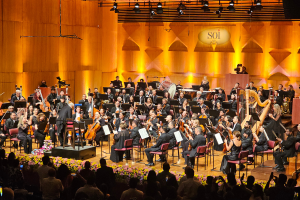
The NCPA was never meant to be a shrine to one tradition alone. That it came to be known as the home for Western music says less about how it was founded and more about the community kept showing up, year after year, to keep that part of it alive.
But here is the arithmetic that underpins everything. The 2011 census counted just 57,000 Parsis in India. A whole strand of Mumbai’s cultural life, including its patron networks, and audience members, rests on a community small enough to be called a tribe.
Perhaps this is too dark a view. The NCPA’s SOI Music Academy is beginning to sculpt young talent, and is sending teachers into municipal-run schools as well. A stream of schoolchildren are choosing to learn the pianoforte, the cello, the violin, the viola, if nothing else than to facilitate entry into colleges abroad. Younger audience members too, are growing in number. Could this be the future? We can only hope.





Leave a Reply