

It all began with an offhand remark.
In May, the Chief Justice of India, Surya Kant, called some unemployed young Indians “cockroaches.” Soon after, Abhijeet Dipke, a Dalit student living in Boston, posted a comment on Instagram: “What if all cockroaches come together?”
A gush of likes and comments followed Dipke’s comment. And this is how the Cockroach Janta Party was born; it now has 26 million Instagram followers to date. Dipke and his roaches set down their first demand: the resignation of Dharmendra Pradhan, the education minister who they believed was accountable for a snarl of exam paper leaks. In the wake of this demand came protests by students, centered around Delhi’s Jantar Mantar, but soon spreading to other Indian cities.
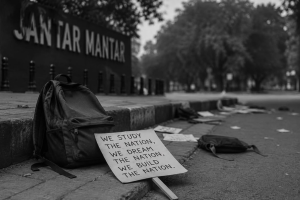
But this protest has been like no other so far.
Most importantly, the vanguard of the movement was led by a predominantly younger demographic. This was a generation born into social media. They didn’t adapt to it the way millennials or Gen X did — they’re native to it the way earlier generations were native to television. Untainted by the opinions of newspaper editors and news anchors, they chose to trust online influencers. And as a result, they folded dissent into internet culture. From subway surfer runs escaping police to GRWM memes, humor didn’t detract from the movement. Instead, it became an indelible part of it.
Gen Z eschewed the faded old playbook of press releases, media cells and spokespeople, the old ways of previous generations. Instead, a carnivalesque protest erupted on screen as much as on ground.
The cardio community showed up. Protesters shared reels of themselves fleeing to the Subway Surfers soundtrack — the game where you run from a cop. ‘Cardio day at Dadar, thank you Mumbai Police!’ read one post. Another reel showed a Strava account logging miles at the protest.
The gym bros and the muscle mamas threw their weight behind it too — a poster reading ‘Free Protein for Stronger Bones’, was followed by an actual protein-powder giveaway at the protest. Meanwhile, the MMA community drilled lathi-charge evasion like it was just another day in the MMA ring.
There were protest fit-checks and ‘GRWM for the protest’ videos. There were ‘What I eat in a day at the protests’ reels — ice cream, medium fries, chowmein, biscuits, papad, a fizzy orange drink, apparently. There was a whole genre recreating the Who Was Interested First meme, except with police and protesters standing in for the couple. Someone restaged Norway’s viral Viking Row, swapping ‘ro’ for ‘resign’.
Facing police action, crowds burst into the national anthem, forcing police to stand at attention. Then they made reels about that too.
To add to the carnivalesque atmosphere: kids came to the protest dressed up as cockroaches, dinosaurs (reels set to the Jurassic Park theme), and an entire DC-Marvel multiverse of Batmans, Supermans, and Spider-Men, alongside no shortage of self-declared protest ‘baddies’.
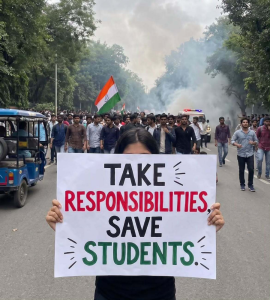
For older generations, this felt like a seismic shift. Gen Z scythed through complicated times with grace and humor and meme after hilarious meme; they took an offhand remark and turned it into a rallying cry, knowing that satire cuts through faster than any op-ed can. Some online viewers found the humour jarring. But for the young people creating the videos, there was nothing contradictory about it at all.
Their brand of dissent cemented dark humor with pop culture, internet memes, political history, and brand advertising. Portraits of Ambedkar and Che sat beside Bollywood references and cosplay because, for this generation, history, politics, and pop culture were never separate registers to begin with. The personal is political, after all.
Smartphones turned ordinary people into chroniclers of political upheaval, recording moments that might otherwise disappear. Plus, they got people to actually act, spreading fast because people share and remix them, and because social media algorithms reward that kind of engagement. Memes gathered meaning as they got passed from phone to phone; this became another way to support the movement.
Watching it unfold felt like witnessing a movie with no filter and no script, playing out in real time — more absorbing even, because every frame here belonged to people with genuine stakes in the outcome. We weren’t merely spectators; we were pulled into the frame ourselves.
The cockroaches didn’t invent a new way to protest — they simply refused to perform dissent the traditional way. History will remember the slogans; this one will also remember the reels.




Leave a Reply