

If you stand in a narrow lane of Old Delhi at dusk, you’ll see it: a green-and-yellow auto-rickshaw pulsing through the evening haze, its driver slipping through traffic with a kind of practised instinct only city living can teach. In suburban Mumbai, the mood shifts but the signature remains — rickshaws clustered outside railway stations, shuttling office-goers home after long commutes, pivoting neatly around potholes and parked scooters. And in Bangkok, the tuk-tuk — neon trim, open sides — cuts jerkily past food stalls and high-rises.
Across these cities, the rickshaw isn’t just transport; it’s part of the texture of daily life. It’s the background noise, the shorthand for ‘local’, the thing you remember long after the trip. But these freewheeling three-wheelers didn’t originate here, and their journey across Asia isn’t a straight line. To understand why they remain indispensable in some places and have nearly disappeared in others, you have to trace not just their origin but the cultures and economies that shaped them.
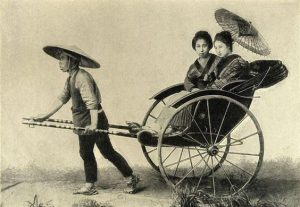
The rickshaw’s story begins in 19th-century Japan, where the first hand pulled rickshaws — jinrikisha, or ‘human-powered vehicles’ appeared in the late 1860s. They arrived at a moment when cities were expanding, and for a time, the pulled rickshaw was seen as modern, efficient, and almost futuristic. But as Japan industrialized and motor transport took over, the rickshaw’s role faded, eventually becoming a tourist relic rather than a central part of city life.
Its afterlife, however, didn’t unfold in Japan. Instead, through trade, labour movement, and colonial influence, the rickshaw spread across Asia and took on new forms. In India, it became the cycle rickshaw and the auto. In Thailand, the tuk-tuk. In the Philippines, a motorcycle-with-sidecar tricycle was influenced in part by Japanese military bikes during the occupation. By the 1970s, three-wheelers had even reached Nigeria, Bangladesh, Sudan, Bahrain, Hong Kong and Yemen.
But survival wasn’t guaranteed everywhere. In countries with strong public transport and formalized urban planning, the rickshaw lost ground. In places where cities grew unevenly — dense cores, narrow lanes, informal housing, unpredictable infrastructure — the rickshaw adapted with remarkable agility. It became affordable when other options were not. It went where buses couldn’t. It filled gaps the state didn’t. Rickshaws in cities like Delhi, Mumbai, Bangkok, Manila became part of the choreography of everyday life and an affordable lifeline for middle class citizens.
India’s contemporary version, the auto-rickshaw, has its own industrial history. The country’s largest manufacturer is Bajaj Auto, but another key player is Piaggio — an Italian company whose iconic scooters were adapted into three-wheelers decades ago, which today produce CNG, diesel, and electric variants for the Indian market. Hero Motocorp, TVS Motor and Atul Auto were amongst the other companies manufacturing autos for Indian roads.
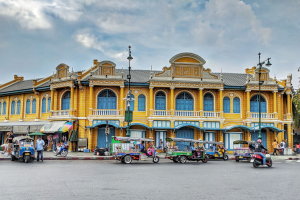
And then there’s the cultural memory attached to the rickshaw. In India, you see its distinct silhouette appear everywhere — Bollywood chase scenes, political protests, love stories, budget commutes, and in the case of Kolkata’s hand-pulled rickshaws, debates about labour, dignity, and tradition. In Bangkok, the tuk-tuk is practically a national symbol. In Manila, the tricycle is woven into the rhythm of local neighbourhoods. What these versions share is form and function. They belong to cities where informality is a parallel system — messy, flexible, adaptive, unstoppable.
When you step into a rickshaw, you enter a microcosm of the city. The cramped seat, the negotiation over the fare, the improvisational route — all of it says something about where you are. These vehicles reveal more about urban life than they’re often credited for: how people work, how they move, how they improvise, how public life is negotiated, and how cities manage chaos without ever fully solving it.
The global shift toward electric mobility is now reshaping this landscape again. In India, the electric rickshaw market is projected to double between 2025 and 2030. Apps such as Ola and Uber now include rickshaws as well as taxis. A machine once dismissed as outdated is now being re-engineered for the future.
If you look closely, the rickshaw’s survival has never been about nostalgia. It’s about suitability. Cultures that kept the rickshaw alive didn’t preserve it for tradition, they preserved it because it worked. Because it fits their streets, their economies, their pace, their people. A city’s transport isn’t just about engineering; it’s about culture. And in that sense, the rickshaw might be the clearest mirror a city can hold to itself.




Leave a Reply