Category: culinary culture

  • The Politics of a Flatbread

    Rolled out in kitchens across the Indian subcontinent, roti has remained a humble flatbread that has travelled far and wide in tiffins and memories, surviving displacement, scarcity, and change. It moved in the hands of traders, sailors, migrants, and indentured labourers — its shape shifting with every border it crossed. Even in its earliest forms, roti wasn’t just sustenance; it was a migrant story. In the 19th and early 20th centuries, after the abolition of slavery, Britain sent over 1.3 million Indian indentured labourers to far-flung colonies — about 145,000 to Trinidad alone between 1845 and 1917. Alongside clothes and keepsakes, they carried recipes and muscle memory: the instinct to make something familiar in an unfamiliar land.


    Where wheat was scarce, they improvised. In the Caribbean, that meant lentils — giving rise to dhalpuri, roti stuffed with split peas and blistered on a hot plate. In Malaysia, Indian Muslim migrants known as mamak stretched dough into roti canai, paired with dhal or sweetened condensed milk. Even Mexico’s tortilla, though corn-based, echoes roti’s logic of adaptability: a flatbread shaped by the land it’s made on. What this really shows is that roti’s evolution has always been tied to power — who moves, who adapts, and whose foodways get preserved or erased.


    Culinary Power and Ownership: Who Gets to Tell the Story?


    Today, Indian cuisine means different things in different parts of the world. In London, it may appear on a tasting menu; in Trinidad, in a lunchtime wrap; in Kuala Lumpur, at breakfast. This diversity hints at the breadth of Indian food’s migration — but also reveals who gets celebrated and who gets edited out of the frame.
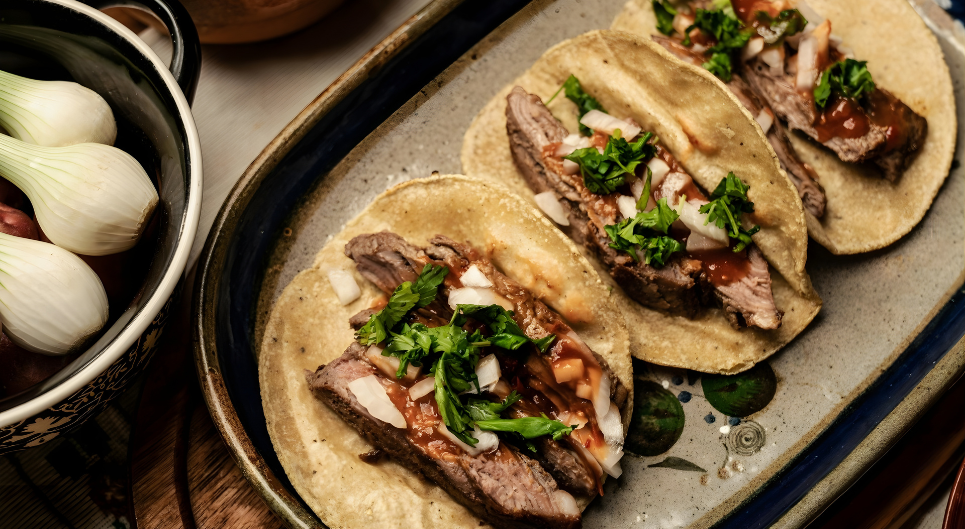
     

    Sliced beef and vegetables on a tortilla | Image Credit: Los Muertos Crew on Pexels


    In some Western dining spaces, Indian flavours are reframed as modern or refined, often with little acknowledgement of the histories they carry. British chef Tom Kerridge’s £28 Butter Chicken, for instance, reflects its market and audience, yet became a talking point because of how casually it detached a dish rooted in Delhi homes and dhabas from its cultural context. For many, the issue wasn’t the reinvention — it was the idea of presenting it at a luxury price point without any real nod to where it came from. On supermarket shelves, boutique spice brands continue to favour polished packaging even as conversations about sourcing and credit grow more urgent with the rise of diaspora-led brands.


    Of the few Michelin-recognised Indian restaurants in the world, many sit outside India — a reminder that global prestige often arrives only when Indian cuisine is filtered through Western institutions. London alone has multiple Michelin-starred Indian restaurants, while India has none under the official Michelin Guide, which still doesn’t operate in the country. The symbolism writes itself.


    At the same time, borrowing isn’t a one-way street. Indian chefs reinterpret French pâtisserie, Japanese matcha, and New York bagels, layering their own histories onto global forms. The question isn’t whether adaptation is allowed — it’s whether the origin story stays visible, and whether those who shaped a dish have a seat at the table when its value is determined.


    Picture a grandmother in Port of Spain dusting flour off her palms, or a student in London making roti on a tiny stovetop because it tastes like home. For many, cooking it is an act of remembrance. For others, it’s the start of experimentation.


    Reception and Reality


    The flavours may be the same, but the reception rarely is. Restaurants serving “elevated Indian street food” often draw critical attention, while Indian-run dhabas offering similar dishes are rarely spotlighted. Part of this is access — who can secure prime real estate, hire PR, or design spaces that match fine-dining expectations. Part of it is perception: dishes become more “approachable” when plated minimally, spiced subtly, and narrated through a Western frame.


    Economically, the landscape mirrors this. The market for Indian packaged foods and spices has grown rapidly, with diaspora-led brands driving global curiosity. Those who control the narrative often control the profits, too.


    But these tensions exist within the diaspora as well. A Trinidadian dhalpuri won’t taste like a Punjabi roti, yet both carry the same emotional resonance for those who grew up eating them. Authenticity becomes a question of belonging rather than purity: who decides what counts, and what gets preserved?

     

    A serving of soft-shell tacos | Image Credit: ROMAN ODINTSOV on Pexels


    Preserving and Redefining Roti Across Borders


    Despite all its migrations and reinventions, roti is still rolled out each morning — soft, warm, familiar. Picture a grandmother in Port of Spain dusting flour off her palms, or a student in London making roti on a tiny stovetop because it tastes like home. For many, cooking it is an act of remembrance. For others, it’s the start of experimentation. Across the globe, chefs, home cooks, and street vendors add to roti’s atlas of identities, each version shaped by history, geography, and personal taste.


    In the end, roti’s story isn’t about drawing hard lines between “pure” and “changed.” It’s about recognising that every flatbread — whether folded around curry in Trinidad, flipped in a Malaysian street stall, or plated in a New York bistro — carries the imprint of the hands that made it and the landscapes it travelled through. The challenge is making sure those hands and landscapes aren’t forgotten when the dish arrives at the table.


  • The New Loneliness Market

    Open any major platform and a certain pattern appears. A stranger studies quietly on TikTok Live, a creator walks through a supermarket with viewers trailing behind, meditation apps offer modes that resemble shared presence, and AI companions send morning greetings. Productivity tools now include virtual coworkers. These features look like entertainment or efficiency hacks, yet they are built to give people the sense that someone is nearby.


    A decade ago, loneliness felt like an interior mood. Now it shapes product decisions across the tech industry. Companies have realised that users return more reliably when something feels companionable. The numbers reflect this shift. Low-interaction livestreams on TikTok have grown steadily over the past two years, AI companion apps have pulled in tens of millions of users around the world, and long, quiet study videos on YouTube continue to draw consistent viewing. The engagement holds even when very little is happening.


    The reasons stretch beyond technology. Remote work reduced daily contact, and many shared spaces either changed or disappeared. Cafés raised prices, libraries shortened hours, and neighbourhood spots became harder to maintain. A global survey in 2023 by Meta and Gallup reported that around one in four adults experiences frequent loneliness. It tracks with what people describe in their own lives. As familiar rhythms faded, they began looking for softer forms of connection that could slip into unpredictable days.


    Someone’s presence in the background, even through a screen, can soften the day | Image Credit: Libby Penner on Unsplash


    AI accelerated the trend. Companion apps offer a feeling of steadiness without the weight of social performance. Conversations take place at a pace people can manage, which often makes them easier than real ones. The appeal here is quiet. Many users are not searching for romance or fantasy. They want acknowledgement that fits into the edges of a scattered routine.


    Livestreams and shared-task videos serve a different purpose. Someone’s presence, even through a screen, can create a backdrop that softens the day. Walking streams, cooking sessions, and silent study rooms are simple formats, yet they mimic the comfort of being around others who are also going about their lives. These spaces carry no pressure, which explains their endurance.


    Many people are not seeking grand emotional narratives or deep conversation. They want a softer kind of company that can sit beside work, chores, or study, and the world does not offer that easily anymore.


    The behaviour is most visible among younger users, yet it crosses age groups. Many people feel stretched by erratic schedules, high expectations, and social environments that sometimes feel too demanding. A low-demand connection can feel reliable in a way traditional social life often does not. A livestream does not ask you to keep up. A digital companion stays even when you step away.


    Companies respond to what they see. Some now measure engagement in terms of presence rather than taps or clicks. A few surface creators who hold attention simply by showing up regularly. The idea is straightforward. People trust spaces that feel steady, and steadiness keeps them returning.


    There are concerns about how these habits develop. Platforms gain when users stay inside their ecosystems, so these environments can expand quietly. Hours drift by. A stream that starts as a background company sometimes takes up a larger share of the day than expected. Comfort and habit can merge without much notice.


    Observed among young users, the behaviour crosses age groups | Image Credit: Amanda Vick on Unsplash


    Even with the risks, it is clear that these tools fill a gap. Many people are not seeking grand emotional narratives or deep conversation. They want a softer kind of company that can sit beside work, chores, or study, and the world does not offer that easily anymore. Technology stepped into the space left behind by changes in work, housing, mobility, and community life.


    The loneliness market is less a verdict on people and more a reflection of the moment. It shows how individuals are rearranging their emotional routines when older forms of casual connection no longer appear without effort. Digital companionship, even when light, offers a sense of continuity that is hard to find elsewhere. The behaviour will shift as the world changes, yet the need that drives it feels durable. People want to move through their day with some feeling of closeness, even when that closeness takes a different shape from what they expected.

  • The Men Who Carry Mumbai’s Heart in a Tiffin Box

    Every day in Mumbai starts with a familiar beat: the hum of rickshaws, the ring of local trains, and making their way through it all, a steady procession of men in white. In cotton shirts and Nehru caps, they navigate crowds with lunchboxes balanced on bicycles or slung over shoulders. These are the dabbawalas — a service that began in 1890 to bring home-cooked meals to office workers. More than deliverymen, they are guardians of trust: carrying a family’s food, keys, or sometimes even cash across a sprawling city, and returning it safely.


    For more than a century, dabbawalas have perfected a system that modern apps and algorithms continue to study: moving 200,000 meals every day across Mumbai, without a single GPS ping, and with an error rate so low it has earned a Six Sigma certification — near perfection in a city where even Google Maps often falters. Harvard has studied it; global figures from Prince Charles to Richard Branson have praised it.


    But this isn’t a story about statistics. It’s about how Mumbai — in the thick of modernity, chaos, and congestion — still makes room for human care.


    The Soul in the Steel Box


    Mumbai is a city of commuters. Every morning, millions cram into local trains, leaving home at 6 a.m. to reach offices by 9. For most, carrying a tiffin is a logistical impossibility. One dabbawala collects your lunch at 8:30 a.m., bikes it to a train station, passes it to a colleague riding into the city, and finally hands it to the last-mile courier who delivers it to your desk. By afternoon, the empty box is back home, often before you even leave the office.


    In today's fast-paced world, the dabbawalas demonstrate that slower can be smarter. And in their persistence, in their quiet mastery of turmoil, they resemble Mumbai itself: durable, resourceful, and vibrant.


    There’s no tech, just a brilliant system of colour-coded markings: a squiggle for Churchgate Station, a number for a specific office tower in Nariman Point. The code is memorised by heart, often by men with little formal schooling. They are mostly from Maharashtra’s Varkari community, working as equal stakeholders in a co-operative. They take home modest earnings — ₹9,000 to ₹12,000 (roughly $100–$130 USD) per month — globally admired, yet financially vulnerable. Yet the system hums with remarkable consistency, day after day.


    Trust in Motion


    The dabbawalas’ fame belies the intimacy of their work. Office workers hand them spare keys, forgotten wallets, and even cash with quiet confidence. Many have survived monsoon floods, negotiating swollen streets to deliver on time. They embody precision amid the city’s controlled chaos: Six Sigma meets overcrowded trains, unmarked lanes, and a city that rarely stops moving.


    A dabbawala making deliveries in Mumbai | Image Credit: Abhishek Mishra on Pexels


    When the World Paused


    The COVID-19 lockdown tested this century-old system. Trains halted, offices closed, and the number of daily deliveries fell from 200,000 to a few hundred. While some dabbawalas went back to their communities, others switched to delivering groceries or medications. Some tried digital payments and orders based on WhatsApp. By 2022, the “Digital Dabbawala” had emerged, extending to new last-mile delivery models while maintaining its foundation in human contact and trust. It was a shift embraced cautiously: the work remained personal, the relationships remained central.


    More Than a Logistics Miracle


    Globally, they are studied for efficiency. In Mumbai, they are woven into the city’s rhythms.  The approach is based on local knowledge, intuition, and interpersonal interactions.  It is also low-carbon, with bicycles, trains, and a commitment replacing engines and paper.


    In today’s fast-paced world, the dabbawalas demonstrate that slower can be smarter. And in their persistence, in their quiet mastery of turmoil, they resemble Mumbai itself: durable, resourceful, and vibrant.


    So the next time you see a man in white pedaling past, dabbas clinking like wind chimes, remember that you are experiencing the city’s heartbeat.