

There are a handful of tropes that keep dogging the South Asian diaspora dining scene. One of the biggest is the pursuit of authenticity, as if there was only one way to make a mutton biryani, one way to make a pulao, one way to make a dhansak, pinned into a particular period in time and thereafter left untouched.
The other is the idea that curry is a dish that somehow exists only in the Western sphere, that no such thing exists in India.
The truth of course is far more nuanced than that. The word ‘curry’ has been used by the West (most notably the UK) to congeal a vast cornucopia of Indian dishes that range from saag paneer to pulao. ‘Popping out for a curry’ is now shorthand for eating at an Indian restaurant, a shorthand that flattens the immense sophistication and variety of Indian food. This Western ossification is incontrovertible, and it makes complete sense for a person of Indian origin to reject the term outright as a Western invention. Because in one sense, it is.
K.T. Achaya’s explanation for this English usurpation of the term curry has been the one largely memorialized across culinary discourse: “The meat dishes cooked with pepper were called kari in Tamil, a word now used in English as curry,” he writes in the The Story of Our Food, one of the most seminal texts in the history of Indian food, and one oft quoted in food writing literature in India.
On the other hand, the word might have extended back to the Portuguese occupation of India. Gaspar Correa, who accompanied the famous Vasco da Gama on his gory voyages, used the term ‘caril’ in 1503. The word appeared again in 1623 in the writings of Pietro del Valle, who travelled extensively along India’s western coast. In The Travels of Peter Della Valle, Sirnamed The Traveller, he wrote about caril as “a name which in India they give to certain Broths made with Butter, the Pulp of Indian Nuts (instead of which, in our Countries Almond Milk may be us’d, being equally good, and of the same virtue) and all sorts of Spices, particularly, Cardamoms and Ginger, (which we use but little) besides herbs, fruits, and a thousand other condiments.”
Whichever origin story you might choose, curry is a very real, very specific type of dish, made with protein or vegetables sunk in spiced gravy, halfway between a stew and a soup and eaten with rice, flatbreads, or leavened breads.
Many different Indian communities have their own versions of curry, each of which hew to the climates and geographies of their region. The Pandi (pork) curry of the Kodava community of Karnataka for examples, gains its complex flavor from the triumphant marriage of peppercorns and kachumpuli, an ink-dark vinegar drawn from the fruit of a tree that grows in the state. Similarly, the Western coast of India is thick with coconut trees; naturally enough, many of these curries are anchored in ground or milked coconut. Meanwhile, an Odisha-stye curry is made with seafood and potato, the gravy thinned to a light ras.
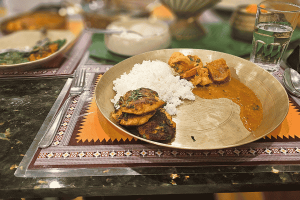
Even within the western coast, there are differences. For instance, the bedrock of an East Indian chicken khudd curry comes from the bottle masala (a pre-mixed masala that is made of about 30 different spices), bolstered with dried or grated coconut. A burnished orange Goan curry (xitt kodi), on the other hand, might eschew chicken for fish simmered in a pool of coconut milk. The curry of the Parsis, similarly burnished, is girded by poppy seeds and gram flour for heft, its sourness from tomatoes and tamarind rather than the more popular coastal fruit, kokum.
And even within the Parsi community, there are various types of curries – fiery red, vivacious green (girded by coriander and green chiles) and even the wildly decadent 100-almond curry, an almost-unheard of treat. Across Parsi and Goan restaurants, the bestselling dishes always include – you guessed it – the curry.
All this is to say that in attempting to reject colonial culinary impositions, we risk the erasure of the very traditions that we are attempting to reclaim. Curry can be a colonial inheritance as well as a living tradition, an Orientalist shorthand that elides variety, and a dish that expresses it. The task, then, is not to banish curry from our vocabulary, but to restore to it the specificity it has lost: to talk about the depth of a Pandi curry, the coconut-rich gravies of the Konkan coast, the emollience of a Parsi curry, and all the innumerable variations that refuse to be folded into a single definition.





Leave a Reply