

In recent times, the modern Indian art market has been on a high, with top prices offered for several Indian artists at Saffronart, Pundole’s, and Sotheby’s. Many of these artists belonged to the Bombay Progressive Artists’ Group, while some belonged to the Baroda group. An S.H. Raza painting sold for a record-breaking price of nearly ₹45 crore, and two bidders, Shankh Mitra and Kiran Nadar, fought a fierce battle for two of F.N. Souza’s works. All these auctions resulted in ‘white glove’ sales, a term for an auction in which every offered lot finds a buyer.
Such remarkable developments call for a moment to reckon with the movements and styles that have emerged in the history of Indian art. Following India’s independence in 1947, as a new state sought to define sovereignty on its own terms, a group of artists in Bombay decided the time was ripe to envision a new India. The name ‘Progressive Artists’ Group’ was inspired by the Progressive Writers’ Association of the 1930s, which tried to challenge traditional and orthodox thinking through literature. The Progressives envisioned a modernity that wasn’t dominated by religious dogma, and they sought to celebrate the plurality of the Indian nation. In doing so, they challenged the traditions that governed the artistic world at the time. Many of these artists attended the Sir Jamsetjee Jeejeebhoy School of Art, popularly known as the JJ School of Art. Here are five artists from the group you may have heard of and, if you haven’t, should know about.
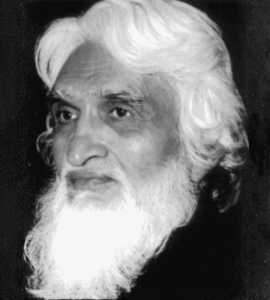
Maqbool Fida Husain
Arguably one of the most famous painters in India, M.F. Husain was also a hugely controversial figure in the world of Indian art. A primary source of Husain’s inspiration was Indian mythology, the epics—Ramayana and Mahabharata—and religious iconographies. Traditional folk art and temple structures were reinterpreted in his work, and he was often hailed as the ‘Picasso of India’. Besides paintings, he also directed a handful of films such as Meenaxi: A Tale of Three Cities and Gaja Gamini. The well-known Hindi film actor, Madhuri Dixit, was the lead actor in the latter production and was also his muse on several occasions. One can find many of Husain’s original paintings in her home.
While growing up in a small town in Maharashtra, Husain was surrounded by horses and other animals, and as a result of being influenced by the majestic grace of the horses, they became a central theme in his work. They are often depicted in motion, drawn with bold strokes and a palette of solid colours that sought to capture their energy and vitality. In 2006, Husain left India because he was subjected to death threats, and criminal lawsuits had been filed against him over his depiction of Hindu deities. In 2010, he took up the citizenship of Qatar, where a museum has been dedicated to his art. There, one can view some of his works, such as Arab Astronomy, a series of paintings on Mother Teresa, and Doll’s Wedding, which dates back to 1950.
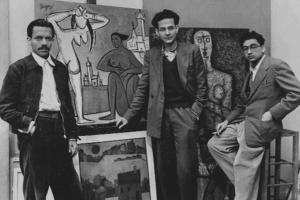
Francis Newton Souza
Francis Newton Souza was born in Goa and received his education in Mumbai and London. He developed a rather raw visual style of painting that was defined by bold black outlines, and distorted figures. He did not shy away from engaging with taboo subjects either — he sought to expose eroticism, human frailty and religious dogma.
Souza’s method of painting merged the sacred with the profane, challenging conventional aesthetics by painting striking portraits and landscapes. His son, Francis Patrick Souza stated in an interview that his father was ‘quite an impassioned man who had heartfelt feelings about numerous world situations, events and people.’ These feelings may or may not have been felt by other artists of his time, but they made themselves clear in Souza’s works.
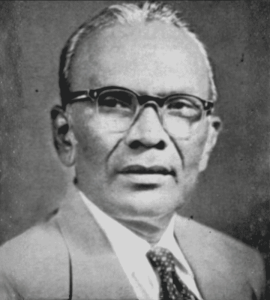
Krishnaji Howlaji Ara
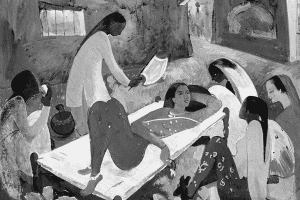
The art critic, Nissim Ezekiel stated that Ara was the first contemporary Indian painter who used female nude bodies as subjects for his compositions. He also worked with human figures and still life subjects. Born in 1914, in a town near Secunderabad, Krishnaji Howlaji Ara lost his mother at a young age. He ran away to Bombay when he was a child and worked odd jobs — as a car cleaner for a Japanese firm, and as domestic help for a European lady. Ara devoted his spare time to painting. Unlike his colleagues in the Progressive Artists’ Group, he was a self-taught artist, and over the years became the recipient of some major recognitions. In 1944, he was awarded the Governor’s Prize, and in 1952, a Bombay Art Society Gold Medal.
Krishnaji Howlaji Ara was the founder and secretary of the Artists’ Aid Centre in Bombay, which was created to provide a support system for artists who needed help — in the form of grants, mentoring, and even a space where they could hold exhibitions. Some of his most famous paintings include Still Life With Fish, Deccan Dancers, and The Breakfast Table.
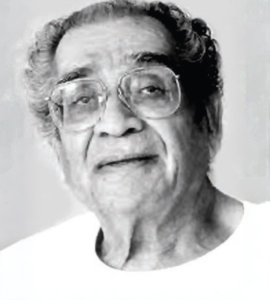
Akbar Padamsee
Akbar Padamsee was born in an affluent family that hailed from the Kutch region of Gujarat. In his formative years, he would copy the images he would see in the Illustrated Weekly, an English-language weekly magazine which had a successful run for over a century – from 1880 to 1993. Padamsee worked with a variety of media—from watercolours, to oil paintings, sculptures, printmaking and photography. He also concentrated on a few subjects: such as the depictions of Jesus Christ, heads, couples, still-life paintings, metascapes and mirror images. He was in particular obsessed with depicting the human face.
Following his graduation from JJ School of Art, Padamsee moved to Paris. There, he was influenced by artists such as Georges Rouault and André Breton. He also had to defend his work against ‘obscenity charges’ against two of his paintings that were displayed in his first solo exhibition held at the Jehangir Art Gallery in Mumbai. Following Padamsee’s return to Mumbai, he sought to gradually eliminate colours from his work, while painting only using different shades of grey.
Sayed Haider Raza
Sayed Haider Raza was born and raised in Madhya Pradesh, and he moved first to Nagpur to study art. Subsequently, he enrolled in the JJ School of Art. Raza was known for his abstract works characterized by concentric circles and geometric patterns, which have at times been compared to the paintings of the American Abstractionist, Frank Stella, whose works Raza admired in the early 1960s. For him, the Tantric practices in Hinduism and Buddhism were a source of inspiration. In many of his landscapes, Raza has often painted scenes that look otherworldly, at times combining the landscapes of France with colours and aesthetics that are typically associated with India.
He has held numerous solo shows in galleries across the world, and has had his works included in international exhibitions, including at the Royal Academy of Arts in London. Today, some of his paintings can be found at the Piramal Museum of Art in Mumbai.




Leave a Reply