

Synagogues and Chabad houses — do we associate institutions like these with the idea of India? At one point of time, the country was home to a sizable population of Jewish people who had settled down in different parts of India. They could be put into three categories: the Baghdadi Jew community, Kochi Jews, and Bene Israelis, but there were others too. One can find Mizo and Kuki tribes in Manipur who are called the Bnei Menashe, and trace their origins to the ‘Ten Lost Tribes’– groups of people exiled from their homes in West Asia.
In recent years, the numbers of the community have dwindled significantly, as the Jewish people have migrated to other parts of the world. While synagogues are places for worship, Chabad houses are centers where Jewish people congregate for the purpose of disseminating Judaism, usually run by a Chabad couple. These sites might now grant access to only a select few people, or remain shut. But one doesn’t necessarily need to pay a visit to them in order to understand how they are important, both historically and socially.
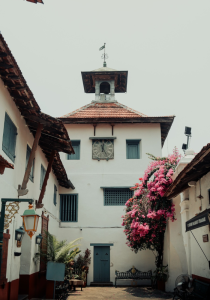
The Paradesi Synagogue, Kochi
According to some sources, the first Jews came to the Malabar Coast during the 1st Century BCE, settling down in an ancient port city called Muziris (in the Kodungallur region of Kerala). This is the oldest synagogue in the Commonwealth, built in 1568 by Samuel Castiel, David Belila, Efrahim Sala and Joseph Levi. It is named ‘Paradesi’ after the Malayalam word for foreigner. In 1662, the synagogue was destroyed by Portuguese forces, but then rebuilt the next year.
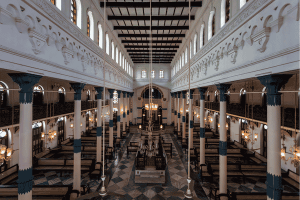
The Magen David Synagogue, Kolkata
Kolkata is home to three synagogues: the Neveh Shalom Synagogue (the oldest in the city), the Magen David Synagogue and the Beth-El Synagogue. The Magen David Synagogue was built in 1884 by Elias David Joseph Ezra, who, like Mumbai’s David Sassoon, was a Baghdadi Jew. Beyond its grand red-brick façade and clock tower, the interior of the synagogue displays pillars carved out of marble, ornate chandeliers and Hebrew inscriptions. The synagogue is an important reminder of the economic and cultural prominence of the Jewish community in colonial Calcutta. Although the Jewish population continues to dwindle, the synagogue thrives through a legacy of interfaith harmony, as generations of Muslim caretakers have faithfully maintained and guarded the space.
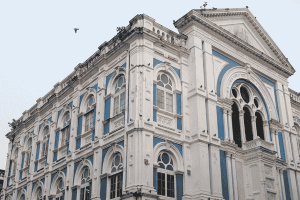
The Knesset Eliyahoo Synagogue, Mumbai
The Knesset Eliyahoo Synagogue is one of South Mumbai’s most well-known architectural treasures. It has also been called the ‘Blue Synagogue’ because of the colours used on the façade. Although its exterior has now been restored to its original white colour with blue detailing, the nickname remains in use. This synagogue continues to be an active house of prayer and a symbol of Mumbai’s rich Baghdadi Jewish legacy. It was established in 1884 by Jacob Elias Sassoon in memory of his father, Eliyahoo David Sassoon, the son of David Sassoon.
While learning about the Knesset Eliyahoo Synagogue, it is also important to note the history of the Sassoon family, and particularly of David Sassoon. Arriving in the 1830s from Baghdad in Ottoman Iraq, he established a vast mercantile empire spanning cotton, silk, and tea, transforming Mumbai into a crucial hub of international trade. The family funded iconic institutions, including the David Sassoon Library, the Sassoon Docks, Victoria Jubilee Technical Institute, and the Knesset Eliyahoo synagogue itself.
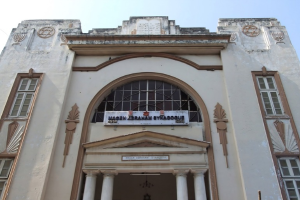
The Magen Abraham Synagogue, Ahmedabad
The Magen Abraham Synagogue happens to be the only synagogue in the city of Ahmedabad — a surviving marker of Gujarat’s Jewish heritage. It emerged from the Bene Israel community’s migration from the Konkan coast and Maharashtra into Gujarat. By the mid-19th century, Ahmedabad’s Jewish congregation had formed around a small prayer hall tied to Dr. Abraham Erulkar, and after his son Dr. Solomon Abraham Erulkar helped expand it with a larger hall in 1906, the foundation stone of the present synagogue was laid in October 1933.
The synagogue was designed by architects Ellis Abraham Bhinjekar and Daniel Samson, also members of the Bene Israel community. Magen Abraham translates to ‘The Shield of Abraham’. It’s built in a style that has been classified as Indo-Judaic Art Deco, with European architectural influences, and is a structure that incorporates Grecian columns, stained-glass windows, marble floors, and a women’s gallery. It’s said to represent both Jewish traditions and the modernism that was characteristic of Ahmedabad during the inter-war period.
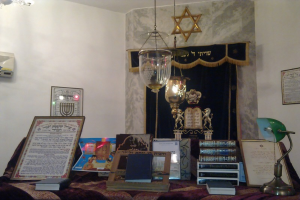
The Judah Hyam Synagogue, New Delhi
It is said that many visitors to the Judah Hyam synagogue in New Delhi come through the embassies — which means that although the Jewish population in India is akin to a ‘drop in the ocean’, each year this place sees a footfall of nearly 20,000 visitors. Dr. Judah Hyam Masilkar, born in 1862, was a community and social worker of the Pune Bene Israel community. The synagogue that was named after him was constructed in 1956. According to the caretaker of this synagogue, this is the only place of worship for Jews across the entirety of North India. For more than a quarter of a century, Rabbi Malekar, the current rabbi, has overseen the sanctuary and fostered interfaith outreach. To keep services active despite shifting demographics, he conducts Friday Shabbat prayers whenever ten Jewish individuals are present, regardless of gender, thereby waiving the traditional requirement for ten adult males.





Leave a Reply