

A Night Out in London with Priyam Sharma, Founder & Editorial Director, The Moment
3 pm: Tonight’s plan
I’m back in London, and a few friends and I decide on one of our old favourites: dinner, a play and drinks afterwards. We’re seeing To Kill a Mockingbird at Wyndham’s Theatre, so we’re making a night of it around Chinatown.
What I’m wearing: If I’m taking the Tube and walking at either end, I’m wearing flats. Heels can go in my bag if I want them later. What I rarely wear around London anymore is precious jewellery. With the rise in mobile phone theft and other petty street crime over the last few years, I’ve become much more careful about what I have visibly on me when I’m moving around the city.
Phone, keys, Tube card and charger go inside. Always the charger. I’m slightly neurotic about having a charged phone, something that dates back to the terrorist attacks in London and Paris between 2015 and 2017. Those years left me with a lasting unease about being caught somewhere without a working phone. Even now, however unlikely the circumstances, I never want to find myself unable to call someone.
6 pm: Heading into town
I check the Transport for London app for delays and take the Tube into central London. It’s generally the quickest way to get into the West End, and I’ve been going to theatres and cinemas on my own for years, particularly matinees.
We meet in Chinatown for Cantonese before the play. At this point, getting home later isn’t really on my mind. It’s early, Chinatown is packed, I’m with friends, and we need to be at Wyndham’s in time for the performance.
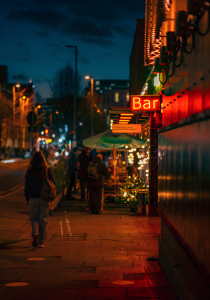
7 pm: Wyndham’s Theatre
Once I’m inside, my attention shifts entirely to the play. There is one thing I do automatically in crowded places, though. I register where the exits are and take in what’s happening around me. I don’t consciously think about why I’m doing it. It’s a habit I picked up years ago and never quite lost.
10 pm: Opium Bar
After the play, we head to Opium, one of my favourite places in Chinatown, a hidden cocktail bar above Gerrard Street fashioned after a 1920s Shanghai speakeasy.
This is roughly when my thinking begins to shift. How late are we staying? How long will the Tube take? Will I need to change lines? How much walking is there at the other end? London in summer feels easier because it stays light so late. Winter, when it can be dark by four in the afternoon, feels very different.
00:00 midnight: Heading back
By the time I leave, I’m still happy to take the Tube, but I’m more aware of what is happening around me. I choose a carriage with plenty of people in it and tend to notice whether there are other women around and whether the people near me seem sober. I don’t consciously make a checklist of these things. They’re decisions I make almost instinctively.
My phone habits have changed too. When I come out of the station, I check anything I need to check and put my phone away. If I need to use it on the street, I’ll stop somewhere rather than walk with it in my hand, often with my back against a wall. It’s one of those small behaviours I’ve picked up in response to phone theft in London without really thinking about how much I’ve changed the way I move around the city.
If it’s particularly late, I’m tired or the journey home involves too many changes or a long walk, I’ll check the price of an Uber. Being able to spend £20 or £25 on a car because I would rather not take public transport at that hour obviously gives me a choice that another woman having exactly the same night may not have.
I’ve also become much more conscious of what those fares cost since spending more time in Mumbai, where getting a car home is considerably less expensive.
12:15 am: The last seven minutes
I come out of the station with about a seven-minute walk to where I’m staying. At night, it probably takes me six.
I take the main road rather than the darker side streets and I walk more quickly than I would during the day. I never wear headphones at that hour, my phone stays in my bag, and I’m very aware of who is around me and who might be walking behind me. I don’t linger or allow myself to become distracted. If I’m walking with someone else, I notice how much of that vigilance disappears.
12:25 am: Reached Home
Once I’m through the door, I can finally relax.
The interesting thing is that I still feel fundamentally free in London. I go out alone, wear what I want and take public transport without giving much thought to whether I can get myself somewhere.
What changes is the journey back. Once the play is over and the evening starts moving towards home, a different set of calculations quietly begin. How late is it? Which Tube am I taking? Who is in the carriage? Where is my phone? How far do I have to walk? Should I get a car instead?
None of these decisions feels particularly significant on its own. I’ve made them for so long that they simply feel like part of going out at night.
A Night Out in Mumbai with Meher Mirza, Senior Editor, The Moment
3 pm (three weeks ago):
Let’s be real. I live in Mumbai. There are no last-minute plans here. If it isn’t inked into my diary at least three weeks ago, it isn’t happening. Getting four friends together in one room at the same time is a task nigh impossible. Nonetheless, we persist.
The Plan: Dinner at BandraBorn at 8:30 pm, then drinks at Idoru after. I love BandraBorn for its vivacity and its Goan/East Indian inspired menu – who could resist Grandmother Fanny’s Prawn Dish with its East Indian bottle masala and dried mango accoutrements? I love Idoru for the complete opposite reason – for its delicate Japanese-inspired cocktails.
6 pm: Home
As the most absurdly punctual person I know, I have already showered, and I am ready to leave. My outfit for the night is a long denim skirt and a sleeveless red top, with a stole to mantle around myself for when I return home. I ponder changing from my sloppy everyday canvas bag into something slightly less shabby, then decide against it. Nobody really dresses up in Mumbai, unless they’re from Delhi. Yes, I said what I said.
Besides, the advantage is that everything I need – phone, wallet, house keys, pepper spray – is all inside. I will never leave my house without my phone, and I will check, over and over again, that it is charged to at least 80%. Also, I will not wear heels or expensive jewellery if I am not getting picked up and dropped to my doorstep by a family member or a friend. On the other hand, I never wear heels or jewellery anyway, so perhaps this is a moot point.
7:30 pm: On My Way
I set off, assuming Mumbai traffic would stretch my journey to an hour. At this time, my mind is bent on calculations around the traffic situation in Bandra, rather than my safety. The city is heaving with cars and people and I think quickly of alternate routes and check Google maps obsessively. I instinctively tighten my shawl around me, as I flag down a black-and-yellow taxi, and bend down to offer directions to the driver. In absolutely any car or taxi, I am conscious of where I sit; ideally, diagonally behind the driver, so I am not in direct view of his mirror. I check that the door lock is working from the inside. This, again, is an instinctive checklist that I follow no matter where in the world I am. The shawl continues cloaking my shoulders till I arrive.
The taxi isn’t air-conditioned, so I envisage arriving in a puddle of sweat.
8:30 pm: BandraBorn
I have arrived in a puddle of sweat.
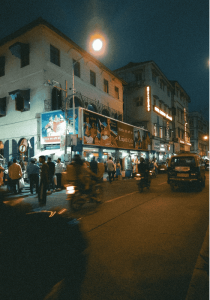
10:30 pm: Idoru
The three of us (one cancels at the last minute) scramble into an auto rickshaw and go to Idoru. I am only one drink down at this time, and with my friends, so my defences (shawl) drop. The one thing I never do is to let go of my sloppy sling bag. The strap will always stay on my shoulder, and the bag will always stay on my lap, no matter where in the world I travel to. This has become so ingrained, it is subconscious. The one time I slid it behind my back was on an Italian bus, and that trip did not end well.
12:30 pm: The Way Home
Giggling stops, and we whip out our phones to consult the time. We have missed the last local train for the night, so we all call Ubers. As soon as I get into the cab, the easy camaraderie of the evening slips away. I am hyper alert now, making sure we stick to the roads I know. I have already shared my cab details with my friends and vice versa. The shawl is wrapped tighter than ever around me, and since I have exhausted my Uber balance, I keep the final amount ready in cash. I check multiple times that my bag is tightly zipped shut, and nothing has fallen out.
The entire way home, friends keep messaging to ask where I am. Depending on how late it is, I make pretend phone calls to various male members in my circle, telling them loudly and clearly where I am at all times, and describing various details of my taxi. There is no question of my wearing earphones or listening to music. These things are so instinctive, I don’t even think about them. This is Mumbai, and I have never felt anything less than safe in my city, but I have had far too many unfortunate incidents around the world to take a chance.
1 am: The Last Five Minutes
The taxi overshoots my house, and I have to walk back to my building. At this time, I am hyper alert about my surroundings, and walk briskly, almost at a run, to my gate. I get a friendly, reassuring nod from my guard, and the gates clang behind me. My shoulders fall, relaxed finally. The only indication I have as to how tightly I was holding myself the whole way home



Leave a Reply