

Whenever India’s NorthEast is mentioned in conversation, shallow associations of political turmoil, untrammelled nature, and tribal communities often spring to mind. But in the past decade, a generation of filmmakers from the region has begun changing that image, earning international acclaim while expanding India’s conception of itself.
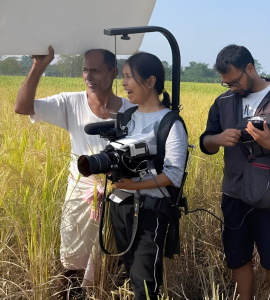
Few have been more visible internationally than Rima Das. A self-taught filmmaker from Assam, she worked with a small crew and non-professional actors, writing, directing, editing and producing Village Rockstars (2017). Reminiscent of Sean Baker’s award-winning The Florida Project, the film shows joy, simplicity and humor through the lens of children in village life.
Das had three consecutive films – Village Rockstars (2017), Bulbul Can Sing (2018) and Tora’s Husband (2022) – showing as world premieres at the Toronto International Film Festival (TIFF), accumulating over 150 festival selections and 70 awards in nearly 40 countries. Perhaps it’s the romanticism of the natural world against the concrete jungles many of us inhabit, but Das consistently painted a world where tradition and modernity could co-exist – electric guitars, teenage love along with local languages and customs – creating a unique form of identity.
Goan-American writer Vivek Menezes saw this firsthand when visiting Manipur in 2019, noting that the Manipuri people used creativity and cosmopolitanism through fashion, music, food and entrepreneurship to express their cultural roots. Be it meeting a Bob Dylan-influenced band leader who combines Manipuri and American folk music, or a tea entrepreneur who was once an investment banker in London and Singapore.
A year later, Menezes visited Nagaland, and saw a similar story – “The fact is that much of what you’ll see in Nagaland resists tired clichés around India’s Northeast,” he writes. “Instead, you’ll find wildly stylish urbanites flaunting effortless street chic to rival Milan or Paris — the difference is that these global souls have powerful roots in their clan, tribe and hilltop villages.”
These observations show that modernization doesn’t equal discarding traditions in the name of anachronism and mimicking Westernization, but using Western tools of storytelling, branding, and differentiation to allow for rediscovery, and even reinvention.
That growing cultural confidence goes beyond film. The region’s tourism has doubled (7.9 million to 15 million) from 2015 to 2020, amplified by Nagaland’s Hornbill Festival and Arunachal Pradesh’s Ziro Festival of Music, which have used a mix of indie music, unique architecture, camping, local culture and environmentalism to appeal to urban Indians.
Arunachal Pradesh’s tourism ambassador, the Bollywood star John Abraham, has long been drawn to the region, and created NorthEast United to represent all eight states in the football league, the Indian Super League. He called the growth of the sport there “cultural and organic,” acknowledging that it has been overlooked.
“Every time I meet someone new, I’ve had to explain where I come from, because internationally – and even nationally –
Nagaland is so underrepresented,” said filmmaker Theja Rio. “There are always raised eyebrows when I tell people that I come from India.”
Kohima-born, educated in the UK, and influenced by Hollywood and kung fu films, thirty-year-old Rio saw that “our daily lives, our perspectives – those were not meant for cinema.” He adds that “Nagaland now is drastically different from the world I grew up in, and I’m only thirty… a new generation is now attempting a cultural U-turn.”
Rio’s film, Angh, will be premiering at TIFF, and features “a chief must choose between his family and a transforming world embodied by an incoming American missionary.” Rio follows a limited – but increasingly growing – trend of films from the NorthEast at major film festivals. Manipuri and Assamese cinema was occasionally featured in the 1980s and 1990s, but TIFF has provided a major platform beginning in 1983 with Aribam Syam Sharma’s Imagi Ningthem and in 1991 with Ishanou.
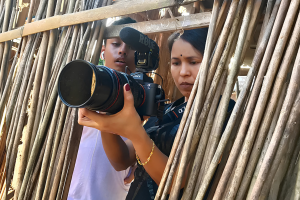
Similarly, Lakshmipriya Devi, a veteran of Bollywood’s Excel Entertainment but a first-time director, created Boong. Her 2024 ‘labour of love,’ premiered at TIFF, and offers a child’s perspective to show India–Myanmar border tension around ethnicity, migration and belonging. She travelled across Manipur for the film in an attempt to strike a balance between budget and scenery.
The sense of being an ‘outsider’ has become one of NorthEast cinema’s recurring subjects. In Crossing Bridges (2013), an Arunachali man who has spent years working away from his village, returns home after losing his job and rediscovers the culture he had left behind. Boong reverses that perspective: a Manipuri child goes searching for a father who has left to work at the Myanmar border. In the Sikkim-situated Shape of Momo (2025), the star leaves her job in Delhi to spend time in her ancestral village, only to discover that the community that offers belonging also carries expectations about marriage and gender norms.
Rapture (2023), about a remote Meghalaya village consumed by fear of outsiders, uses belief systems to explore who belongs and how communities react when they feel threatened. Initially unable to get distribution, the production team rented an 800-person venue and filled it for weeks, leading to far larger releases in dozens of cinemas in France! Similarly, Axone and Aamis, had houseful screenings at 2019 MAMI Film Festival in Mumbai, with the former even reaching #1 on Netflix in India. The success of these films shows how talking about migration and identity aren’t just meant for sociological studies, but can have deep resonance in cinematic storytelling.
Many of these grassroots filmmakers are committed to a syncretic mix of tradition and modernity, offering a more nuanced and contemporary view of the region. While festival prizes and sold-out screenings strengthen credibility, the NorthEast looks cool not because it is setting new trends, but also because it is allowing others to rediscover it.





Leave a Reply