

What cuisine comes to mind when you think of khow suey? A rich coconut noodle soup from Myanmar, warm and comforting, topped with crunchy fried garlic, chilli oil, and lime. It’s creamy, spicy, slurpable — the kind of dish that feels unmistakably moreish. Maybe it’s the combination of coconut milk and turmeric, or the layers of texture — soft noodles, crisp toppings, a soupy base — that root it so firmly in memory.
Thailand has khao soi — a spicier, tangier, crowned version with crispy noodles. Malaysia offers laksa, a riot of flavour swimming in coconut milk and lemongrass. Indonesia’s soto ayam, Sri Lanka’s kiri hodi, and even Peru’s chupe de camarones all orbit the same sun: broth, spice, starch, and texture. These are not copies. These are cousins — born of similar climates, similar geographies perhaps, and wildly different cultures.

But the real twist? You don’t need to cross continents to taste this evolution. Sometimes, just crossing a few neighbourhoods or family kitchens is enough.
Khow suey’s path to India wasn’t a smooth one. Burma (now Myanmar), once a British colony, had swathes of Indian traders, especially those from the Gujarati Memon and the South Indian Chettiar communities. But the Japanese invasion of the country in 1942, followed by the occupation of the military junta in the 1960s forced an exodus of South Asians back to India and Pakistan. They brought with them their culinary memories, especially their version of the traditional Burmese dish, the Ohn-No Kyaukse, noodles in a coconut milk-based broth (often thickened with chickpea flour), studded with chicken or meat.
Gujarat has its own version, khausa, a similar soupy noodle dish thick with yogurt and gram flour, swished with spicy chutney, heaped with crunchies on top, and a boiled egg sloshing within. Most famously, the dish was served at Anant Ambani and Radhika Merchant’s pre-wedding festivities in 2024. But most Gujaratis eat it off the street stalls in Surat, which is where it’s made its home.
Down south, in Tamil Nadu, it was the wealthy Chettiar merchants and civil servants who had rooted themselves in British-colonized Burma. Turfed out during the takeover by the Myanmar junta, they returned to Chennai, bringing their version of the dish with them. North Chennai has a scatter of vendors serving Myanmar-inspired cuisine like Atho (cabbage-tossed fat noodles in gravy, crowned with condiments), possibly a corruption of the original Kauk Swe Thoke.
Khow suey has found its way into every menu at restaurants serving South East Asian food. It has become a staple, understandably, since its flavors sit so comfortably close to coconut-sluiced gravies of India.
For example, sol kadhi of the Konkan coast — a cool, pink coconut-based digestive, usually eaten with rice with a fiery seafood thali. In Bengal, shorshe ilish marries mustard with chilli and oil in a sauce that’s more punch than comfort. In Tamil Nadu, coconut takes over the entire spice mix — kozhi kuzhambu brings a quiet heat mellowed by fresh ground masala and curry leaves. And even this barely scratches the surface. These are just fragments from a much larger, richer mosaic — one that shifts across regions, communities, and generations.
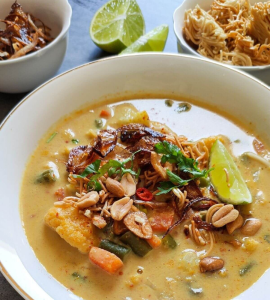
So, how did we all end up with variations of the same comfort food?
For too long, food discourse has been obsessed with ‘authenticity’. Who invented what? Whose grandmother’s recipe is the original? But khow suey, and the many dishes like it, show us that origin stories are often a little fuzzy — and that’s okay. Food isn’t static. It adapts, travels, merges. Sometimes it forgets where it came from.
And within India itself, this multiplicity is everywhere. There’s no single Indian curry, for instance. There are at least fifty. Some are made with coconut, others with yogurt, some are soured with kokum, some sweetened with jaggery, some are silken smooth, others are rugged and mustardy. Some are vegan by default, some overflow with meat.
So maybe the point isn’t to find the first khow suey. Maybe the more interesting story is how so many people, across oceans and states and languages, came up with some version of the same thing. A bowl. A broth. Some carbs. And a little crunch. Khow suey didn’t spread because people copied the recipes. It spread because hungry taste buds everywhere recognized it as a shape hunger takes everywhere, filled in differently by whoever’s cooking.





Leave a Reply