

Consider Shivaji Park. Every evening, elderly men walked its perimeter. Teenagers practised cricket with taped tennis balls. Women sat on the grass and talked. No tickets. No programming. No expectation that anyone needed to be doing something productive.
Similar scenes existed elsewhere. In New York, urban activist Jane Jacobs wrote about Washington Square Park in the 1950s and 60s as a place people passed through, paused in, argued in, lingered in. In Seoul, neighbourhood parks and local jjimjilbangs functioned as everyday social infrastructure well before the city’s current emphasis on speed, efficiency, and twenty four-hour productivity. These spaces were not neutral or perfect, but they shared a defining feature: anyone could be there without explanation.
That has become increasingly rare.
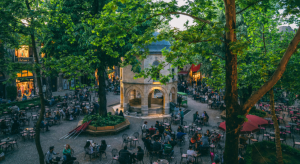
In 1989, American sociologist Ray Oldenburg gave these environments a name in The Great Good Place. He called them ‘third places’: informal, low-cost spaces outside home and work where people could gather without obligation. Oldenburg’s argument was not sentimental. What made third places work was not charm or design, but accessibility. They encouraged idleness. They allowed regulars without requiring paid memberships. They made room for people whose only reason for showing up was time.
What has changed since then is not simply taste. It is structure.
Most third places did not disappear overnight. They were slowly made inhospitable. In Mumbai, Irani cafés like Café Military and Café Ideal once functioned as all-day linger spaces, especially for people who had nowhere else to go between shifts or errands. Rising rents, shrinking margins, and redevelopment pressures have since pushed cafés toward faster turnover. Sitting too long now carries an implicit cost.
In New York, public seating has been systematically reduced or redesigned. Benches are removed, divided, or made deliberately uncomfortable. Parks that once absorbed unstructured social life are increasingly surveilled, policed, or programmed. The goal is not gathering, but control. Space that does not circulate people efficiently or generate revenue is treated as a problem to be managed.
This is not accidental. Cities over the last three decades have been redesigned around transit, productivity, and risk mitigation. Loitering becomes a security concern. Lingering becomes inefficiency. Free time, once an ordinary and necessary part of life, starts to read as indulgence.
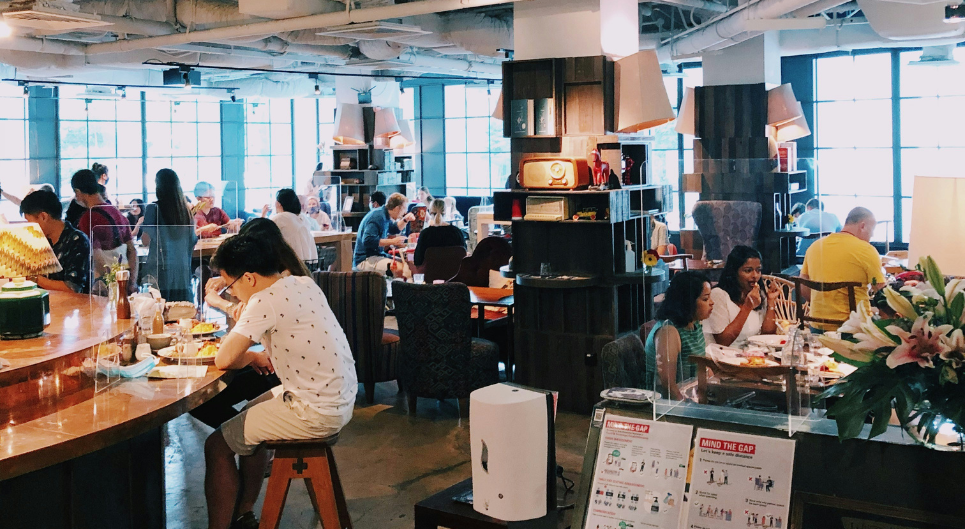
The language follows the logic. ‘Third place’ now appears in real estate decks and brand strategy documents, used to describe co-working cafés, members’ clubs, or lifestyle lounges. These spaces promise community, but only through access. You can belong, but briefly. You can stay, but not for free. Presence is permitted only when it can be justified, monetized, or optimized.
Functionally, this changes how social life feels.
When cafés double as offices, sitting without a laptop becomes suspect. When libraries close or shrink, quiet public refuge disappears. When promenades are designed as backdrops for events and content, stillness feels out of place. The value of doing nothing together erodes, replaced by the expectation that time in public must produce something: work, networking, fitness.
The pandemic accelerated this shift, but it did not invent it. Lockdowns disrupted social reflexes, and the return to public life came with new rules. Interaction felt safer when it was structured: a class, a workshop, a ticketed gathering.
What gets lost in this transition is difficult to measure, which is why it is easy to dismiss. It is not just space, but familiarity. The quiet recognition of seeing the same strangers every week. The trust that forms without conversation. These are social capacities that emerge slowly, and only in places where people are allowed to exist without performing usefulness.
People sense this loss, even if they do not name it. That is why new, improvised versions keep appearing. Community fridges on street corners. Zine fairs in half-empty malls. Chai circles in parking lots. Skate crews occupying forgotten patches of city. These are not nostalgic recreations. They are workarounds, evidence that the desire for unstructured public life persists even as the conditions that once supported it are withdrawn.
So the question is not whether third places mattered. They did. The harder question is why we have become so comfortable designing cities that no longer tolerate them.
Not everything needs to be activated. Not every gathering needs a theme. Sometimes what is missing is not innovation, but permission: a place where you can sit, take up space, and not be asked what you are doing there.





Leave a Reply